QUESTION IMAGE
Question
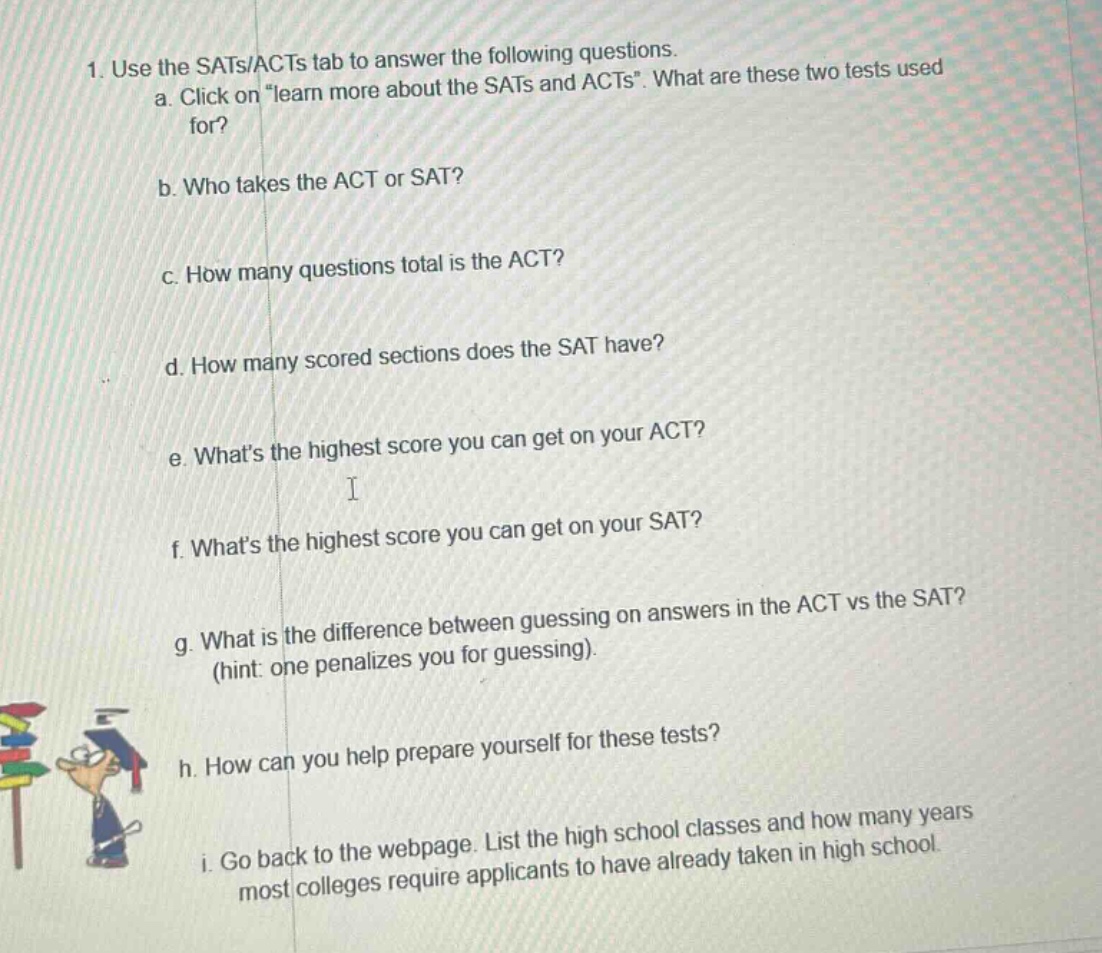
- use the sats/acts tab to answer the following questions.
a. click on \learn more about the sats and acts\. what are these two tests used for?
b. who takes the act or sat?
c. how many questions total is the act?
d. how many scored sections does the sat have?
e. whats the highest score you can get on your act?
f. whats the highest score you can get on your sat?
g. what is the difference between guessing on answers in the act vs the sat? (hint: one penalizes you for guessing).
h. how can you help prepare yourself for these tests?
i. go back to the webpage. list the high school classes and how many years most colleges require applicants to have already taken in high school.
These questions are about SAT and ACT exams, which are related to education (a subfield of Social Science). Since these are questions that require recalling or researching information about the exams (no calculations), we'll use the Answer - Explanation Format.
a. The SAT and ACT are standardized tests used for college admissions in the United States. They help colleges assess the academic preparedness of high school students applying for undergraduate programs.
b. Typically, high school students (usually in their junior or senior year) who are planning to apply to colleges or universities take the ACT or SAT. Some students may also take them earlier for practice or to meet specific program requirements.
c. The ACT has a total of 215 questions (75 in English, 60 in Math, 40 in Reading, 40 in Science, and an optional 40 - question Writing section, but the Writing section is not always considered for the total question count in the same way; the main four sections sum to 215).
d. The SAT has two scored sections: Evidence - Based Reading and Writing, and Math. (Note: There was also an optional Essay section, but it has been discontinued for most test - takers as of 2021.)
e. The highest score you can get on the ACT is 36. This is calculated by averaging the scores of the four main sections (English, Math, Reading, Science), each of which is scored on a scale of 1 - 36.
f. The highest score you can get on the SAT is 1600. This is the sum of the scores from the two main sections: Evidence - Based Reading and Writing (scored from 200 - 800) and Math (scored from 200 - 800).
g. The SAT used to penalize for guessing (0.25 points deducted for each incorrect answer on the multiple - choice questions), but this penalty has been removed. The ACT does not penalize for guessing, so it is beneficial to answer every question on the ACT, even if you have to guess.
h. To prepare for these tests, students can: take practice tests to familiarize themselves with the format and types of questions; study relevant content (e.g., review math concepts, practice reading comprehension strategies); enroll in test - prep courses or work with a tutor; use official study materials from the test - makers (College Board for SAT, ACT, Inc. for ACT); and develop good time - management skills for the timed sections.
i. Most colleges require applicants to have taken: English (4 years), Math (3 - 4 years, including Algebra I, Geometry, Algebra II), Science (2 - 3 years, including Biology, Chemistry, Physics), Social Studies/History (2 - 3 years, including U.S. History, World History), and a Foreign Language (2 - 3 years of the same language). The specific number of years can vary by college, but these are common requirements.

Snap & solve any problem in the app
Get step-by-step solutions on Sovi AI
Photo-based solutions with guided steps
Explore more problems and detailed explanations
s:
a. Used for college admissions to assess high school students' academic readiness.
b. High school students (junior/senior) applying to college.
c. 215 (main four sections) or 255 (with optional Writing).
d. 2 (Evidence - Based Reading and Writing, Math).
e. 36.
f. 1600.
g. SAT (previously) penalized for guessing, ACT does not. Now SAT also doesn't penalize.
h. Take practice tests, study content, enroll in prep courses, use official materials, manage time.
i. English (4y), Math (3 - 4y), Science (2 - 3y), Social Studies (2 - 3y), Foreign Language (2 - 3y) (varies by college).