QUESTION IMAGE
Question
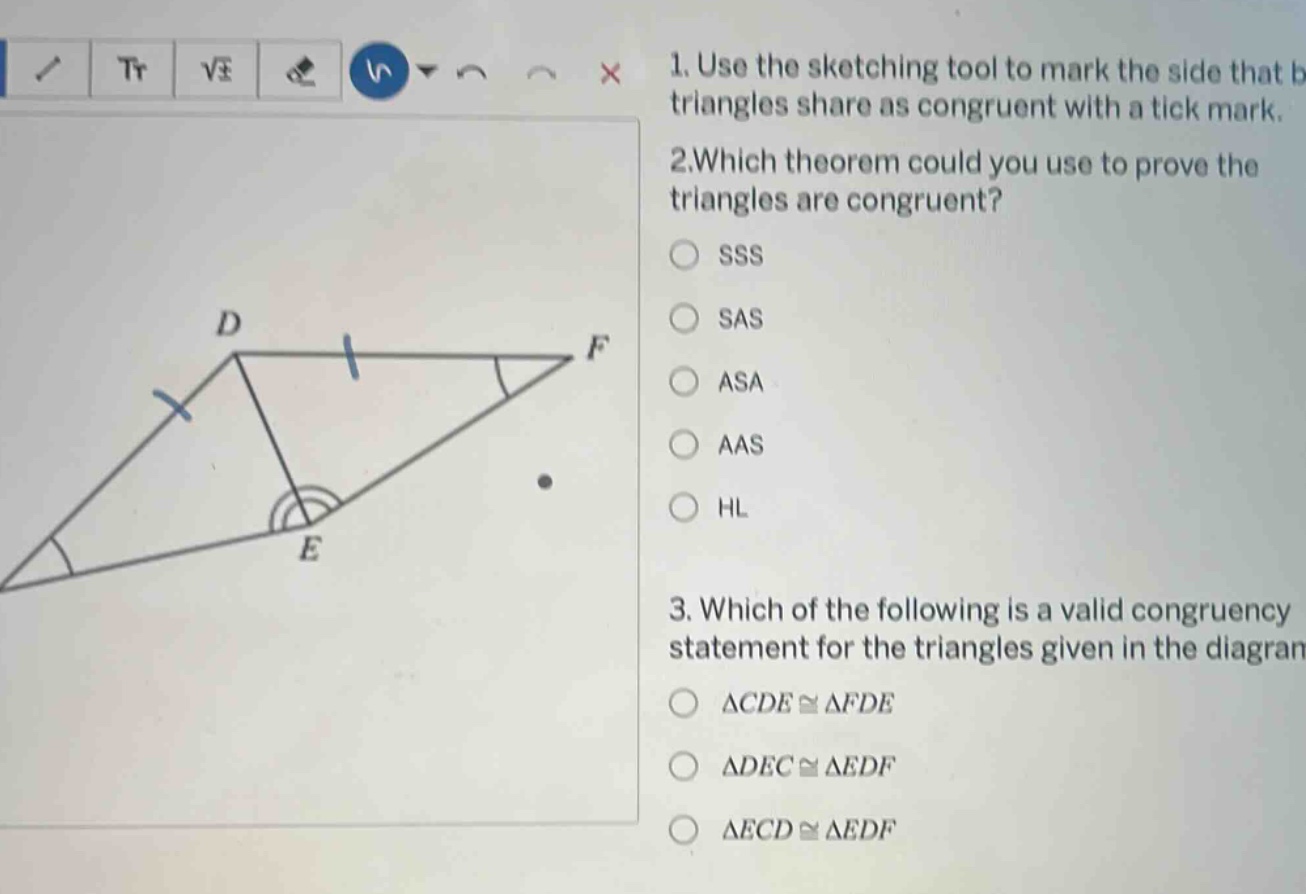
- use the sketching tool to mark the side that b triangles share as congruent with a tick mark. 2.which theorem could you use to prove the triangles are congruent?
○ sss
○ sas
○ asa
○ aas
○ hl
- which of the following is a valid congruency statement for the triangles given in the diagra
○ $\triangle cde \cong \triangle fde$
○ $\triangle dec \cong \triangle edf$
○ $\triangle ecd \cong \triangle edf$
Question 2
To determine the congruence theorem, we analyze the given triangle diagram. We have a shared side \( DE \) (common side), a marked congruent side (e.g., \( CD \cong DF \) from tick marks), and a congruent angle (the right - like angle at \( E \) and the marked angles at \( C \) and \( F \)? Wait, no, looking at the diagram, we have two sides and the included angle? Wait, no, let's re - examine. The triangles share side \( DE \), we have one side marked congruent (e.g., \( CE \) and \( EF \)? No, the tick marks: one on \( CD \) and \( DF \), and the angle at \( E \) is a right angle? Wait, actually, the key is: we have two sides and the included angle? Wait, no, the SAS (Side - Angle - Side) theorem states that if two sides and the included angle of one triangle are congruent to two sides and the included angle of another triangle, then the triangles are congruent. Looking at the diagram, we have a common side \( DE \), one pair of congruent sides (marked with ticks), and the included angle (the angle between the two sides) which is congruent (the angle at \( E \) is shared or congruent). Wait, actually, the correct theorem here is SAS? Wait, no, let's think again. Wait, the triangles are \( \triangle DEC \) and \( \triangle DEF \)? Wait, the angle at \( E \) is a right angle? No, the diagram shows that \( \angle DEC \) and \( \angle DEF \) are congruent (the marked angle at \( E \)), we have \( DE = DE \) (common side), and \( CE = EF \)? No, the tick marks: one on \( CD \) and \( DF \), and another on \( CE \) and \( EF \)? Wait, maybe I misread. Alternatively, the SAS theorem: if two sides and the included angle are congruent. Let's check the options. The SAS (Side - Angle - Side) theorem is applicable here because we have two sides (one pair marked congruent, and the common side) and the included angle (the angle between them) congruent.
To find the valid congruency statement, we need to match the corresponding vertices. Let's analyze the triangles. Looking at the diagram, the triangles are \( \triangle ECD \) and \( \triangle EDF \). Let's check the correspondence: \( E \) corresponds to \( E \), \( C \) corresponds to \( D \)? No, wait, let's check the sides and angles. The congruency statement \( \triangle ECD\cong\triangle EDF \) matches the corresponding parts. Let's verify: \( EC \) should correspond to \( ED \)? No, wait, maybe \( \triangle ECD \) and \( \triangle EDF \): \( E \) is common, \( C \) corresponds to \( F \), \( D \) corresponds to \( D \)? No, let's look at the options. The option \( \triangle ECD\cong\triangle EDF \) is valid because the corresponding sides and angles (from the congruence conditions we found earlier) match. The other options: \( \triangle CDE\cong\triangle FDE \) - the vertices don't correspond correctly. \( \triangle DEC\cong\triangle EDF \) - the vertex order is wrong. But \( \triangle ECD\cong\triangle EDF \) has the correct correspondence of vertices based on the congruent sides and angles (the common side \( DE \), the congruent sides, and the congruent angle).

Snap & solve any problem in the app
Get step-by-step solutions on Sovi AI
Photo-based solutions with guided steps
Explore more problems and detailed explanations
B. SAS