QUESTION IMAGE
Question
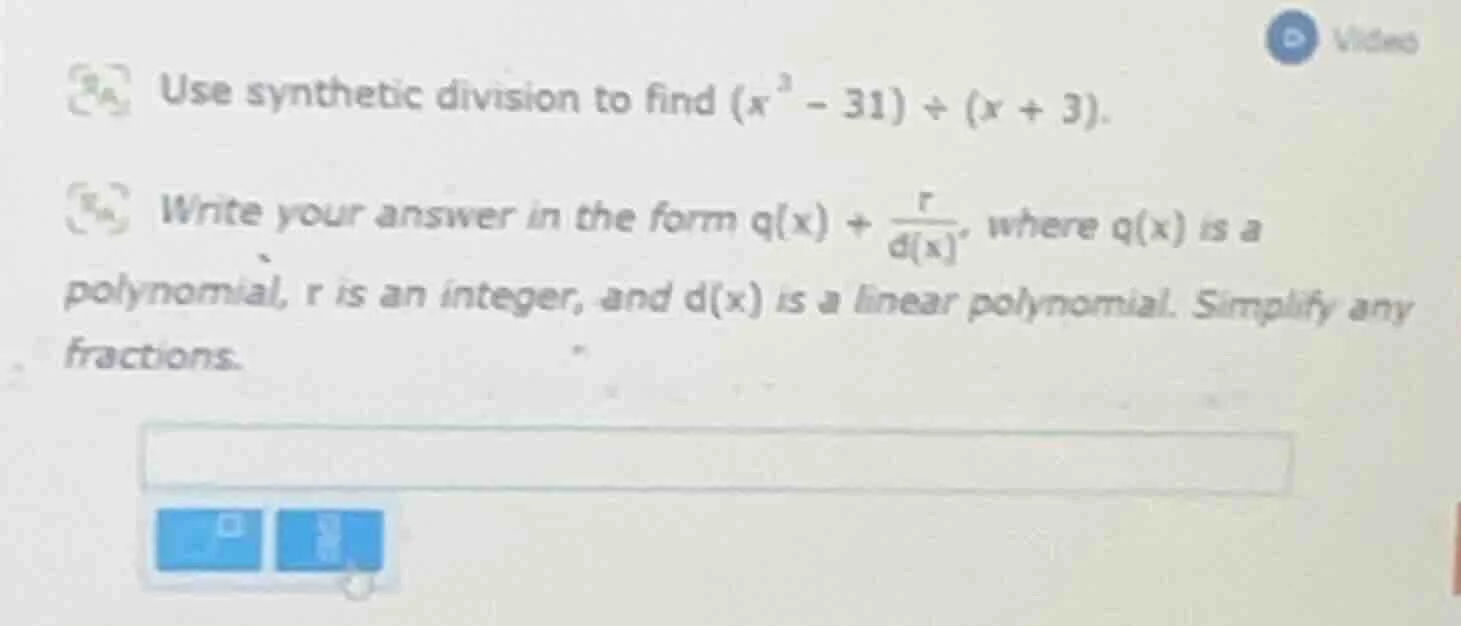
use synthetic division to find ((x^{3}-31)div(x + 3)). write your answer in the form (q(x)+\frac{r}{d(x)}), where (q(x)) is a polynomial, (r) is an integer, and (d(x)) is a linear polynomial. simplify any fractions.
Step1: Identify the root of the divisor
The divisor is \(x + 3\), so we set \(x+3 = 0\) and solve for \(x\). We get \(x=-3\).
Step2: Set up synthetic division
The dividend is \(x^{3}-31\), which can be written as \(x^{3}+0x^{2}+0x - 31\). So the coefficients are \(1\) (for \(x^{3}\)), \(0\) (for \(x^{2}\)), \(0\) (for \(x\)), and \(-31\) (the constant term). We set up synthetic division with \(-3\) as the root:
\[
\]
Step3: Interpret the results
The numbers at the bottom row are the coefficients of the quotient polynomial and the remainder. The quotient polynomial \(q(x)\) has degree one less than the dividend, so it is \(x^{2}-3x + 9\), and the remainder \(r\) is \(-4\). The divisor \(d(x)\) is \(x + 3\).

Snap & solve any problem in the app
Get step-by-step solutions on Sovi AI
Photo-based solutions with guided steps
Explore more problems and detailed explanations
\(x^{2}-3x + 9+\frac{-4}{x + 3}\) (or \(x^{2}-3x + 9-\frac{4}{x + 3}\))