QUESTION IMAGE
Question
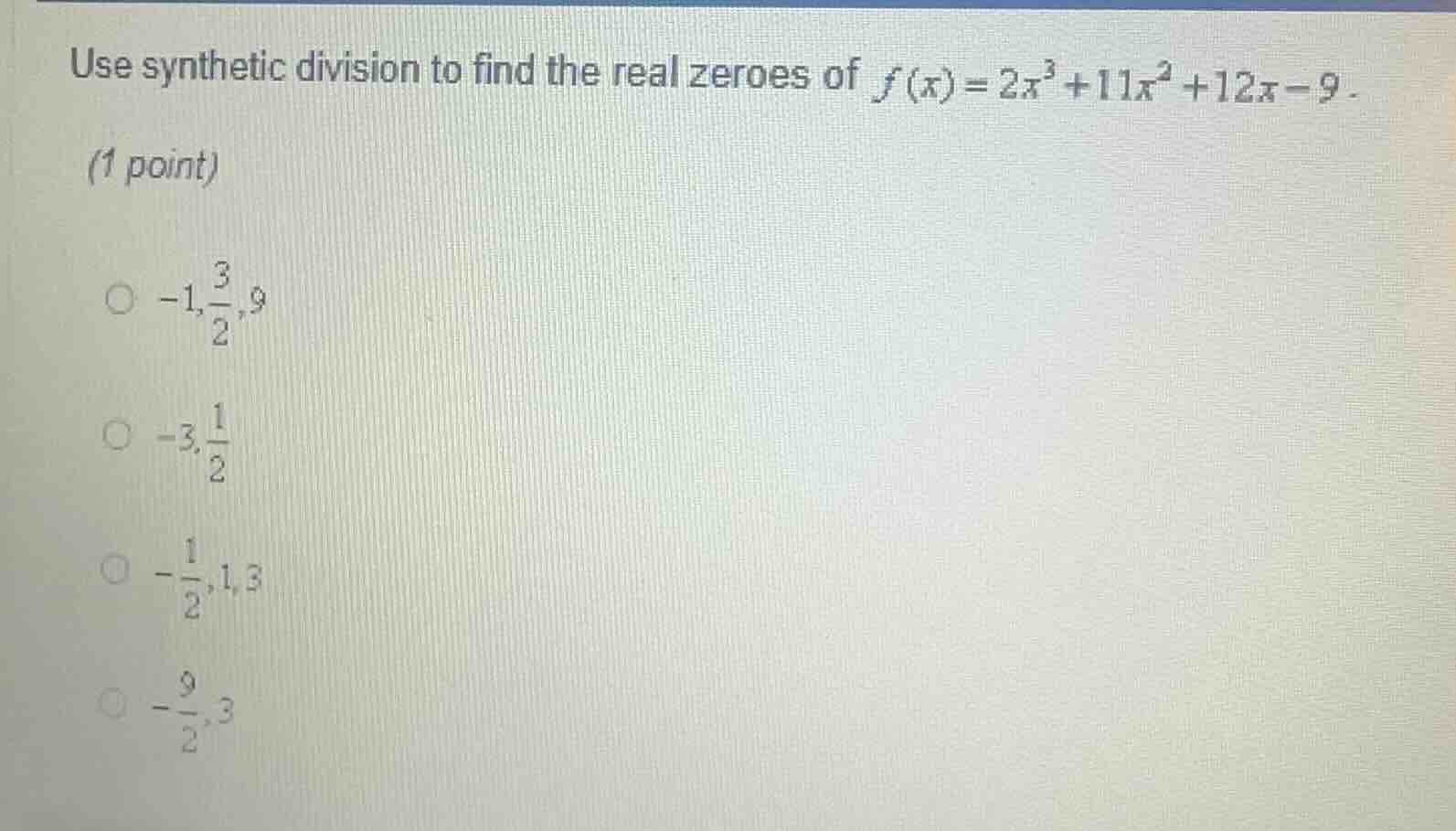
use synthetic division to find the real zeroes of $f(x)=2x^3 + 11x^2 + 12x - 9$.(1 point)\\(\bigcirc -1,\frac{3}{2},9\\)\\(\bigcirc -3,\frac{1}{2}\\)\\(\bigcirc -\frac{1}{2},1,3\\)\\(\bigcirc -\frac{9}{2},3\\)
Step 1: Find possible rational roots
Using the Rational Root Theorem, the possible rational roots are factors of the constant term over factors of the leading coefficient. For \( f(x) = 2x^3 + 11x^2 + 12x - 9 \), the constant term is \(-9\) and the leading coefficient is \(2\). So possible roots are \(\pm1, \pm3, \pm9, \pm\frac{1}{2}, \pm\frac{3}{2}, \pm\frac{9}{2}\).
Step 2: Test possible roots with synthetic division
Let's test \( x = \frac{1}{2} \):
The coefficients are \(2, 11, 12, -9\).
Bring down the \(2\). Multiply \(2\times\frac{1}{2}=1\), add to \(11\): \(11 + 1 = 12\). Multiply \(12\times\frac{1}{2}=6\), add to \(12\): \(12 + 6 = 18\). Multiply \(18\times\frac{1}{2}=9\), add to \(-9\): \(-9 + 9 = 0\). So \( x = \frac{1}{2} \) is a root? Wait, no, wait, maybe I made a mistake. Wait, let's test \( x = -3 \):
Coefficients: \(2, 11, 12, -9\)
Bring down \(2\). Multiply \(2\times(-3)= -6\), add to \(11\): \(11 - 6 = 5\). Multiply \(5\times(-3)= -15\), add to \(12\): \(12 - 15 = -3\). Multiply \(-3\times(-3)= 9\), add to \(-9\): \(-9 + 9 = 0\). So \( x = -3 \) is a root. Now, the quotient polynomial is \(2x^2 + 5x - 3\).
Step 3: Factor the quadratic
Factor \(2x^2 + 5x - 3\). We need two numbers that multiply to \(2\times(-3)= -6\) and add to \(5\). Those numbers are \(6\) and \(-1\). So rewrite as \(2x^2 + 6x - x - 3 = 2x(x + 3) - 1(x + 3) = (2x - 1)(x + 3)\). Wait, but we already have \(x = -3\) as a root. Wait, no, the quadratic is \(2x^2 + 5x - 3\), setting it to zero: \(2x^2 + 5x - 3 = 0\). Using quadratic formula \(x = \frac{-5 \pm \sqrt{25 + 24}}{4} = \frac{-5 \pm 7}{4}\). So \(x = \frac{-5 + 7}{4} = \frac{2}{4} = \frac{1}{2}\) or \(x = \frac{-5 - 7}{4} = \frac{-12}{4} = -3\). Wait, but that would mean the roots are \(-3, \frac{1}{2}\) (and \(-3\) is a repeated root? No, wait, the original polynomial is cubic, so three roots. Wait, maybe I made a mistake in synthetic division. Wait, let's try \(x = \frac{1}{2}\) again. Wait, no, when we tested \(x = -3\), we got a zero remainder, so the polynomial factors as \((x + 3)(2x^2 + 5x - 3)\). Then factoring \(2x^2 + 5x - 3\) gives \((2x - 1)(x + 3)\)? Wait, no, \((2x - 1)(x + 3) = 2x^2 + 6x - x - 3 = 2x^2 + 5x - 3\), correct. So the roots are \(x = -3\) (from \(x + 3\)) and \(x = \frac{1}{2}\) (from \(2x - 1\)), but wait, that's a quadratic, so the cubic has a root at \(x = -3\) (with multiplicity 2?) No, wait, the original polynomial is \(2x^3 + 11x^2 + 12x - 9\). Let's check \(x = -3\): \(2(-27) + 11(9) + 12(-3) - 9 = -54 + 99 - 36 - 9 = 0\). \(x = \frac{1}{2}\): \(2(\frac{1}{8}) + 11(\frac{1}{4}) + 12(\frac{1}{2}) - 9 = \frac{1}{4} + \frac{11}{4} + 6 - 9 = \frac{12}{4} - 3 = 3 - 3 = 0\). Wait, but then where is the third root? Wait, maybe I made a mistake in synthetic division. Wait, let's try \(x = \frac{1}{2}\) again. Wait, no, the cubic has three roots. Wait, maybe my initial synthetic division was wrong. Wait, let's try \(x = -3\) again. Coefficients: 2, 11, 12, -9. Bring down 2. Multiply by -3: -6. Add to 11: 5. Multiply by -3: -15. Add to 12: -3. Multiply by -3: 9. Add to -9: 0. Correct. So the quotient is \(2x^2 + 5x - 3\). Now, let's factor \(2x^2 + 5x - 3\) again. Wait, maybe I should use synthetic division on the quadratic? No, it's a quadratic. Wait, but the options include \(-3, \frac{1}{2}\) as an option (the second option: \(-3, \frac{1}{2}\)). Let's check the options. The options are:
- \(-1, \frac{3}{2}, 9\)
- \(-3, \frac{1}{2}\)
- \(-\frac{1}{2}, 1, 3\)
- \(-\frac{9}{2}, 3\)
Wait, but a cubic should have three real roots (since it's a cubic with…

Snap & solve any problem in the app
Get step-by-step solutions on Sovi AI
Photo-based solutions with guided steps
Explore more problems and detailed explanations
B. \(-3, \frac{1}{2}\)