QUESTION IMAGE
Question
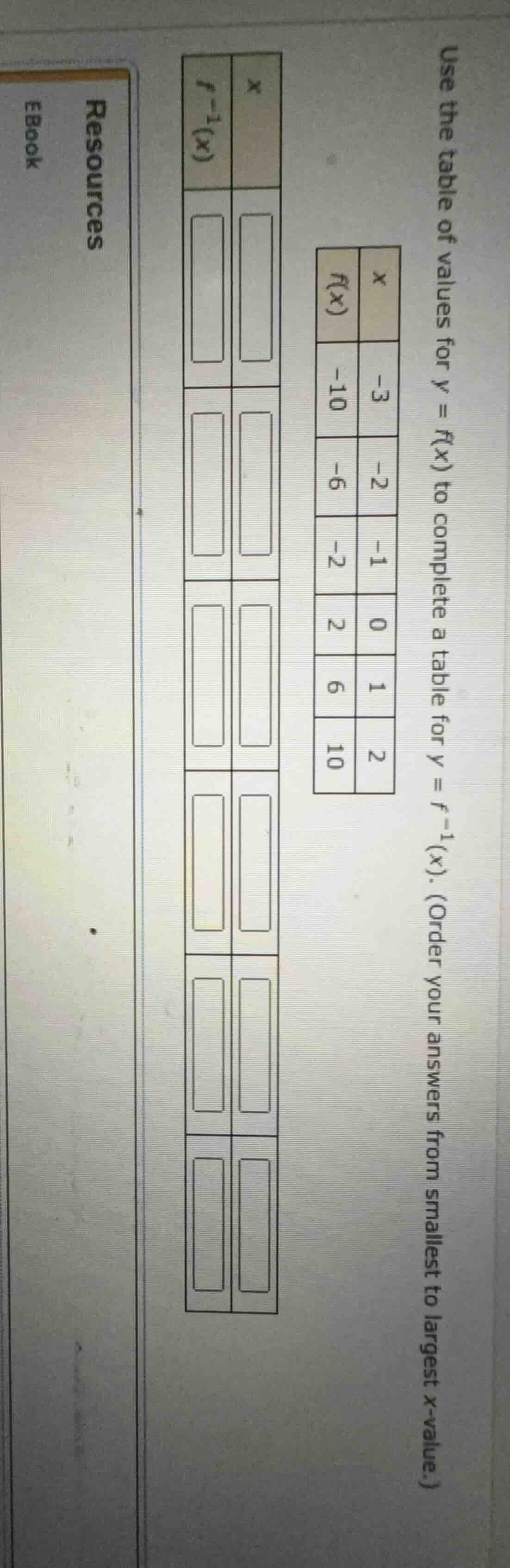
use the table of values for ( y = f(x) ) to complete a table for ( y = f^{-1}(x) ). (order your answers from smallest to largest ( x )-value.)
the table for ( y = f(x) ) is:
| ( x ) | ( f(x) ) |
|---|---|
| -2 | -6 |
| -1 | -2 |
| 0 | 2 |
| 1 | 6 |
| 2 | 10 |
and we need to complete the table for ( y = f^{-1}(x) ) with columns ( x ) and ( f^{-1}(x) ), with several empty rows for filling in values.
Step1: Recall inverse function property
For a function \( y = f(x) \) and its inverse \( y = f^{-1}(x) \), if \( f(a)=b \), then \( f^{-1}(b)=a \). So we need to swap the \( x \) and \( f(x) \) values from the given table to get the table for \( f^{-1}(x) \).
Step2: List given \( (x, f(x)) \) pairs
From the table: \( (-3, -10) \), \( (-2, -6) \), \( (-1, -2) \), \( (0, 2) \), \( (1, 6) \), \( (2, 10) \).
Step3: Swap \( x \) and \( f(x) \) for inverse
For each pair \( (x, f(x)) \), the inverse function \( f^{-1}(x) \) will have pairs \( (f(x), x) \). So:
- When \( f(x)=-10 \), \( x = -3 \) ⇒ \( f^{-1}(-10)=-3 \)
- When \( f(x)=-6 \), \( x = -2 \) ⇒ \( f^{-1}(-6)=-2 \)
- When \( f(x)=-2 \), \( x = -1 \) ⇒ \( f^{-1}(-2)=-1 \)
- When \( f(x)=2 \), \( x = 0 \) ⇒ \( f^{-1}(2)=0 \)
- When \( f(x)=6 \), \( x = 1 \) ⇒ \( f^{-1}(6)=1 \)
- When \( f(x)=10 \), \( x = 2 \) ⇒ \( f^{-1}(10)=2 \)
Step4: Order by \( x \) (which is \( f(x) \) from original)
Now, we order the \( x \)-values (which are \( -10, -6, -2, 2, 6, 10 \)) from smallest to largest and list the corresponding \( f^{-1}(x) \) (which are \( -3, -2, -1, 0, 1, 2 \)).

Snap & solve any problem in the app
Get step-by-step solutions on Sovi AI
Photo-based solutions with guided steps
Explore more problems and detailed explanations
| \( x \) | \( f^{-1}(x) \) |
|---|---|
| -6 | -2 |
| -2 | -1 |
| 2 | 0 |
| 6 | 1 |
| 10 | 2 |