QUESTION IMAGE
Question
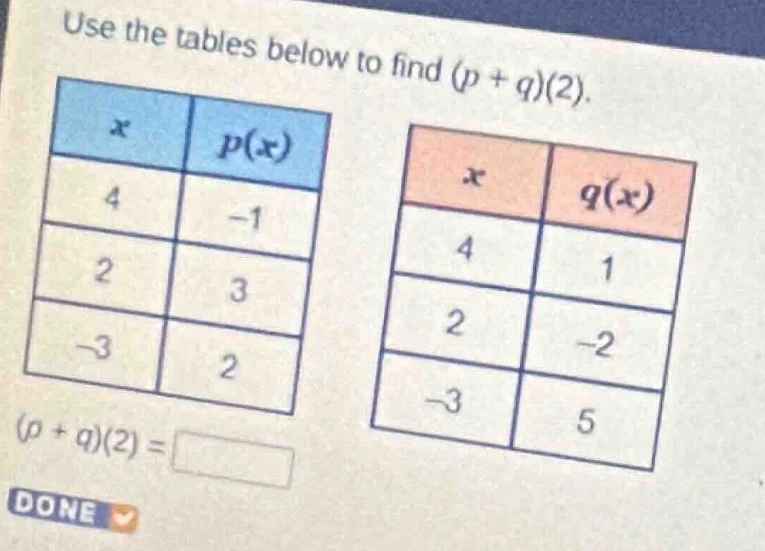
use the tables below to find $(p + q)(2)$.
| $x$ | $p(x)$ | $x$ | $q(x)$ | |
|---|---|---|---|---|
| 2 | 3 | 2 | -2 | |
| -3 | 2 | -3 | 5 |
$(p + q)(2) = \square$
Step1: Recall the definition of \((p + q)(x)\)
By the definition of function addition, \((p + q)(x)=p(x)+q(x)\). So, to find \((p + q)(2)\), we need to find \(p(2)\) and \(q(2)\) first, then add them together.
Step2: Find \(p(2)\) from the first table
Looking at the table for \(p(x)\), when \(x = 2\), the corresponding value of \(p(x)\) is \(3\). So, \(p(2)=3\).
Step3: Find \(q(2)\) from the second table
Looking at the table for \(q(x)\), when \(x = 2\), the corresponding value of \(q(x)\) is \(- 2\). So, \(q(2)=-2\).
Step4: Calculate \((p + q)(2)\)
Using the formula \((p + q)(2)=p(2)+q(2)\), substitute \(p(2) = 3\) and \(q(2)=-2\) into it. We get \((p + q)(2)=3+(-2)\).
Simplify the expression: \(3+(-2)=3 - 2=1\).

Snap & solve any problem in the app
Get step-by-step solutions on Sovi AI
Photo-based solutions with guided steps
Explore more problems and detailed explanations
\(1\)