QUESTION IMAGE
Question
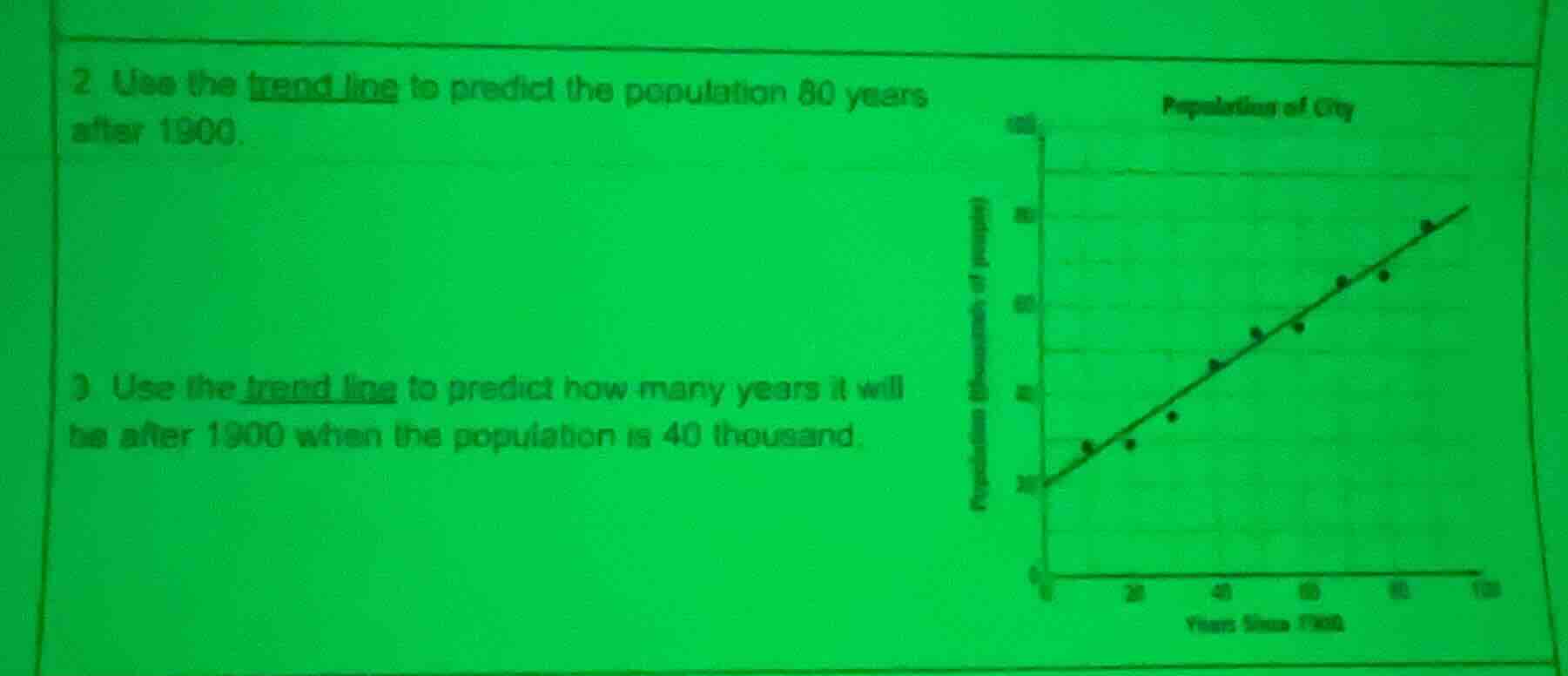
2 use the trend line to predict the population 80 years after 1900.
3 use the trend line to predict how many years it will be after 1900 when the population is 40 thousand.
Problem 2:
Step 1: Analyze the trend line equation (assume linear trend)
From the graph, the y - intercept (when \(x = 0\), \(x\) is years since 1900) is 20 (thousand). Let's find the slope. For example, when \(x = 20\), if we assume a point, let's say the line passes through \((0,20)\) and \((40,40)\) (approximate from the trend). The slope \(m=\frac{y_2 - y_1}{x_2 - x_1}=\frac{40 - 20}{40 - 0}=\frac{20}{40}=0.5\). So the equation of the trend line is \(y = 0.5x+20\), where \(y\) is population in thousands and \(x\) is years since 1900.
Step 2: Substitute \(x = 80\) into the equation
We want to find the population 80 years after 1900, so \(x = 80\). Substitute into \(y=0.5x + 20\).
\(y=0.5\times80 + 20\)
\(y = 40+20\)
\(y=60\)
Step 1: Use the trend line equation \(y = 0.5x+20\)
We know that \(y = 40\) (thousand) and we need to find \(x\) (years since 1900).
Step 2: Solve for \(x\)
Substitute \(y = 40\) into \(y=0.5x + 20\):
\(40=0.5x+20\)
Subtract 20 from both sides: \(40 - 20=0.5x\)
\(20 = 0.5x\)
Divide both sides by 0.5: \(x=\frac{20}{0.5}=40\)

Snap & solve any problem in the app
Get step-by-step solutions on Sovi AI
Photo-based solutions with guided steps
Explore more problems and detailed explanations
The population 80 years after 1900 is 60 thousand.