QUESTION IMAGE
Question
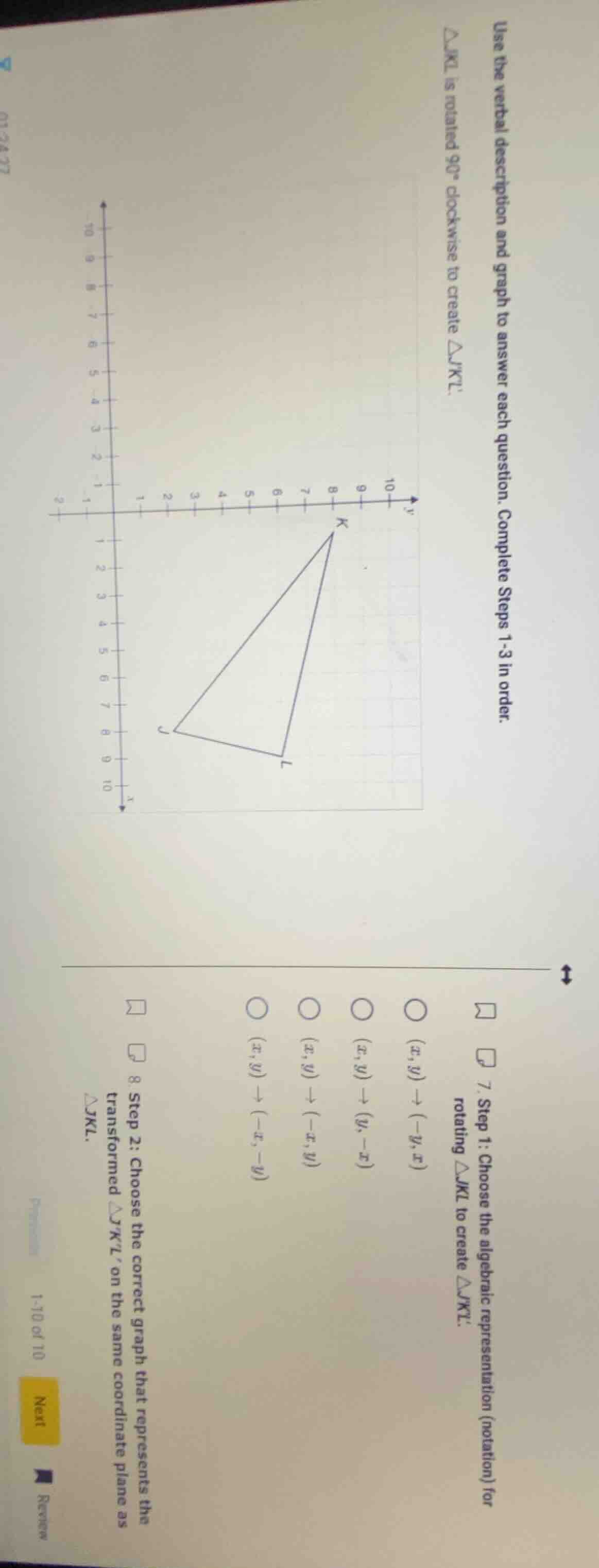
use the verbal description and graph to answer each question. complete steps 1-3 in order. \\(\triangle jkl\\) is rotated \\(90^\circ\\) clockwise to create \\(\triangle jkl\\). \\(\\) 7. step 1: choose the algebraic representation (notation) for rotating \\(\triangle jkl\\) to create \\(\triangle jkl\\). \\(\\) \\(\bigcirc\\ (x,y)\to (-y,x)\\) \\(\bigcirc\\ (x,y)\to (y,-x)\\) \\(\bigcirc\\ (x,y)\to (-x,y)\\) \\(\bigcirc\\ (x,y)\to (-x,-y)\\) \\(\\) 8 step 2: choose the correct graph that represents the transformed \\(\triangle jkl\\) on the same coordinate plane as \\(\triangle jkl\\).
Step1: Recall 90° clockwise rotation rule
The rule for a 90° clockwise rotation about the origin is that a point \((x, y)\) is transformed to \((y, -x)\). Let's verify:
- For a 90° clockwise rotation, we can think of rotating the coordinate system or the point. The standard transformation matrix for 90° clockwise rotation is \(
\), so applying it to \(
\) gives \(
\), which means \((x, y)\to(y, -x)\).
- Let's check the other options:
- \((x, y)\to(-y, x)\) is for 90° counter - clockwise rotation.
- \((x, y)\to(-x, y)\) is for 180° rotation (not 90° clockwise).
- \((x, y)\to(-x, -y)\) is also for 180° rotation (or a combination of reflections, not 90° clockwise).
Step2: Confirm the correct transformation
Based on the rule of 90° clockwise rotation, the correct algebraic representation is \((x, y)\to(y, -x)\).

Snap & solve any problem in the app
Get step-by-step solutions on Sovi AI
Photo-based solutions with guided steps
Explore more problems and detailed explanations
\((x, y)\to(y, -x)\) (the third option among the given choices)