QUESTION IMAGE
Question
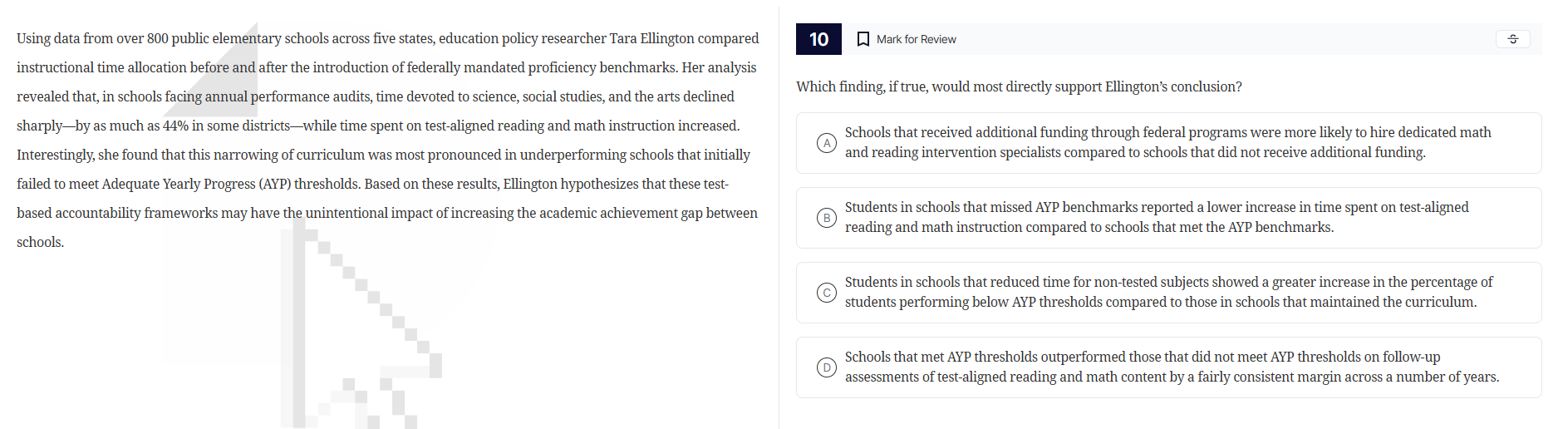
using data from over 800 public elementary schools across five states, education policy researcher tara ellington compared instructional time allocation before and after the introduction of federally mandated proficiency benchmarks. her analysis revealed that, in schools facing annual performance audits, time devoted to science, social studies, and the arts declined sharply—by as much as 44% in some districts—while time spent on test - aligned reading and math instruction increased. interestingly, she found that this narrowing of curriculum was most pronounced in underperforming schools that initially failed to meet adequate yearly progress (ayp) thresholds. based on these results, ellington hypothesizes that these test - based accountability frameworks may have the unintentional impact of increasing the academic achievement gap between schools.
10
mark for review
which finding, if true, would most directly support ellington’s conclusion?
a schools that received additional funding through federal programs were more likely to hire dedicated math and reading intervention specialists compared to schools that did not receive additional funding.
b students in schools that missed ayp benchmarks reported a lower increase in time spent on test - aligned reading and math instruction compared to schools that met the ayp benchmarks.
c students in schools that reduced time for non - tested subjects showed a greater increase in the percentage of students performing below ayp thresholds compared to those in schools that maintained the curriculum.
d schools that met ayp thresholds outperformed those that did not meet ayp thresholds on follow - up assessments of test - aligned reading and math content by a fairly consistent margin across a number of years.
To support Ellington's conclusion that test - based accountability frameworks may increase the academic achievement gap, we need a finding that shows a negative consequence of the curriculum narrowing (reducing time for non - tested subjects) on academic performance, especially in relation to AYP thresholds.
- Option A: Talks about funding and hiring specialists, which is not related to the achievement gap due to curriculum narrowing. Eliminate A.
- Option B: Compares the increase in test - aligned instruction time between schools that missed and met AYP, but this doesn't directly show the impact on the achievement gap. Eliminate B.
- Option C: Shows that students in schools that reduced time for non - tested subjects (curriculum narrowing) had a greater increase in the percentage of students performing below AYP thresholds compared to those in schools with a maintained curriculum. This implies that the curriculum change (due to test - based accountability) is leading to more students falling below AYP, which would widen the achievement gap between schools with different curriculum approaches. This supports the conclusion.
- Option D: Compares the performance of schools that met and did not meet AYP on test - aligned content, but it doesn't address the impact of curriculum narrowing on the achievement gap. Eliminate D.

Snap & solve any problem in the app
Get step-by-step solutions on Sovi AI
Photo-based solutions with guided steps
Explore more problems and detailed explanations
C. Students in schools that reduced time for non - tested subjects showed a greater increase in the percentage of students performing below AYP thresholds compared to those in schools that maintained the curriculum.