QUESTION IMAGE
Question
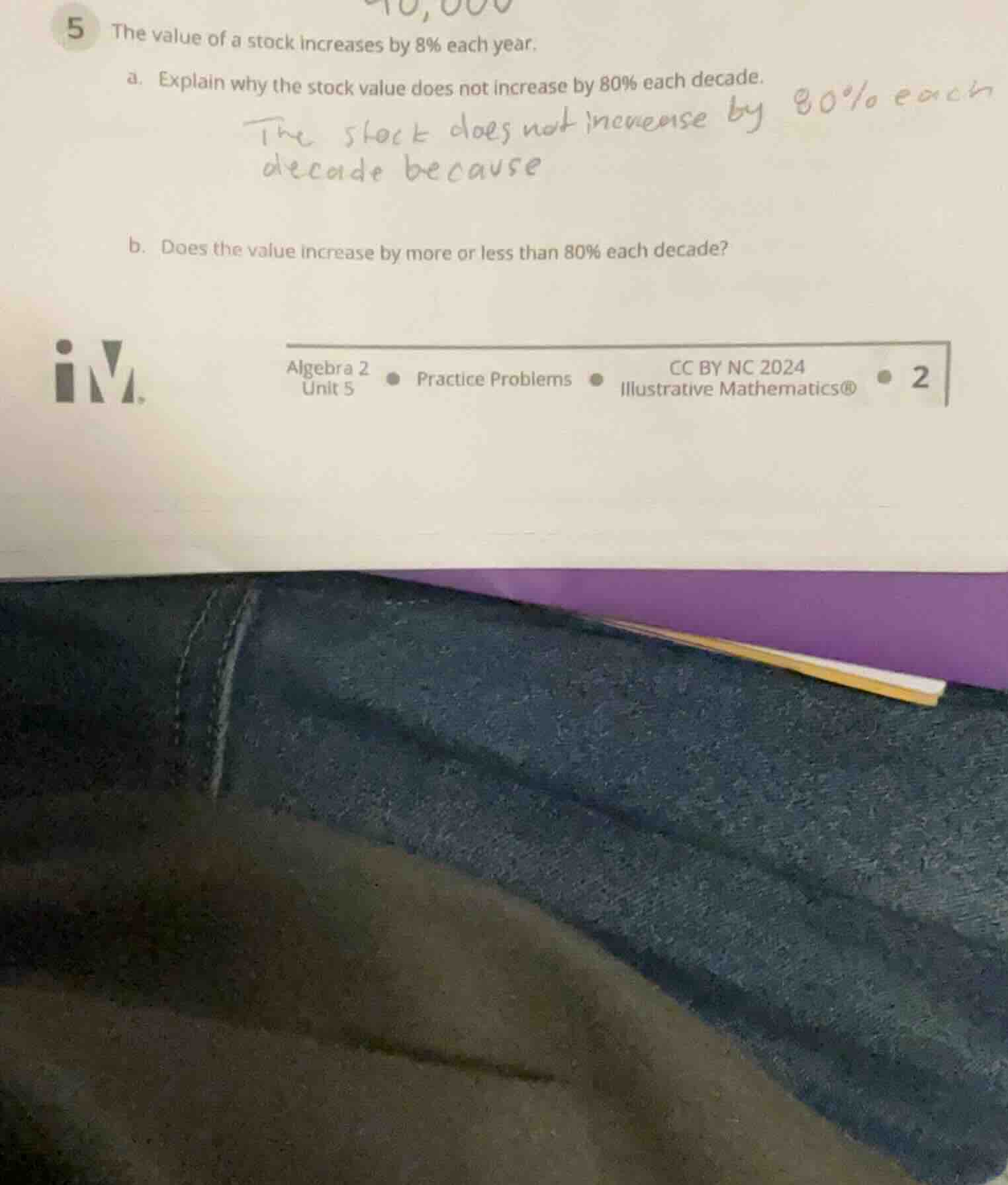
5 the value of a stock increases by 8% each year. a. explain why the stock value does not increase by 80% each decade. b. does the value increase by more or less than 80% each decade? algebra 2 unit 5 practice problems cc by nc 2024 illustrative mathematics® 2
Part (a)
Step1: Recall compound growth
Stock value grows compoundly, not linearly. Let initial value be \( V_0 \). Annual growth rate \( r = 8\% = 0.08 \). After \( n \) years, value \( V_n = V_0(1 + r)^n \).
Step2: Analyze decade growth
A decade has \( n = 10 \) years. So value after decade: \( V_{10} = V_0(1 + 0.08)^{10} \), not \( V_0(1 + 0.8) \). Because growth is compound (interest on interest), not simple addition of annual percentages.
(for clarity):
Stock value grows compoundly (each year's growth is on the previous year's value, not the initial value). For a year \( t \), value is \( V_t = V_{t - 1}(1 + 0.08) \), so over 10 years, it’s \( V_0(1.08)^{10} \), not \( V_0 + 10(0.08V_0) = V_0(1 + 0.8) \). Linear addition (80% total) ignores compounding.
Part (b)
Step1: Calculate compound growth factor
For \( n = 10 \) years, growth factor is \( (1 + 0.08)^{10} \). Compute \( 1.08^{10} \approx 2.1589 \).
Step2: Find total percentage growth
Total growth: \( (2.1589 - 1) \times 100\% \approx 115.89\% \), which is more than 80%.

Snap & solve any problem in the app
Get step-by-step solutions on Sovi AI
Photo-based solutions with guided steps
Explore more problems and detailed explanations
(for clarity):
Using the compound growth formula \( V_{10} = V_0(1.08)^{10} \), calculate \( 1.08^{10} \approx 2.1589 \). This means the value is ~2.1589 times the initial value, so growth percentage is \( (2.1589 - 1) \times 100 \approx 115.89\% \), which is more than 80%.
Final Answers:
(a)
The stock value does not increase by 80% each decade because its growth is compound (each year’s increase is based on the previous year’s value, not the initial value). Linear addition of 8% per year (80% over 10 years) ignores compounding (interest on interest), so the actual growth follows \( V_{10} = V_0(1.08)^{10} \), not \( V_0(1 + 0.8) \).
(b)
The value increases by more than 80% each decade (approximately 115.89% growth over 10 years, from \( (1.08)^{10} \approx 2.1589 \)).