QUESTION IMAGE
Question
2 - variable linear inequality
which linear inequality graphs the solution set shown?
a
$y > \frac{3}{2}x + 3$
b
$y \geq \frac{3}{2}x + 3$
c
$y < \frac{2}{3}x + 3$
d
$y \leq \frac{3}{2}x + 3$
which ordered pair is not a solution to the inequality?
Part 1: Which linear inequality graphs the solution set shown?
Step 1: Determine the slope of the line
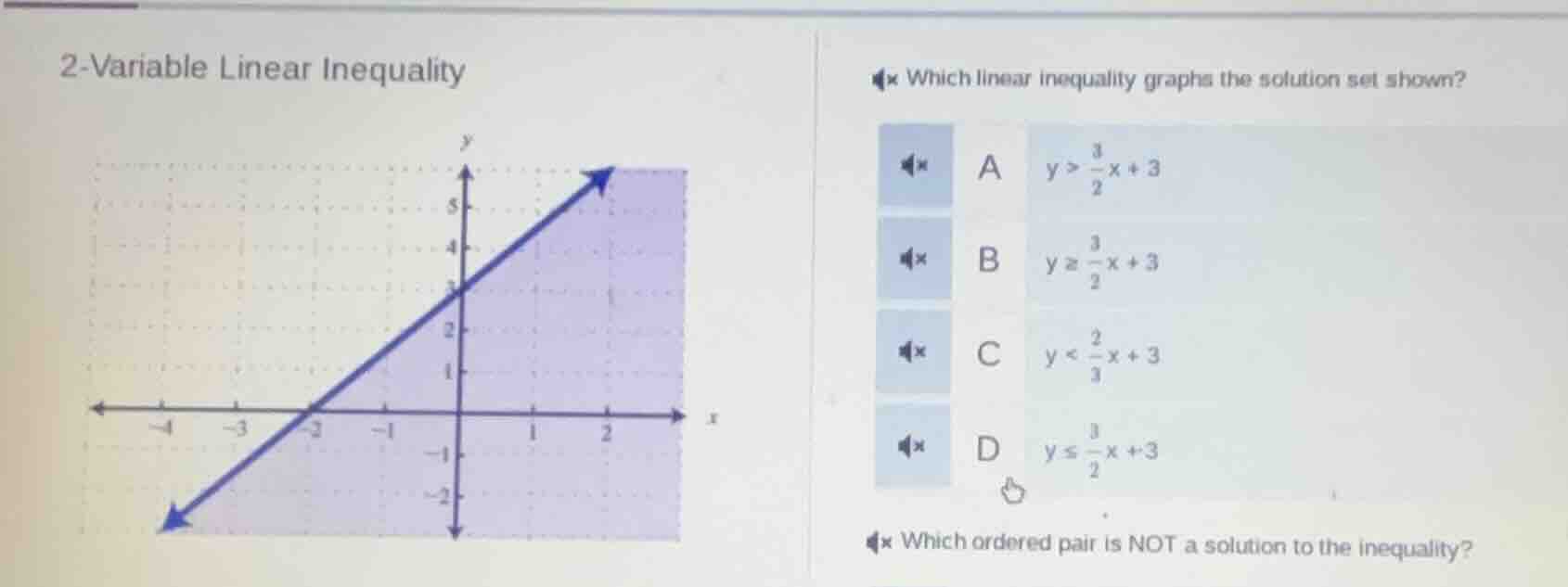
The line passes through points \((-2, 0)\) and \((0, 3)\). The slope \(m\) is calculated as \(m=\frac{y_2 - y_1}{x_2 - x_1}=\frac{3 - 0}{0 - (-2)}=\frac{3}{2}\). So the equation of the line is \(y=\frac{3}{2}x + 3\).
Step 2: Determine the inequality symbol
The line is solid (so the inequality includes equality, i.e., \(\geq\) or \(\leq\)), and the shaded region is above the line (so \(y\) is greater than or equal to the line's equation). So the inequality is \(y\geq\frac{3}{2}x + 3\).

Snap & solve any problem in the app
Get step-by-step solutions on Sovi AI
Photo-based solutions with guided steps
Explore more problems and detailed explanations
B. \( y \geq \frac{3}{2}x + 3 \)
Part 2: Which ordered pair is NOT a solution to the inequality? (Assuming we use the inequality from part 1: \(y\geq\frac{3}{2}x + 3\))
To determine this, we would test ordered pairs (not given in the problem, but generally, we substitute \(x\) and \(y\) into the inequality. For example, if we take a point below the line, say \((0, 2)\): substitute \(x = 0\), \(y = 2\) into \(y\geq\frac{3}{2}x + 3\), we get \(2\geq\frac{3}{2}(0)+3\) which simplifies to \(2\geq3\), which is false. So \((0, 2)\) would not be a solution. But since the problem doesn't provide specific ordered pairs, we can't give a definite answer here without more information. However, the process is to substitute each ordered pair into the inequality \(y\geq\frac{3}{2}x + 3\) and check if the inequality holds. If it doesn't, that ordered pair is not a solution.