QUESTION IMAGE
Question
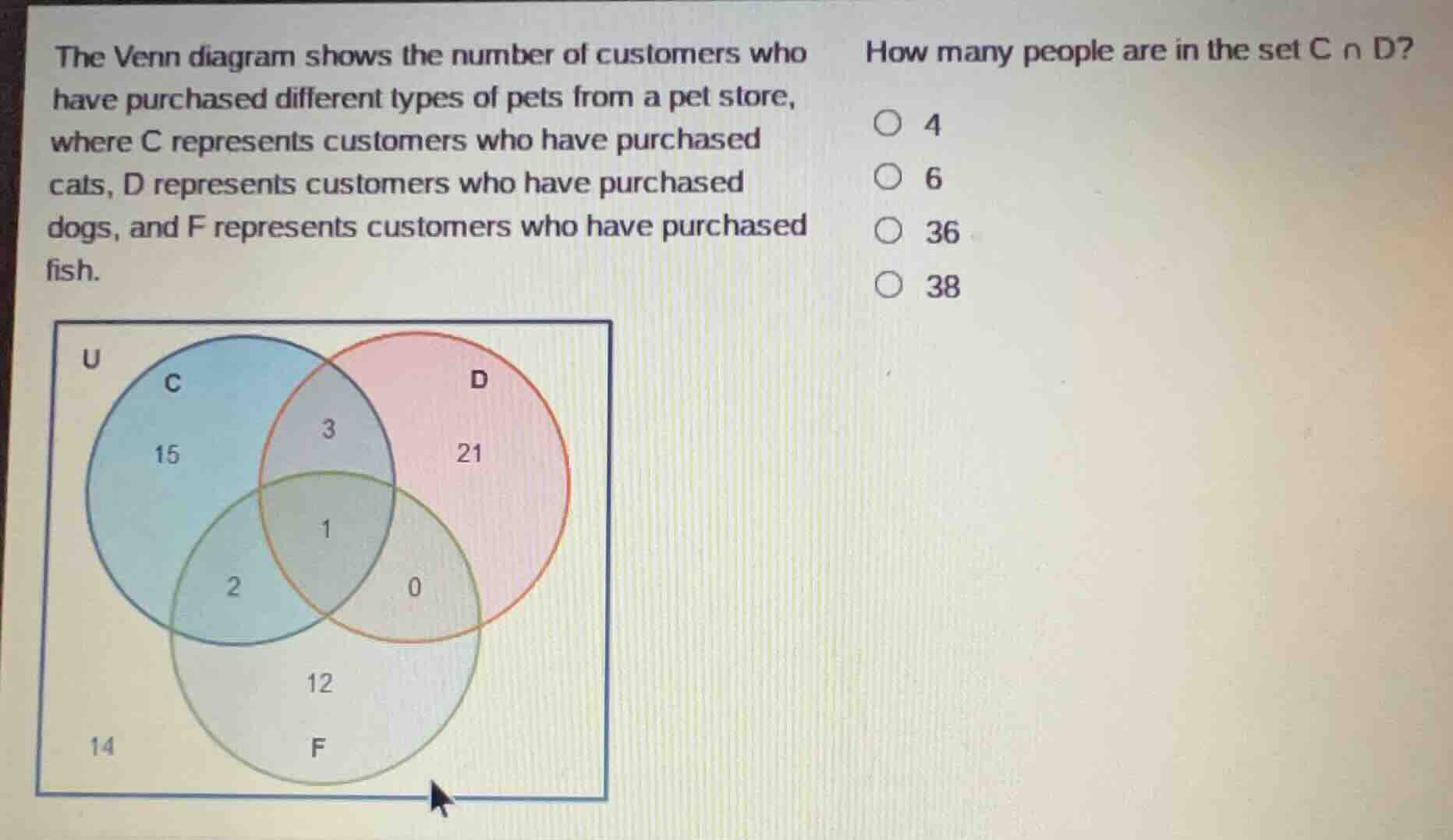
the venn diagram shows the number of customers who have purchased different types of pets from a pet store, where c represents customers who have purchased cats, d represents customers who have purchased dogs, and f represents customers who have purchased fish. how many people are in the set ( c cap d )?
4
6
36
38
Step1: Understand the intersection of sets
The set \( C \cap D \) represents the customers who have purchased both cats (set \( C \)) and dogs (set \( D \)). In a Venn diagram, this is the region that is common to both \( C \) and \( D \), including the part where it also overlaps with \( F \) (fish) and the part where it only overlaps with \( C \) and \( D \).
Step2: Identify the numbers in the intersection region
Looking at the Venn diagram, the region common to \( C \) and \( D \) has two parts: the part where it only overlaps with \( C \) and \( D \) (which is 3) and the part where it overlaps with \( C \), \( D \), and \( F \) (which is 1). To find the total number of customers in \( C \cap D \), we add these two numbers together.
So, we calculate \( 3 + 1 \).
\( 3 + 1 = 4 \)? Wait, no, wait. Wait, maybe I misread. Wait, no, let's check again. Wait, the region for \( C \cap D \) (excluding \( F \)) is 3, and the region for \( C \cap D \cap F \) is 1. So the total number of customers who have purchased both cats and dogs (regardless of fish) is \( 3 + 1 = 4 \)? But wait, the options include 4, 6, 36, 38. Wait, maybe I made a mistake. Wait, no, let's look at the Venn diagram again. Wait, the blue circle is \( C \) (cats), red is \( D \) (dogs), gray is \( F \) (fish). The intersection of \( C \) and \( D \) is the area where blue and red overlap. That area has two parts: the part that's only \( C \) and \( D \) (3) and the part that's \( C \), \( D \), and \( F \) (1). So adding those: \( 3 + 1 = 4 \)? But wait, the options have 4 as an option. Wait, but maybe I misread the numbers. Wait, the blue circle has 15 (only cats), 2 (cats and fish only), 3 (cats and dogs only), 1 (cats, dogs, and fish). The red circle has 21 (only dogs), 0 (dogs and fish only), 3 (cats and dogs only), 1 (cats, dogs, and fish). The gray circle has 12 (only fish), 2 (cats and fish only), 0 (dogs and fish only), 1 (all three). So the intersection of \( C \) and \( D \) is the sum of the numbers in the overlapping region of \( C \) and \( D \), which is \( 3 + 1 = 4 \). So the number of people in \( C \cap D \) is 4? Wait, but let me check again. Wait, maybe the question is asking for the number of people who have purchased both cats and dogs, including those who also purchased fish. So that would be \( 3 + 1 = 4 \)? But the options have 4 as an option. So the answer should be 4? Wait, but let me confirm. The set \( C \cap D \) is all elements that are in both \( C \) and \( D \), so that's the union of the region \( C \cap D \cap F' \) (only cats and dogs) and \( C \cap D \cap F \) (cats, dogs, and fish). So \( 3 + 1 = 4 \). So the answer is 4.

Snap & solve any problem in the app
Get step-by-step solutions on Sovi AI
Photo-based solutions with guided steps
Explore more problems and detailed explanations
4