QUESTION IMAGE
Question
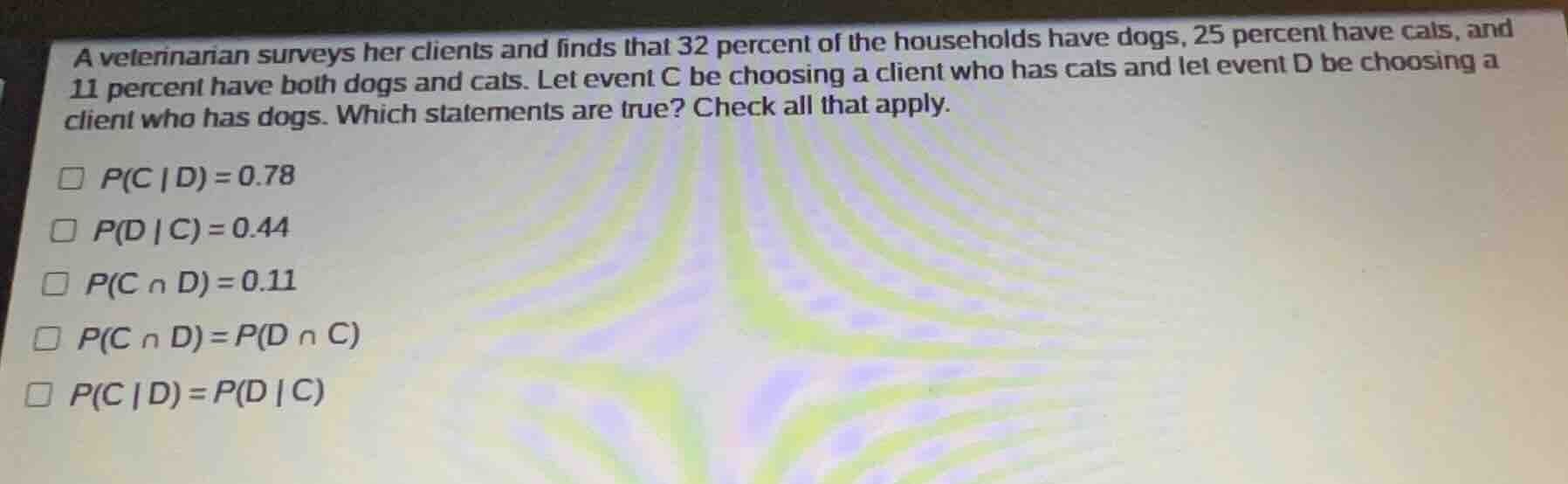
a veterinarian surveys her clients and finds that 32 percent of the households have dogs, 25 percent have cats, and 11 percent have both dogs and cats. let event c be choosing a client who has cats and let event d be choosing a client who has dogs. which statements are true? check all that apply. \\( p(c | d) = 0.78 \\) \\( p(d | c) = 0.44 \\) \\( p(c \cap d) = 0.11 \\) \\( p(c \cap d) = p(d \cap c) \\) \\( p(c | d) = p(d | c) \\)
Step1: Recall Conditional Probability Formula
The formula for conditional probability is \( P(A|B)=\frac{P(A\cap B)}{P(B)} \), and also \( P(A\cap B) = P(B\cap A) \) (intersection of events is commutative).
We are given:
- \( P(D)=0.32 \) (32% of households have dogs)
- \( P(C)=0.25 \) (25% of households have cats)
- \( P(C\cap D) = 0.11 \) (11% of households have both dogs and cats)
Step2: Evaluate \( P(C|D) \)
Using the conditional probability formula \( P(C|D)=\frac{P(C\cap D)}{P(D)} \)
Substitute the values: \( P(C|D)=\frac{0.11}{0.32}\approx0.34375
eq0.78 \)
Step3: Evaluate \( P(D|C) \)
Using the conditional probability formula \( P(D|C)=\frac{P(D\cap C)}{P(C)} \)
Since \( P(D\cap C)=P(C\cap D) = 0.11 \), substitute: \( P(D|C)=\frac{0.11}{0.25} = 0.44 \)
Step4: Evaluate \( P(C\cap D) \)
We are given that 11% of households have both dogs and cats, so \( P(C\cap D)=0.11 \), this statement is true.
Step5: Evaluate \( P(C\cap D)=P(D\cap C) \)
The intersection of two events is commutative, i.e., \( C\cap D = D\cap C \), so their probabilities are equal. Thus \( P(C\cap D)=P(D\cap C) \), this statement is true.
Step6: Evaluate \( P(C|D)=P(D|C) \)
We found \( P(C|D)\approx0.34375 \) and \( P(D|C) = 0.44 \), these are not equal, so this statement is false.

Snap & solve any problem in the app
Get step-by-step solutions on Sovi AI
Photo-based solutions with guided steps
Explore more problems and detailed explanations
- \( P(D | C) = 0.44 \) (True)
- \( P(C \cap D) = 0.11 \) (True)
- \( P(C \cap D) = P(D \cap C) \) (True)
So the correct options are:
- \( P(D | C) = 0.44 \)
- \( P(C \cap D) = 0.11 \)
- \( P(C \cap D) = P(D \cap C) \)