QUESTION IMAGE
Question
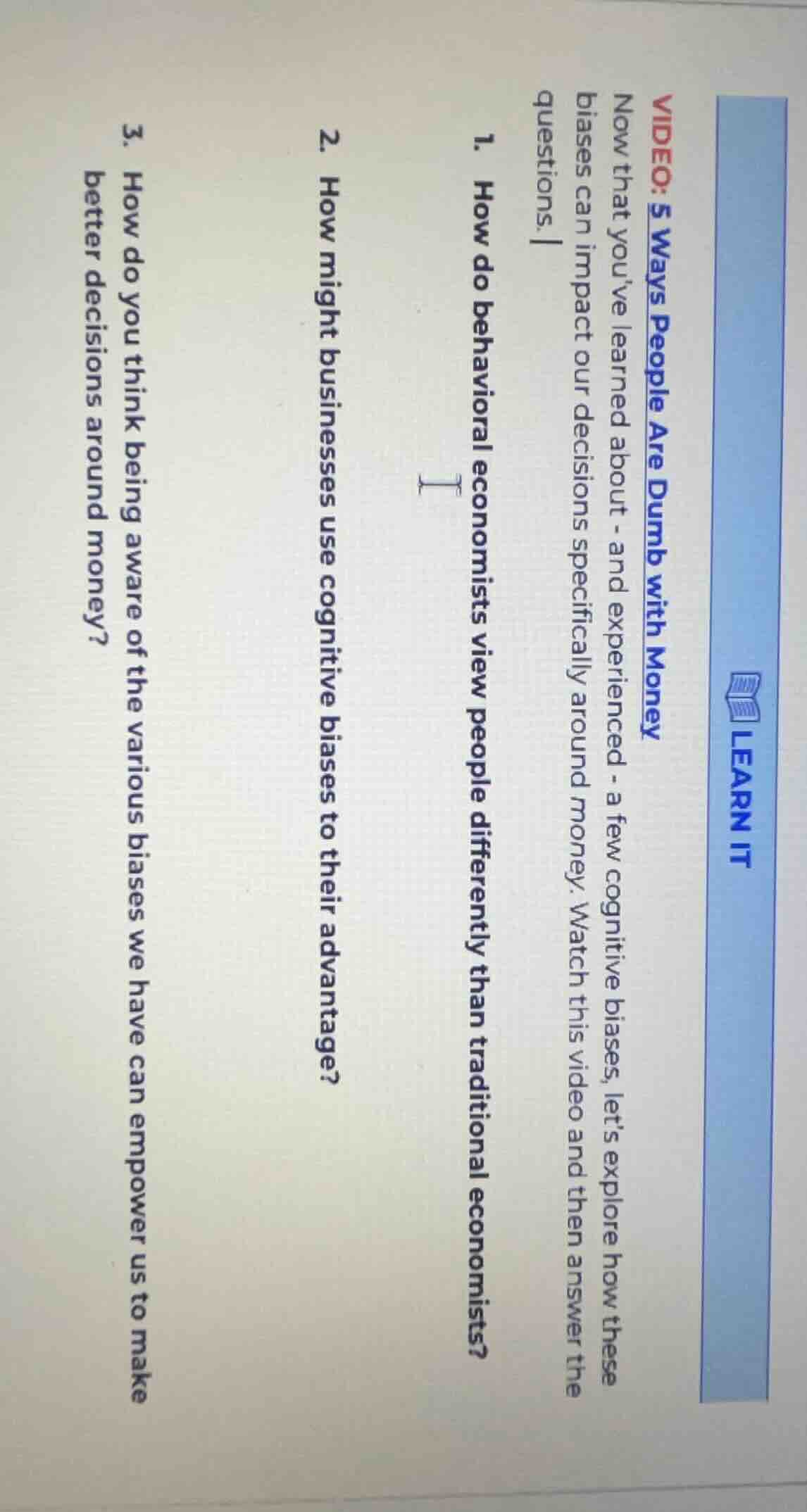
video: 5 ways people are dumb with money now that youve learned about - and experienced - a few cognitive biases, lets explore how these biases can impact our decisions specifically around money. watch this video and then answer the questions. 1. how do behavioral economists view people differently than traditional economists? 2. how might businesses use cognitive biases to their advantage? 3. how do you think being aware of the various biases we have can empower us to make better decisions around money?
Question 1
Traditional economists assume people are rational, maximizing utility with perfect info. Behavioral economists recognize cognitive biases (e.g., loss aversion, overconfidence) that lead to irrational money - related choices (like overspending or poor investment decisions), so they study how these biases affect real - world financial behavior.
Businesses can use cognitive biases to their advantage. For example, the anchoring bias: a store might set a high "original" price (anchor) for a product, then offer a "discounted" price that seems like a great deal, even if the discounted price is still high. The scarcity bias: creating a sense of limited availability (e.g., "limited time offer" or "only a few left") to push customers to buy quickly.
Being aware of biases helps in making better money decisions. For example, if you know about the confirmation bias (seeking info that confirms your existing beliefs about an investment), you can actively seek out opposing views to make a more informed choice. For the sunk cost fallacy (continuing to invest in a failing project because of past investments), awareness lets you cut losses. You can also create systems (like automatic savings, pre - committing to a budget) to counteract biases like impulse spending (due to present bias, prioritizing immediate gratification over long - term goals).

Snap & solve any problem in the app
Get step-by-step solutions on Sovi AI
Photo-based solutions with guided steps
Explore more problems and detailed explanations
Behavioral economists view people as having cognitive biases that cause non - rational money - related decisions (e.g., loss aversion, overconfidence impacting spending/investing), unlike traditional economists who assume rationality and perfect information.