QUESTION IMAGE
Question
view solution history
6x - 25 + 4x
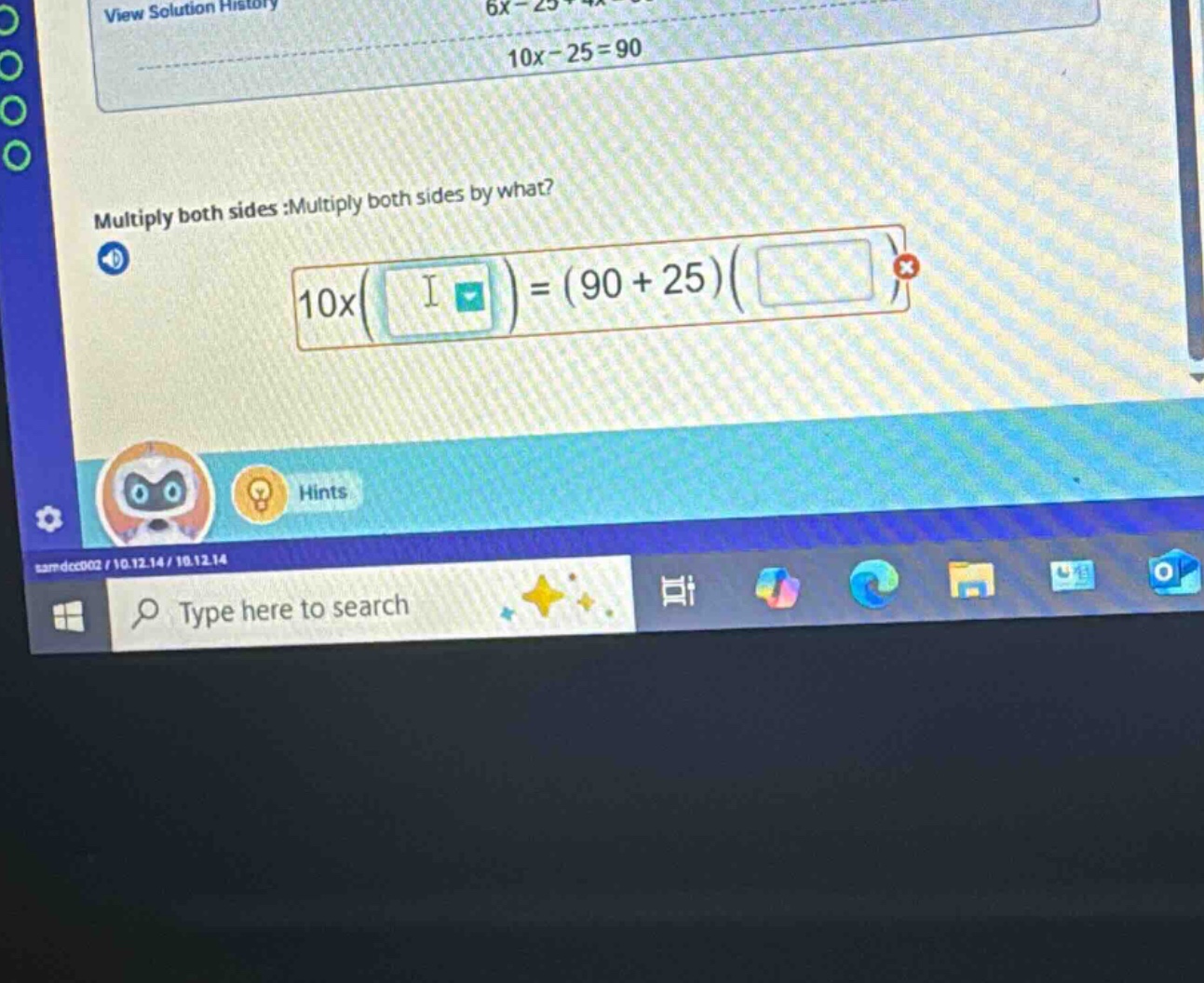
10x - 25 = 90
multiply both sides :multiply both sides by what?
10x( ) = (90 + 25)( )
hints
samdcc002 / 10.12.14 / 10.12.14
Step1: Analyze the equation
We start with the equation \(10x - 25 = 90\). First, we add 25 to both sides to get \(10x=90 + 25\). But in the given format, we need to multiply both sides by a number. Wait, actually, maybe there is a mis - step in the original problem's approach. Wait, no, if we consider that maybe we want to make the coefficient of \(x\) equal to 1, we should divide both sides by 10, but division is multiplying by \(\frac{1}{10}\). Wait, but let's re - examine. The equation after combining like terms is \(10x-25 = 90\), then \(10x=90 + 25\). If we want to solve for \(x\), we can multiply both sides by \(\frac{1}{10}\) (or divide by 10). So for the equation \(10x\times(\frac{1}{10})=(90 + 25)\times(\frac{1}{10})\). But maybe the problem has a typo, and actually, we should first add 25 to both sides (which is what \(90 + 25\) suggests) and then multiply both sides by \(\frac{1}{10}\) to solve for \(x\). So the number we multiply both sides by is \(\frac{1}{10}\) (or 0.1), but since we are dealing with fractions, \(\frac{1}{10}\) is appropriate.
Step2: Determine the multiplier
To isolate \(x\) in the equation \(10x=115\) (since \(90 + 25=115\)), we multiply both sides by the reciprocal of 10, which is \(\frac{1}{10}\). So both boxes should be filled with \(\frac{1}{10}\) (or 0.1). But if we consider the operation of dividing by 10 as multiplying by \(\frac{1}{10}\), then the number to multiply both sides by is \(\frac{1}{10}\).

Snap & solve any problem in the app
Get step-by-step solutions on Sovi AI
Photo-based solutions with guided steps
Explore more problems and detailed explanations
The number to multiply both sides by is \(\frac{1}{10}\) (or 0.1), so both boxes should be filled with \(\frac{1}{10}\) (or 0.1). If we write it as a fraction, the answer is \(\frac{1}{10}\) for both boxes.