QUESTION IMAGE
Question
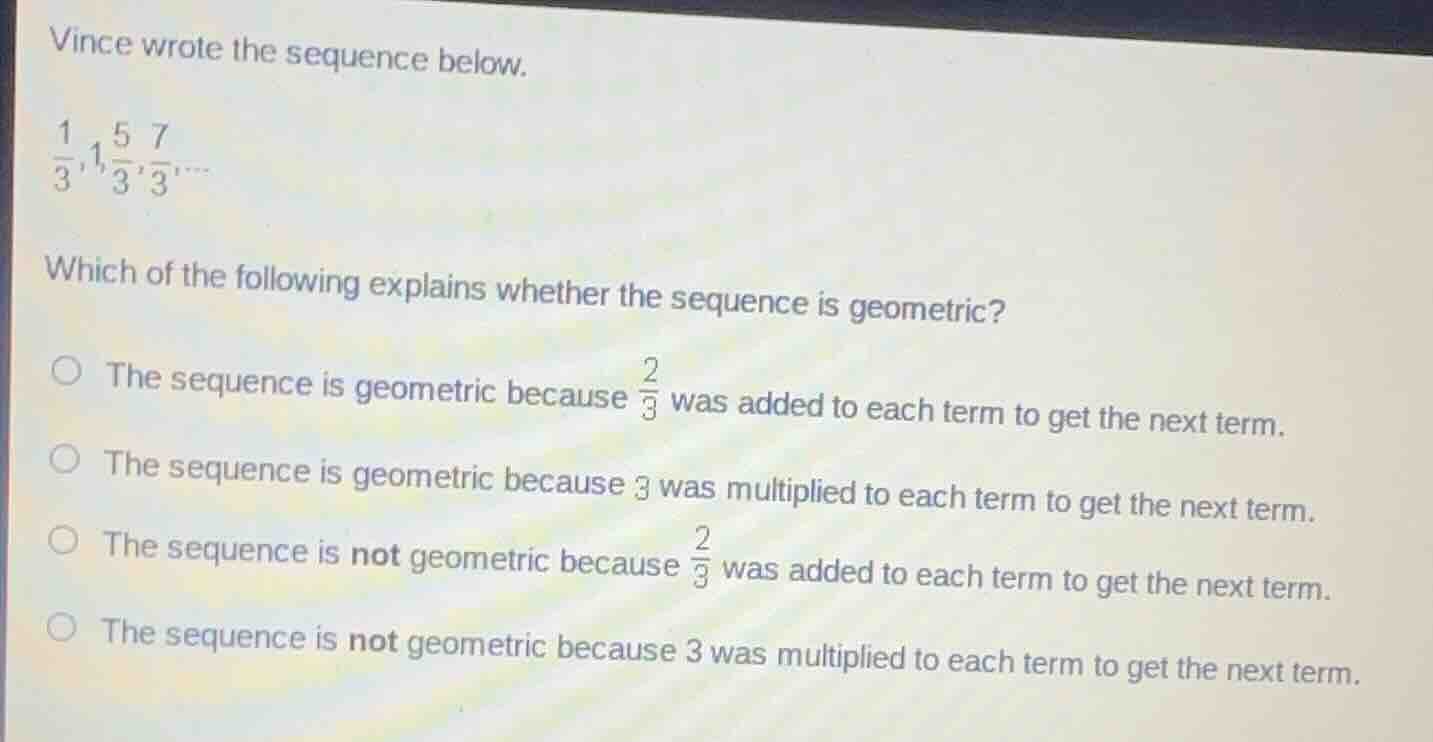
vince wrote the sequence below.\\(\frac{1}{3}, 1, \frac{5}{3}, \frac{7}{3}, dots\\)\\(\\)which of the following explains whether the sequence is geometric?\\(\\)\\(\circ\\) the sequence is geometric because \\(\frac{2}{3}\\) was added to each term to get the next term.\\(\\)\\(\circ\\) the sequence is geometric because 3 was multiplied to each term to get the next term.\\(\\)\\(\circ\\) the sequence is not geometric because \\(\frac{2}{3}\\) was added to each term to get the next term.\\(\\)\\(\circ\\) the sequence is not geometric because 3 was multiplied to each term to get the next term.
Step1: Recall geometric sequence definition
A geometric sequence has a common ratio \( r \), where \( r=\frac{a_{n + 1}}{a_n} \) (each term is multiplied by \( r \) to get the next term). An arithmetic sequence has a common difference \( d=a_{n+1}-a_n \) (each term is added by \( d \) to get the next term).
Step2: Analyze the given sequence
Given sequence: \( \frac{1}{3},1,\frac{5}{3},\frac{7}{3},\dots \)
Calculate the difference between consecutive terms:
- \( 1-\frac{1}{3}=\frac{3 - 1}{3}=\frac{2}{3} \)
- \( \frac{5}{3}-1=\frac{5 - 3}{3}=\frac{2}{3} \)
- \( \frac{7}{3}-\frac{5}{3}=\frac{7 - 5}{3}=\frac{2}{3} \)
So, the common difference \( d = \frac{2}{3} \), meaning it is an arithmetic sequence (terms are added by \( \frac{2}{3} \)), not geometric (geometric requires multiplication by a common ratio, not addition of a common difference).
Now check the options:
- Option 1: Wrong, because adding a term means it's arithmetic, not geometric.
- Option 2: Wrong, we saw the common operation is addition, not multiplication by 3 (check \( 1\div\frac{1}{3}=3 \), \( \frac{5}{3}\div1=\frac{5}{3}
eq3 \), so ratio is not constant).
- Option 3: Correct, as the sequence has a common difference (addition of \( \frac{2}{3} \)), so it's not geometric.
- Option 4: Wrong, the operation is addition, not multiplication by 3.

Snap & solve any problem in the app
Get step-by-step solutions on Sovi AI
Photo-based solutions with guided steps
Explore more problems and detailed explanations
The sequence is not geometric because \(\frac{2}{3}\) was added to each term to get the next term. (Corresponding to the third option among the given choices)