QUESTION IMAGE
Question
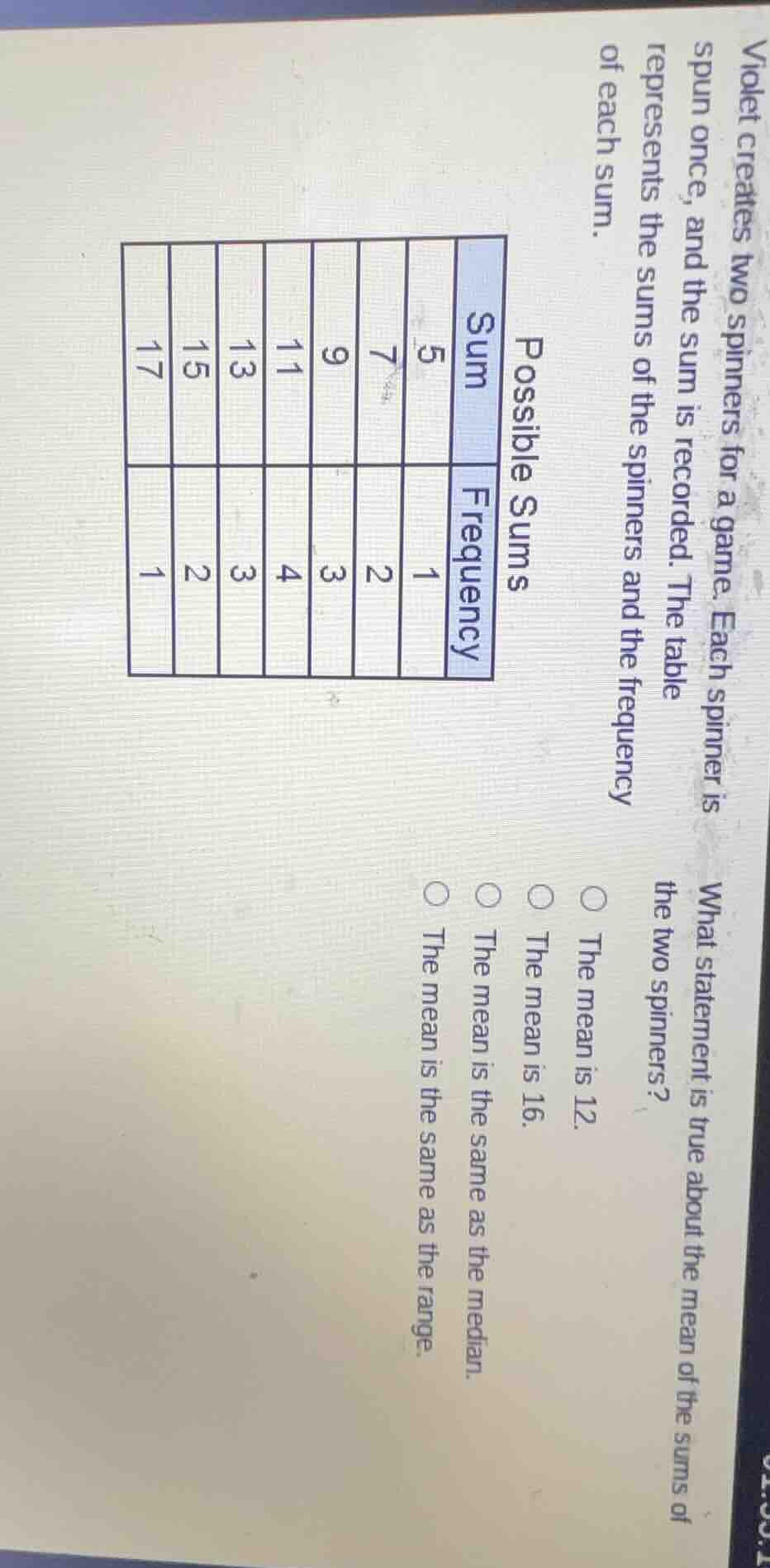
violet creates two spinners for a game. each spinner is spun once, and the sum is recorded. the table represents the sums of the spinners and the frequency of each sum.
possible sums
sum: 5, 7, 9, 11, 13, 15, 17
frequency: 1, 2, 3, 4, 3, 2, 1
what statement is true about the mean of the sums of the two spinners?
options:
- the mean is 12.
- the mean is 16.
- the mean is the same as the median.
- the mean is the same as the range.
Step1: Calculate total frequency
First, we find the total number of data points by summing the frequencies. The frequencies are 1, 2, 3, 4, 3, 2, 1. So, \(1 + 2+3 + 4+3 + 2+1=\frac{(1 + 1)\times7}{2}= 16\) (using the formula for the sum of an arithmetic series \(S_n=\frac{n(a_1 + a_n)}{2}\), where \(n = 7\), \(a_1=1\), \(a_n = 1\)).
Step2: Calculate the sum of (sum × frequency)
Now we calculate the weighted sum:
- For sum = 5, frequency = 1: \(5\times1 = 5\)
- For sum = 7, frequency = 2: \(7\times2=14\)
- For sum = 9, frequency = 3: \(9\times3 = 27\)
- For sum = 11, frequency = 4: \(11\times4=44\)
- For sum = 13, frequency = 3: \(13\times3 = 39\)
- For sum = 15, frequency = 2: \(15\times2=30\)
- For sum = 17, frequency = 1: \(17\times1 = 17\)
Now sum these up: \(5+14 + 27+44+39+30+17\)
\(5+14=19\); \(19 + 27=46\); \(46+44 = 90\); \(90+39=129\); \(129+30 = 159\); \(159+17=176\)
Step3: Calculate the mean
The mean is the weighted sum divided by the total frequency. So, \(\text{Mean}=\frac{176}{16}=11\)? Wait, no, wait, let's recalculate the weighted sum:
Wait, 5×1=5; 7×2=14 (5+14=19); 9×3=27 (19+27=46); 11×4=44 (46+44=90); 13×3=39 (90+39=129); 15×2=30 (129+30=159); 17×1=17 (159+17=176). Total frequency is 1+2+3+4+3+2+1=16. Then \(176\div16 = 11\)? Wait, but let's check the median. The total number of data points is 16, so the median is the average of the 8th and 9th values. Let's list the data points in order:
Sum 5 (1 time), 7 (2 times: positions 2,3), 9 (3 times: positions 4,5,6), 11 (4 times: positions 7,8,9,10), 13 (3 times: positions 11,12,13), 15 (2 times: positions 14,15), 17 (1 time: position 16). So the 8th value is 11, the 9th value is 11. So median is \(\frac{11 + 11}{2}=11\). So the mean (11) is the same as the median (11). Let's check the options:
Option 1: The mean is 12? No, we calculated mean as 11.
Option 2: The mean is 16? No.
Option 3: The mean is the same as the median? Yes, because mean is 11 and median is 11.
Option 4: The mean is the same as the range? Range is \(17 - 5=12\), mean is 11, so no.
Wait, let's recheck the mean calculation:
Total sum of (sum × frequency):
5*1 = 5
7*2 = 14 → 5+14=19
9*3 = 27 → 19+27=46
11*4 = 44 → 46+44=90
13*3 = 39 → 90+39=129
15*2 = 30 → 129+30=159
17*1 = 17 → 159+17=176
Total frequency: 1+2+3+4+3+2+1=16
Mean: 176/16=11.
Median: since n=16 (even), median is average of (n/2)th and (n/2 +1)th term. n/2=8, n/2 +1=9. The 8th term: let's count the cumulative frequency:
Cumulative frequency for 5:1
For 7:1+2=3
For 9:3+3=6
For 11:6+4=10. So the 7th,8th,9th,10th terms are 11. So 8th term is 11, 9th term is 11. Median=(11+11)/2=11. So mean (11) = median (11). So the correct option is "The mean is the same as the median."

Snap & solve any problem in the app
Get step-by-step solutions on Sovi AI
Photo-based solutions with guided steps
Explore more problems and detailed explanations
The mean is the same as the median. (The option: "The mean is the same as the median.")