QUESTION IMAGE
Question
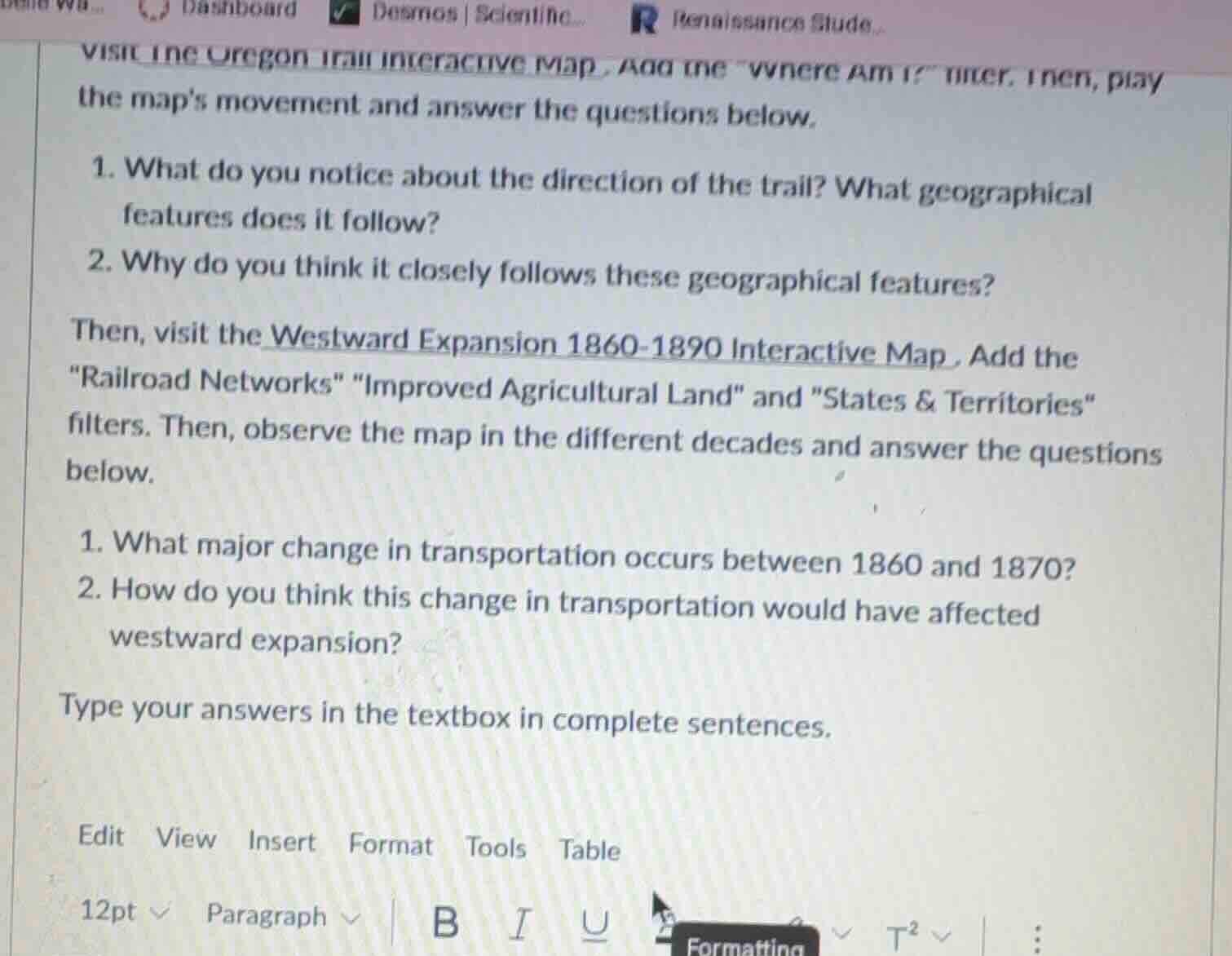
visit the oregon trail interactive map. add the \where am i?\ filter. then, play the maps movement and answer the questions below. 1. what do you notice about the direction of the trail? what geographical features does it follow? 2. why do you think it closely follows these geographical features? then, visit the westward expansion 1860 - 1890 interactive map. add the
ailroad networks\ \improved agricultural land\ and \states & territories\ filters. then, observe the map in the different decades and answer the questions below. 1. what major change in transportation occurs between 1860 and 1870? 2. how do you think this change in transportation would have affected westward expansion? type your answers in the textbox in complete sentences.
Part 1: Oregon Trail Interactive Map Questions
Question 1 (Direction and Geographical Features of the Trail)
The Oregon Trail generally moves westward. It follows major rivers (e.g., the Platte River, Snake River) and avoids extreme mountainous terrain, often using passes through mountain ranges (like the Rocky Mountains’ South Pass). These waterways provided water for travelers/animals, and the passes offered manageable routes over mountains.
Travelers needed water for themselves, livestock, and crops. Rivers also served as natural transportation routes for floating supplies. Mountain passes provided the only practical way to cross ranges without extreme difficulty, so the trail aligned with these features to ensure survival, access to resources, and manageable travel.
Between 1860 and 1870, the transcontinental railroad was completed (1869), and railroad networks expanded dramatically across the West. In 1860, railroads were limited to the East/Midwest; by 1870, a transcontinental line connected coasts, with more regional railroads spreading westward.

Snap & solve any problem in the app
Get step-by-step solutions on Sovi AI
Photo-based solutions with guided steps
Explore more problems and detailed explanations
The Oregon Trail primarily travels westward. It follows major rivers (e.g., the Platte, Snake Rivers) and mountain passes (e.g., South Pass) to navigate terrain, as rivers provided water and passes offered feasible routes over mountains.