QUESTION IMAGE
Question
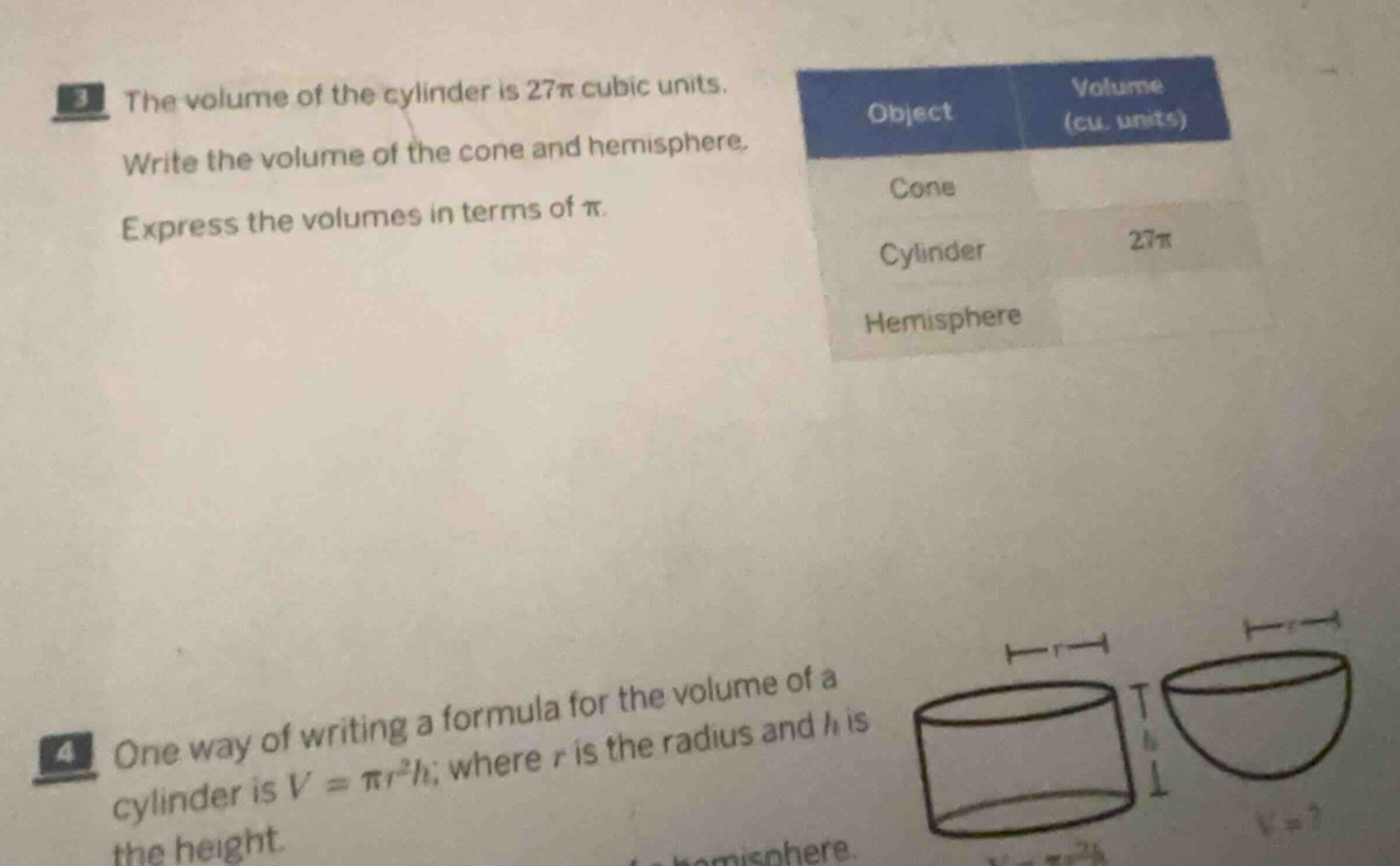
3 the volume of the cylinder is 27π cubic units. write the volume of the cone and hemisphere. express the volumes in terms of π. 4 one way of writing a formula for the volume of a cylinder is v = πr²h, where r is the radius and h is the height. (the chart shows object and volume (cu. units) with cone (blank), cylinder (27π), hemisphere (blank). there are also images of a cylinder and a hemisphere with radius r and height h for the cylinder, and the hemisphere has v=? and the cylinder has v=πr²h.)
Step1: Recall volume formulas
The volume of a cylinder is \( V_{cylinder} = \pi r^2 h \), the volume of a cone with the same radius \( r \) and height \( h \) as the cylinder is \( V_{cone} = \frac{1}{3}\pi r^2 h \), and the volume of a hemisphere with the same radius \( r \) (since the hemisphere and cylinder likely have the same radius, as they are related in the diagram) is \( V_{hemisphere} = \frac{2}{3}\pi r^3 \). But from the cylinder's volume, we know \( \pi r^2 h = 27\pi \), so \( r^2 h = 27 \). For the cone, since \( V_{cone}=\frac{1}{3}\pi r^2 h \), substitute \( \pi r^2 h = 27\pi \) into it.
Step2: Calculate cone volume
\( V_{cone}=\frac{1}{3}\times V_{cylinder}=\frac{1}{3}\times27\pi = 9\pi \)
Step3: Calculate hemisphere volume
First, from the cylinder \( V_{cylinder}=\pi r^2 h = 27\pi \), assume the height \( h \) of the cylinder is equal to the diameter of the hemisphere (so \( h = 2r \), since the hemisphere's diameter would match the cylinder's height for the given diagram context). Then \( \pi r^2(2r)=27\pi \), \( 2\pi r^3 = 27\pi \), \( r^3=\frac{27}{2} \). But the volume of a hemisphere is \( \frac{2}{3}\pi r^3 \), substitute \( r^3=\frac{27}{2} \) into it: \( V_{hemisphere}=\frac{2}{3}\pi\times\frac{27}{2}= 9\pi \)? Wait, no, maybe a better way: since the cylinder, cone, and hemisphere are related such that the cylinder's volume is 3 times the cone's and 1.5 times the hemisphere's? Wait, no, let's re - examine. The volume of a sphere is \( \frac{4}{3}\pi r^3 \), so a hemisphere is \( \frac{2}{3}\pi r^3 \). The cylinder with the same radius \( r \) and height \( h = r \) (if the height of the cylinder is equal to the radius? No, the diagram shows the cylinder and hemisphere with the same radius \( r \) and the cylinder's height \( h \). Wait, maybe the cylinder, cone, and hemisphere have the same radius \( r \) and the cylinder's height \( h \) is equal to the radius \( r \)? No, the key is that for a cone, cylinder, and hemisphere with the same radius \( r \) and the cylinder's height \( h = r \) (not sure, but from the volume relationship: the volume of a cone is \( \frac{1}{3} \) of the cylinder's volume when they have the same radius and height. The volume of a hemisphere: if we consider that the cylinder's volume is \( \pi r^2 h = 27\pi \), and if the hemisphere[SSE onError error]

Snap & solve any problem in the app
Get step-by-step solutions on Sovi AI
Photo-based solutions with guided steps
Explore more problems and detailed explanations
Step1: Recall volume formulas
The volume of a cylinder is \( V_{cylinder} = \pi r^2 h \), the volume of a cone with the same radius \( r \) and height \( h \) as the cylinder is \( V_{cone} = \frac{1}{3}\pi r^2 h \), and the volume of a hemisphere with the same radius \( r \) (since the hemisphere and cylinder likely have the same radius, as they are related in the diagram) is \( V_{hemisphere} = \frac{2}{3}\pi r^3 \). But from the cylinder's volume, we know \( \pi r^2 h = 27\pi \), so \( r^2 h = 27 \). For the cone, since \( V_{cone}=\frac{1}{3}\pi r^2 h \), substitute \( \pi r^2 h = 27\pi \) into it.
Step2: Calculate cone volume
\( V_{cone}=\frac{1}{3}\times V_{cylinder}=\frac{1}{3}\times27\pi = 9\pi \)
Step3: Calculate hemisphere volume
First, from the cylinder \( V_{cylinder}=\pi r^2 h = 27\pi \), assume the height \( h \) of the cylinder is equal to the diameter of the hemisphere (so \( h = 2r \), since the hemisphere's diameter would match the cylinder's height for the given diagram context). Then \( \pi r^2(2r)=27\pi \), \( 2\pi r^3 = 27\pi \), \( r^3=\frac{27}{2} \). But the volume of a hemisphere is \( \frac{2}{3}\pi r^3 \), substitute \( r^3=\frac{27}{2} \) into it: \( V_{hemisphere}=\frac{2}{3}\pi\times\frac{27}{2}= 9\pi \)? Wait, no, maybe a better way: since the cylinder, cone, and hemisphere are related such that the cylinder's volume is 3 times the cone's and 1.5 times the hemisphere's? Wait, no, let's re - examine. The volume of a sphere is \( \frac{4}{3}\pi r^3 \), so a hemisphere is \( \frac{2}{3}\pi r^3 \). The cylinder with the same radius \( r \) and height \( h = r \) (if the height of the cylinder is equal to the radius? No, the diagram shows the cylinder and hemisphere with the same radius \( r \) and the cylinder's height \( h \). Wait, maybe the cylinder, cone, and hemisphere have the same radius \( r \) and the cylinder's height \( h \) is equal to the radius \( r \)? No, the key is that for a cone, cylinder, and hemisphere with the same radius \( r \) and the cylinder's height \( h = r \) (not sure, but from the volume relationship: the volume of a cone is \( \frac{1}{3} \) of the cylinder's volume when they have the same radius and height. The volume of a hemisphere: if we consider that the cylinder's volume is \( \pi r^2 h = 27\pi \), and if the hemisphere[SSE onError error]