QUESTION IMAGE
Question
volume
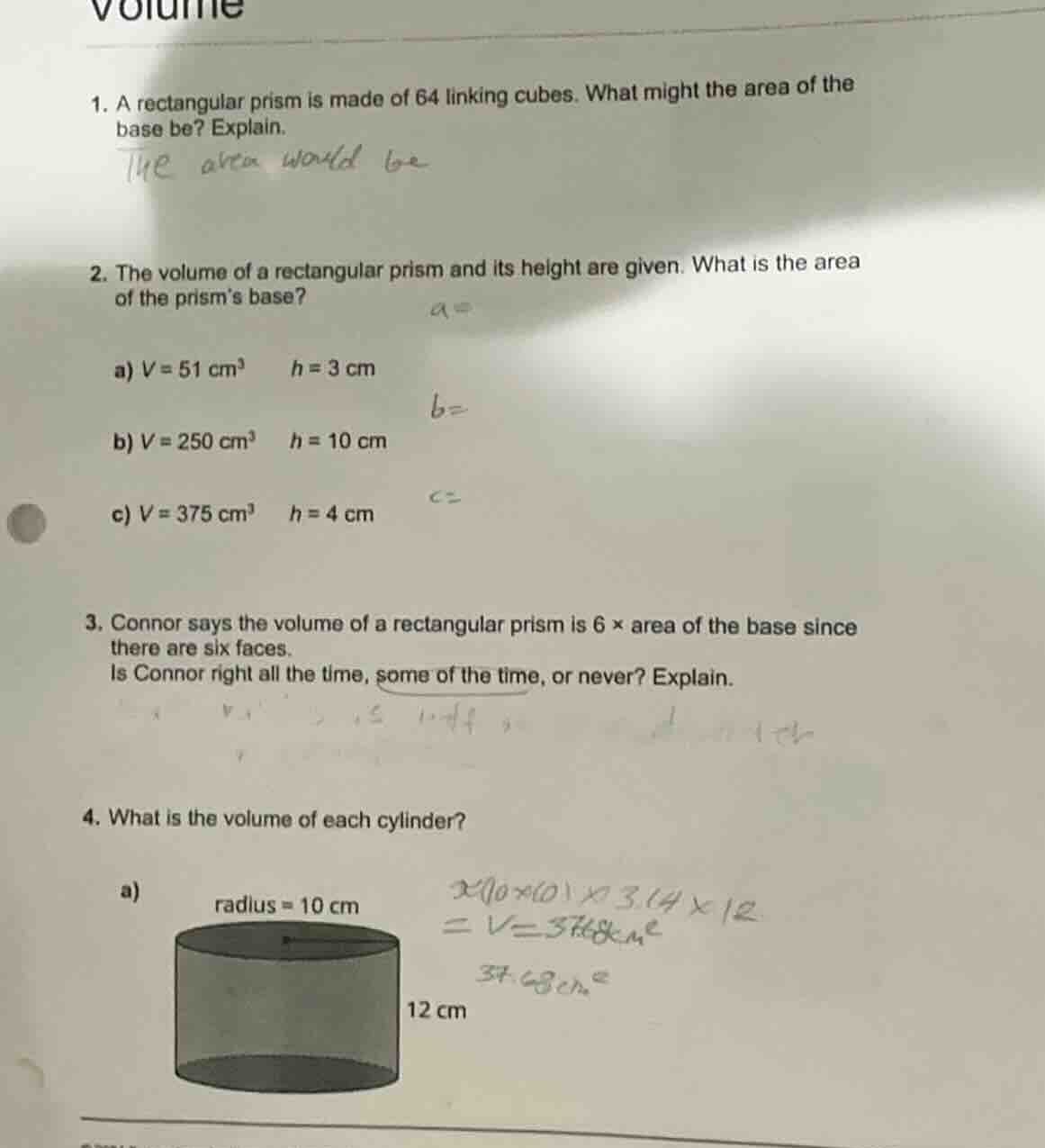
- a rectangular prism is made of 64 linking cubes. what might the area of the base be? explain.
the area would be
- the volume of a rectangular prism and its height are given. what is the area of the prisms base?
a)
v = 51 cm³ h = 3 cm
b)
v = 250 cm³ h = 10 cm
c)
v = 375 cm³ h = 4 cm
- connor says the volume of a rectangular prism is 6 × area of the base since there are six faces.
is connor right all the time, some of the time, or never? explain.
- what is the volume of each cylinder?
a) radius = 10 cm
12 cm
Step1: Recall volume formula for prism
The volume of a rectangular prism is $V = B \times h$, where $B$ is the base area, $h$ is height. Rearranged, $B = \frac{V}{h}$.
---
Problem 1
Step1: Relate cubes to volume
Each cube = 1 unit³, so $V=64$.
Step2: Find possible base areas
Base area $B = \frac{64}{h}$, where $h$ is a positive integer divisor of 64. Possible $h$ values: 1,2,4,8,16,32,64.
Corresponding $B$: $\frac{64}{1}=64$, $\frac{64}{2}=32$, $\frac{64}{4}=16$, $\frac{64}{8}=8$, $\frac{64}{16}=4$, $\frac{64}{32}=2$, $\frac{64}{64}=1$.
---
Problem 2a
Step1: Apply base area formula
$B = \frac{V}{h}$
Step2: Substitute values
$B = \frac{51}{3}$
Step3: Calculate result
$B=17$
---
Problem 2b
Step1: Apply base area formula
$B = \frac{V}{h}$
Step2: Substitute values
$B = \frac{250}{10}$
Step3: Calculate result
$B=25$
---
Problem 2c
Step1: Apply base area formula
$B = \frac{V}{h}$
Step2: Substitute values
$B = \frac{375}{4}$
Step3: Calculate result
$B=93.75$
---
Problem 3
Step1: Recall prism volume formula
Volume $V = B \times h$, not related to face count.
Step2: Analyze Connor's claim
Connor confuses volume with surface area. Volume depends on base area and height, not number of faces.
---
Problem 4a
Step1: Recall cylinder volume formula
$V = \pi r^2 h$, use $\pi=3.14$
Step2: Substitute values
$V = 3.14 \times 10^2 \times 12$
Step3: Calculate step-by-step
$10^2=100$; $3.14 \times 100=314$; $314 \times 12=3768$

Snap & solve any problem in the app
Get step-by-step solutions on Sovi AI
Photo-based solutions with guided steps
Explore more problems and detailed explanations
- Possible base areas are $1\ \text{unit}^2$, $2\ \text{unit}^2$, $4\ \text{unit}^2$, $8\ \text{unit}^2$, $16\ \text{unit}^2$, $32\ \text{unit}^2$, $64\ \text{unit}^2$. These come from dividing the total volume (64 cubic units) by any positive integer height that divides 64 evenly.
- a) $17\ \text{cm}^2$
b) $25\ \text{cm}^2$
c) $93.75\ \text{cm}^2$
- Never. The volume of a rectangular prism is equal to the area of the base multiplied by the height, not 6 times the base area. The number of faces (6) is related to surface area, not volume.
- a) $3768\ \text{cm}^3$