QUESTION IMAGE
Question
warm up 36
identify the x-intercepts,
y-intercepts, vertex,
maximum/minimum, axis
of symmetry.
Step1: Identify x - intercepts
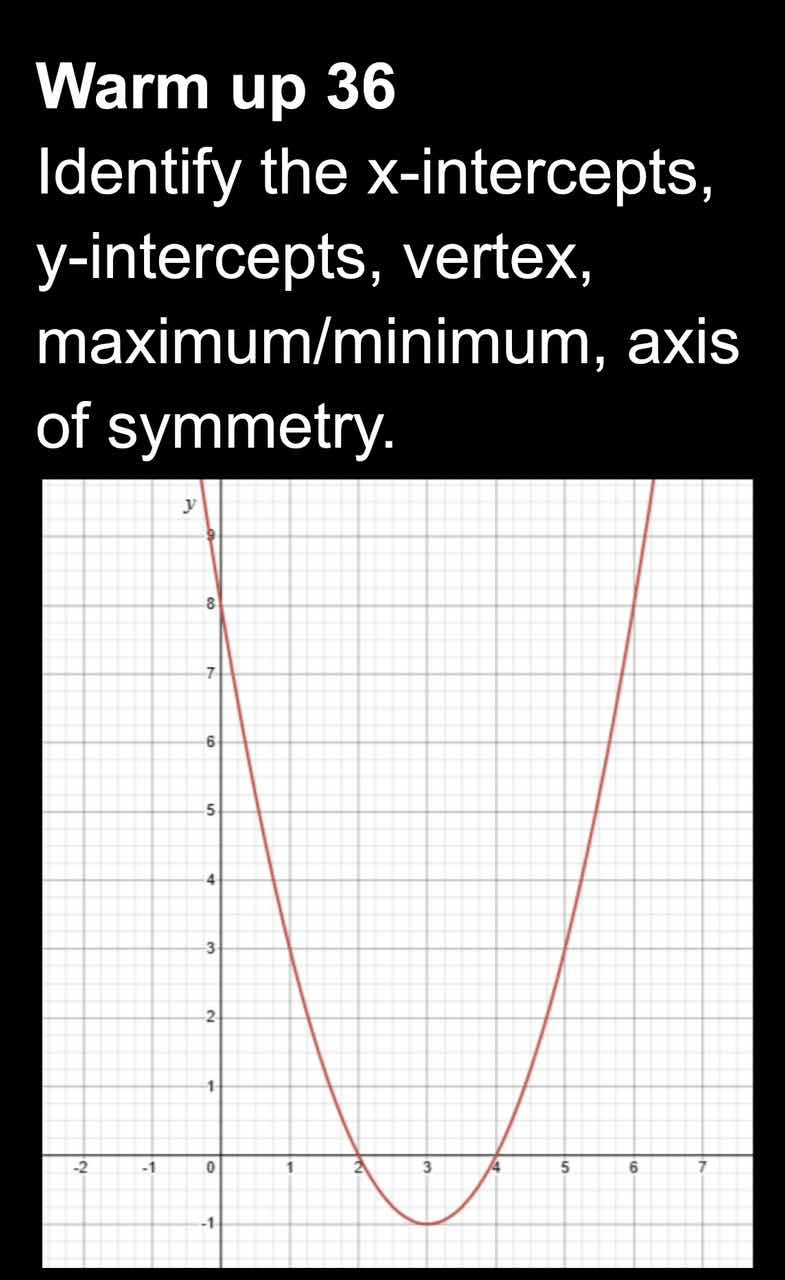
The x - intercepts are the points where the graph intersects the x - axis (where \(y = 0\)). From the graph, we can see that the parabola intersects the x - axis at \(x = 2\) and \(x=4\). So the x - intercepts are \((2,0)\) and \((4,0)\).
Step2: Identify y - intercept
The y - intercept is the point where the graph intersects the y - axis (where \(x = 0\)). From the graph, when \(x = 0\), \(y=8\). So the y - intercept is \((0,8)\).
Step3: Identify vertex
The vertex of a parabola is the lowest (for upward - opening parabola) or highest (for downward - opening parabola) point. The parabola opens upward (since it has a minimum value), and the vertex is at the point where the axis of symmetry intersects the parabola. The x - coordinate of the vertex is the mid - point of the x - intercepts. The mid - point of \(x = 2\) and \(x = 4\) is \(\frac{2 + 4}{2}=\frac{6}{2}=3\). From the graph, the y - coordinate of the vertex is \(- 1\). So the vertex is \((3,-1)\).
Step4: Identify maximum/minimum
Since the parabola opens upward (the coefficient of \(x^{2}\) is positive, as the graph opens upwards), the parabola has a minimum value. The minimum value is the y - coordinate of the vertex, which is \(-1\).
Step5: Identify axis of symmetry
The axis of symmetry of a parabola is a vertical line that passes through the vertex. For a parabola with x - intercepts \(x_1\) and \(x_2\), the axis of symmetry is given by \(x=\frac{x_1 + x_2}{2}\). Here, \(x_1 = 2\) and \(x_2=4\), so \(x=\frac{2 + 4}{2}=3\). So the axis of symmetry is the line \(x = 3\).

Snap & solve any problem in the app
Get step-by-step solutions on Sovi AI
Photo-based solutions with guided steps
Explore more problems and detailed explanations
- x - intercepts: \((2,0)\), \((4,0)\)
- y - intercept: \((0,8)\)
- vertex: \((3,-1)\)
- minimum value: \(-1\) (no maximum value as the parabola opens upward)
- axis of symmetry: \(x = 3\)