QUESTION IMAGE
Question
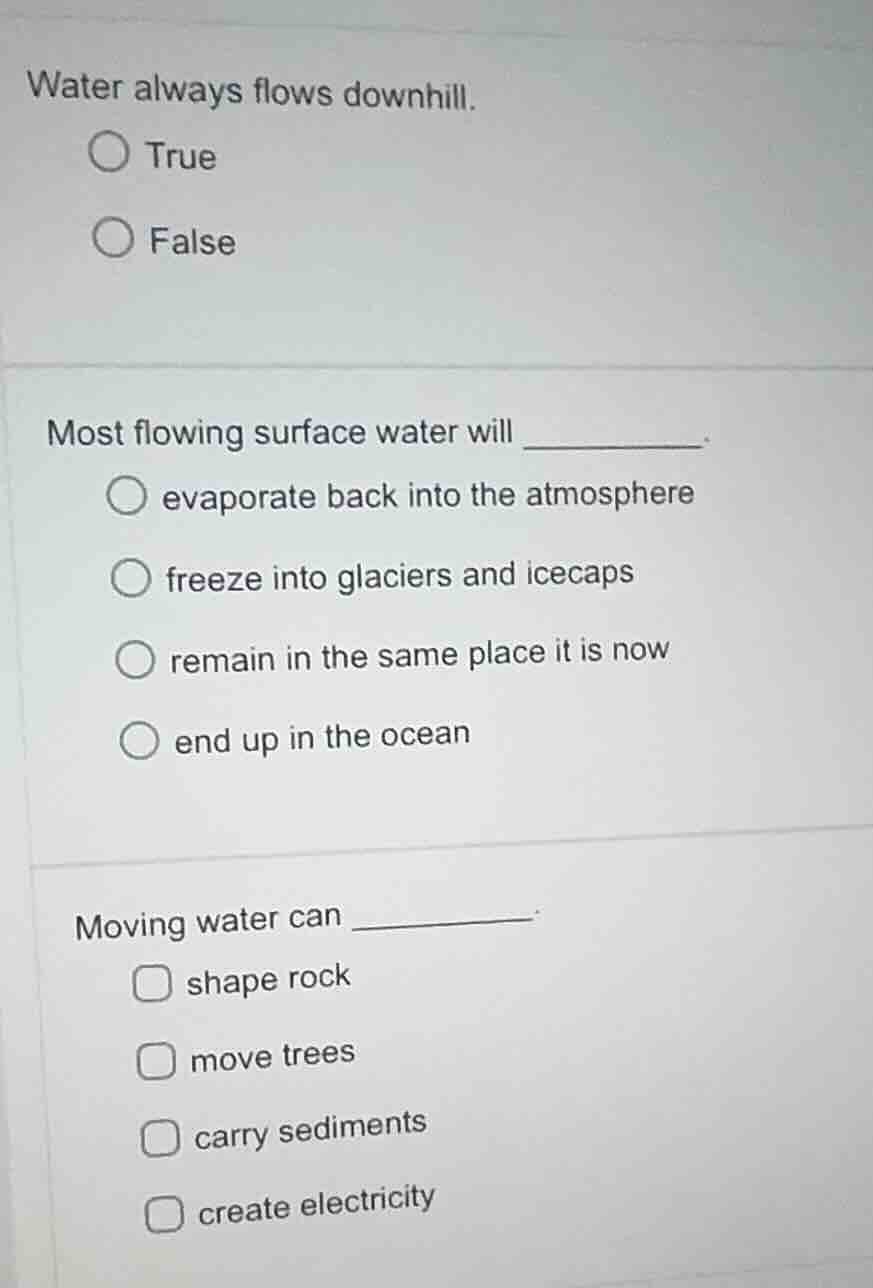
water always flows downhill.
true
false
most flowing surface water will ______.
evaporate back into the atmosphere
freeze into glaciers and icecaps
remain in the same place it is now
end up in the ocean
moving water can ______.
shape rock
move trees
carry sediments
create electricity
First Question:
In general, due to gravity, water flows from higher elevations (uphill) to lower elevations (downhill) in natural surface flow situations. There can be exceptions like in artificial systems with pumps, but the statement "Water always flows downhill" is considered true in the context of natural surface water flow driven by gravity.
Most flowing surface water (like rivers, streams) is part of the water cycle and the drainage system. Rivers and streams flow towards larger bodies of water, and ultimately, most surface water that flows will end up in the ocean (through river systems, etc.). Evaporation is a process but not the final destination for most flowing surface water; freezing into glaciers is for specific cold regions and not most flowing surface water; and water in rivers/streams is moving, not remaining in the same place.
- shape rock: Moving water (like in rivers, streams) can erode, transport, and deposit materials, which shapes rocks (e.g., through processes like abrasion, erosion).
- move trees: Strong flowing water (like in floods) can uproot and move trees.
- carry sediments: Moving water has the ability to transport sediments (soil, sand, etc.) as part of erosion and deposition processes.
- create electricity: Moving water (like in hydroelectric power plants) can be used to turn turbines to generate electricity (hydroelectricity).
So all these options are correct as moving water can perform all these actions.

Snap & solve any problem in the app
Get step-by-step solutions on Sovi AI
Photo-based solutions with guided steps
Explore more problems and detailed explanations
True