QUESTION IMAGE
Question
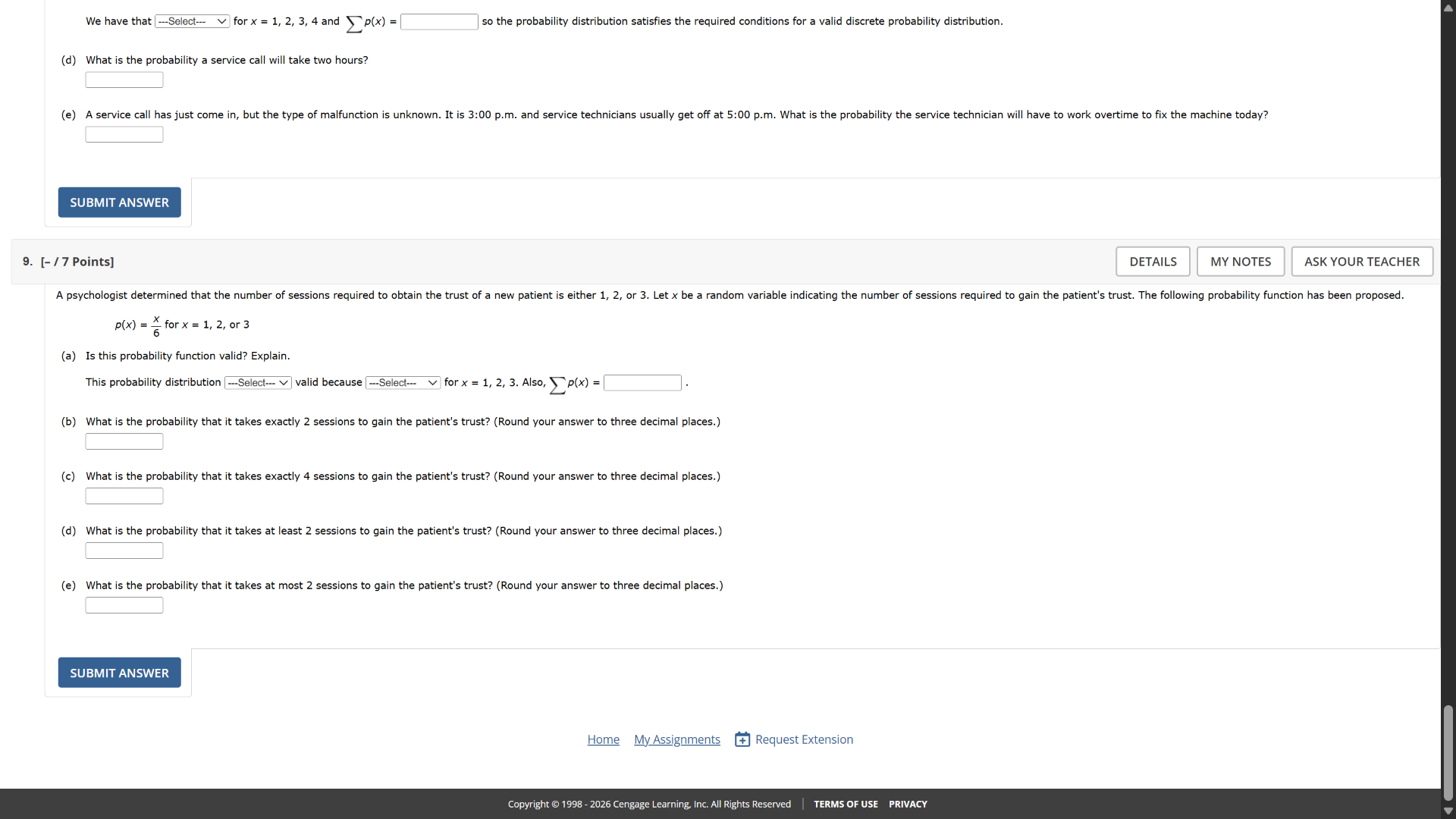
we have that ---select--- for ( x = 1, 2, 3, 4 ) and ( sum p(x) = ) so the probability distribution satisfies the required conditions for a valid discrete probability distribution.
(d) what is the probability a service call will take two hours?
(e) a service call has just come in, but the type of malfunction is unknown. it is 3:00 p.m. and service technicians usually get off at 5:00 p.m. what is the probability the service technician will have to work overtime to fix the machine today?
- - / 7 points
a psychologist determined that the number of sessions required to obtain the trust of a new patient is either 1, 2, or 3. let ( x ) be a random variable indicating the number of sessions required to gain the patients trust. the following probability function has been proposed.
( p(x) = \frac{x}{6} ) for ( x = 1, 2, ) or 3
(a) is this probability function valid? explain.
this probability distribution ---select--- valid because ---select--- for ( x = 1, 2, 3 ). also, ( sum p(x) = ).
(b) what is the probability that it takes exactly 2 sessions to gain the patients trust? (round your answer to three decimal places.)
(c) what is the probability that it takes exactly 4 sessions to gain the patients trust? (round your answer to three decimal places.)
(d) what is the probability that it takes at least 2 sessions to gain the patients trust? (round your answer to three decimal places.)
(e) what is the probability that it takes at most 2 sessions to gain the patients trust? (round your answer to three decimal places.)
Part (a)
Step1: Check non - negativity
For a discrete probability distribution, the probability mass function \(p(x)\) must satisfy \(p(x)\geq0\) for all \(x\) in the sample space. Given \(p(x)=\frac{x}{6}\) and \(x = 1,2,3\).
When \(x = 1\), \(p(1)=\frac{1}{6}\approx0.167>0\); when \(x = 2\), \(p(2)=\frac{2}{6}=\frac{1}{3}\approx0.333>0\); when \(x = 3\), \(p(3)=\frac{3}{6}=\frac{1}{2}=0.5>0\). So \(p(x)\geq0\) for \(x = 1,2,3\).
Step2: Check sum to 1
We calculate \(\sum_{x = 1}^{3}p(x)=p(1)+p(2)+p(3)\).
Substitute \(p(1)=\frac{1}{6}\), \(p(2)=\frac{2}{6}\), \(p(3)=\frac{3}{6}\) into the sum:
\(\sum_{x = 1}^{3}p(x)=\frac{1 + 2+3}{6}=\frac{6}{6}=1\)
Since \(p(x)\geq0\) for all \(x\) in the sample space and \(\sum_{x}p(x) = 1\), the probability distribution is valid.
We need to find \(p(2)\) where \(p(x)=\frac{x}{6}\) and \(x = 2\).
Substitute \(x = 2\) into the formula \(p(x)=\frac{x}{6}\), we get \(p(2)=\frac{2}{6}=\frac{1}{3}\approx0.333\)
The sample space for the number of sessions \(x\) is \(\{1,2,3\}\). So \(x = 4\) is not in the sample space.
For a discrete probability distribution, if \(x\) is not in the sample space, \(p(x)=0\)

Snap & solve any problem in the app
Get step-by-step solutions on Sovi AI
Photo-based solutions with guided steps
Explore more problems and detailed explanations
This probability distribution is valid because \(p(x)\geq0\) for \(x = 1,2,3\). Also, \(\sum p(x)=\boldsymbol{1}\).