QUESTION IMAGE
Question
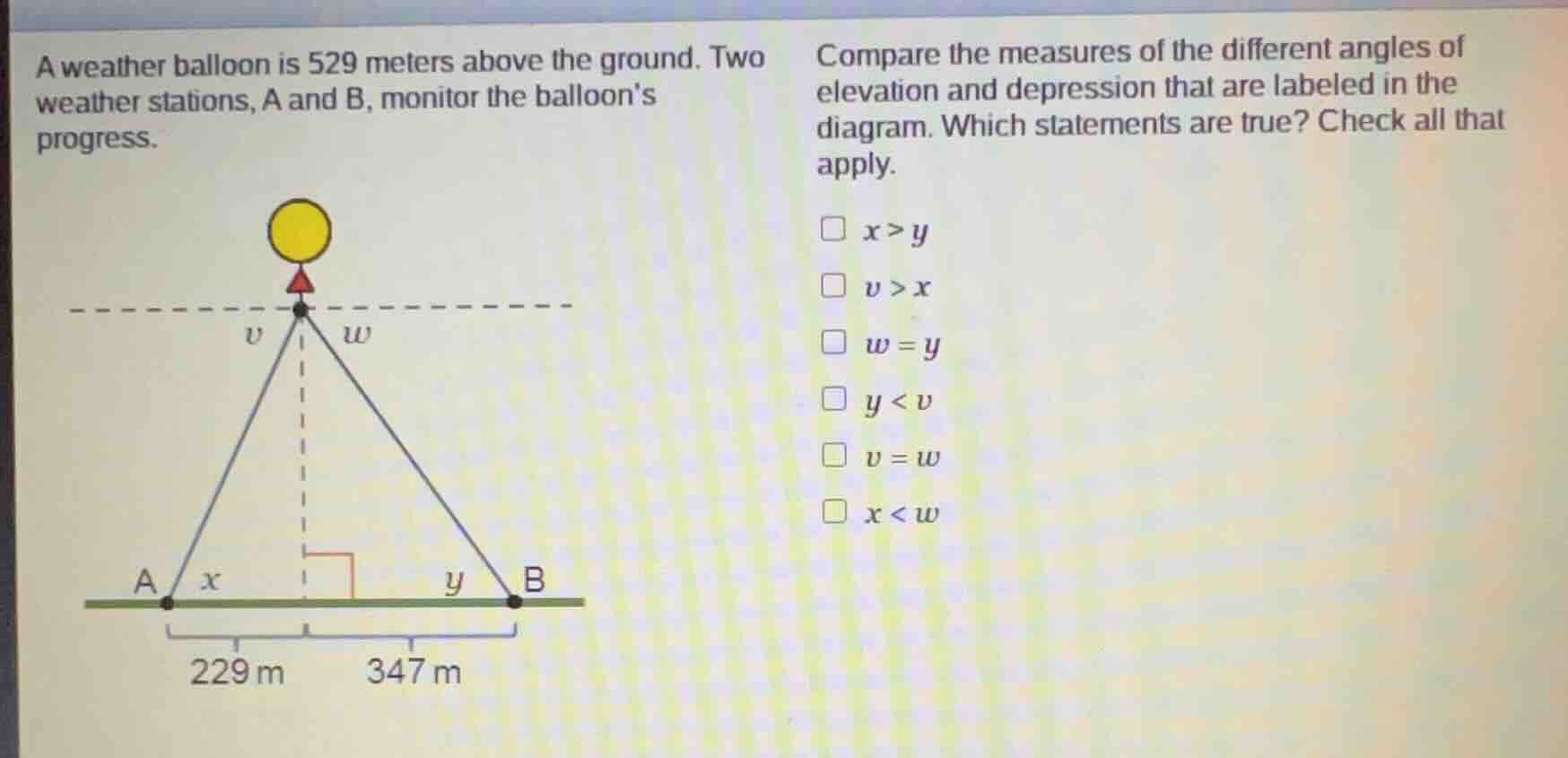
a weather balloon is 529 meters above the ground. two weather stations, a and b, monitor the balloon’s progress.
compare the measures of the different angles of elevation and depression that are labeled in the diagram. which statements are true? check all that apply.
□ $x > y$
□ $v > x$
□ $w = y$
□ $y < v$
□ $v = w$
□ $x < w$
Step1: Analyze tangent of angles
For angle \( x \) (at station A), \(\tan x=\frac{529}{229}\approx2.31\). For angle \( y \) (at station B), \(\tan y = \frac{529}{347}\approx1.52\). Since tangent is increasing in \( (0, \frac{\pi}{2}) \), \( x>y \) (so first statement is true).
Step2: Analyze alternate interior angles
\( v \) and \( x \): \( v \) is equal to the angle of elevation from A, but wait, actually, \( v \) and \( x \): since the horizontal line and the ground are parallel, \( v = x \) (alternate interior angles)? Wait no, wait the vertical line. Wait, \( w \) and \( y \): alternate interior angles, so \( w = y \) (third statement: \( w = y \) is true).
Step3: Compare \( v \) and \( x \)
Wait, \( v \) and \( x \): actually, \( v \) is the angle at the balloon between the horizontal and the line to A. Since \( \tan x=\frac{529}{229} \), and \( \tan v=\frac{229}{529}\approx0.43 \), so \( v < x \), so \( v>x \) is false.
Step4: Compare \( y \) and \( v \)
\( \tan y=\frac{529}{347}\approx1.52 \), \( \tan v=\frac{229}{529}\approx0.43 \), so \( y > v \)? Wait no, wait angle \( y \) is at B, angle \( v \) is at balloon. Wait, \( w = y \) (alternate interior), and \( v \) and \( w \): since the adjacent sides: the horizontal distance to A is 229, to B is 347. So the triangle with angle \( v \) has opposite side 229, angle \( w \) has opposite side 347. So \( \tan v=\frac{229}{529} \), \( \tan w=\frac{347}{529} \). Since \( 229 < 347 \), \( \tan v < \tan w \), so \( v < w \). But \( w = y \), so \( v < y \)? Wait no, the first statement \( x>y \) is true (since \( \tan x > \tan y \)). \( w = y \) (alternate interior angles, so third statement true). \( x < w \)? Wait \( \tan x\approx2.31 \), \( \tan w=\tan y\approx1.52 \)? No, wait \( w \) is equal to \( y \) (alternate interior), and \( x>y \), so \( x > w \), so \( x < w \) is false. \( v = w \)? No, \( \tan v=\frac{229}{529} \), \( \tan w=\frac{347}{529} \), so \( v
eq w \), so \( v = w \) is false. \( y < v \)? No, \( y > v \) (since \( w = y \) and \( v < w \)). Wait, let's re - check:
Wait, angle \( x \): elevation from A, \( \tan x=\frac{529}{229} \approx 2.31\), so \( x=\arctan(2.31)\approx66.7^\circ\).
Angle \( y \): elevation from B, \( \tan y=\frac{529}{347}\approx1.52\), so \( y=\arctan(1.52)\approx56.6^\circ\). So \( x > y \) (true).
Angle \( v \): depression angle from balloon to A, which is equal to elevation angle \( x \)? Wait no, depression angle \( v \) and elevation angle \( x \): alternate interior angles, so \( v = x \)? Wait no, the horizontal line at balloon, and the ground. So the angle of depression \( v \) is equal to angle of elevation \( x \) (alternate interior angles). Wait, that's a key point! So \( v = x \), and \( w = y \) (alternate interior angles, since horizontal line and ground are parallel, the transversal is the line from balloon to B, so \( w = y \)).
So \( v = x \), \( w = y \). Since \( x>y \), then \( v > w \) (because \( v = x \), \( w = y \), \( x>y \)). Wait, earlier mistake: \( v = x \) (alternate interior angles: horizontal line and ground, transversal is line from balloon to A), so \( v = x \). Similarly, \( w = y \). So:
- \( x>y \): true (since \( \tan x > \tan y \)).
- \( v > x \): false (since \( v = x \)).
- \( w = y \): true (alternate interior angles).
- \( y < v \): since \( v = x \) and \( x>y \), so \( y < v \) is true? Wait \( v = x \), \( x>y \), so \( y < v \) (true). Wait, earlier calculation of \( \tan v \) was wrong. Wait \( v \) is equal to \( x \), because alternate interior angles. So \( v = x \),…

Snap & solve any problem in the app
Get step-by-step solutions on Sovi AI
Photo-based solutions with guided steps
Explore more problems and detailed explanations
The true statements are \( \boldsymbol{x>y} \), \( \boldsymbol{w = y} \), \( \boldsymbol{y < v} \) (i.e., the options with \( x>y \), \( w = y \), \( y < v \) are checked).