QUESTION IMAGE
Question
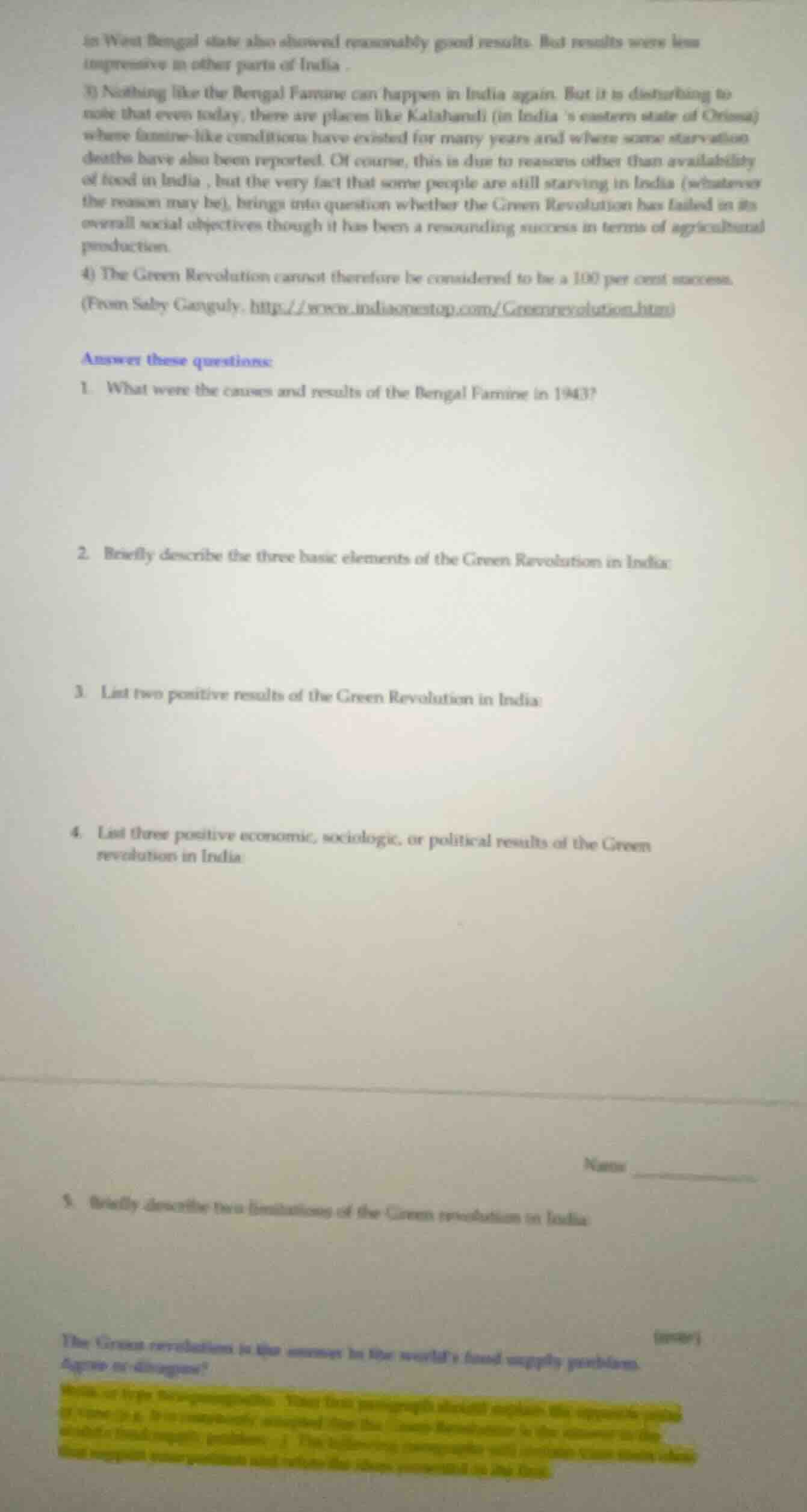
in west bengal state also showed reasonably good results. but results were less impressive in other parts of india .
- nothing like the bengal famine can happen in india again. but it is disturbing to note that even today, there are places like kalahandi (in india s eastern state of orissa) where famine-like conditions have existed for many years and where some starvation deaths have also been reported. of course, this is due to reasons other than availability of food in india , but the very fact that some people are still starving in india (whatever the reason may be), brings into question whether the green revolution has failed in its overall social objectives though it has been a resounding success in terms of agricultural production.
- the green revolution cannot therefore be considered to be a 100 per cent success.
(from saby ganguly. http://www.indiaonestop.com/greenrevolution.html)
answer these questions:
- what were the causes and results of the bengal famine in 1943?
- briefly describe the three basic elements of the green revolution in india
- list two positive results of the green revolution in india
- list three positive economic, sociologic, or political results of the green revolution in india
- briefly describe two limitations of the green revolution in india
the green revolution is the answer to the worlds food supply problem. agree or disagree?
yellow highlighted text is partially illegible and omitted
Brief Explanations
- For Q1: The 1943 Bengal Famine was caused by a combination of British colonial policies (like diverting rice for the war effort, hoarding by traders, and prioritizing military needs over civilian food supply), natural disasters (cyclones and floods that damaged crops), and a collapse in the rice supply chain. The results were an estimated 1-3 million deaths from starvation, disease, and malnutrition; widespread displacement; and long-term public health and economic devastation in the region.
- For Q2: The three core elements of India's Green Revolution are: 1) Adoption of high-yielding variety (HYV) seeds, primarily for wheat and rice; 2) Increased use of chemical fertilizers, pesticides, and irrigation to support HYV crops; 3) Expansion of credit and agricultural infrastructure to support small and large farmers in adopting these new practices.
- For Q3: Two positive results are: 1) A massive increase in India's food grain production, making the country self-sufficient in food and ending large-scale famine risks; 2) Higher incomes for farmers who adopted the new agricultural techniques, reducing rural poverty in some regions.
- For Q4: Three positive cross-sector results are: 1) Economic: Reduced India's dependence on food imports, saving foreign exchange reserves; 2) Sociologic: Created more rural employment opportunities through expanded agricultural activities and related industries; 3) Political: Strengthened India's food security, enhancing its political stability and global standing.
- For Q5: Two limitations are: 1) It was geographically uneven, with most success limited to fertile, well-irrigated regions (like Punjab, Haryana) while dry, rain-fed areas saw little benefit; 2) It widened the gap between large, resource-rich farmers and small, marginal farmers who could not afford HYV seeds, fertilizers, or irrigation.
- For the final essay question: (Agree perspective) The Green Revolution is a critical answer to global food supply issues because it demonstrated that targeted agricultural innovation can drastically boost crop yields, enabling countries to feed growing populations. It prevented large-scale famines in many developing nations, provided a model for agricultural modernization, and laid the groundwork for current sustainable intensification efforts. While it has drawbacks (like environmental harm and inequality), its role in averting widespread hunger makes it a vital solution.

Snap & solve any problem in the app
Get step-by-step solutions on Sovi AI
Photo-based solutions with guided steps
Explore more problems and detailed explanations
- Causes: British colonial war-time policies (rice diversion, hoarding), crop-damaging cyclones/floods, broken supply chains. Results: 1-3 million deaths, mass displacement, long-term regional economic/health collapse.
- 1. High-yielding variety (HYV) seeds for wheat/rice; 2. Expanded chemical inputs (fertilizers, pesticides) and irrigation; 3. Agricultural credit and infrastructure support.
- 1. India achieved national food grain self-sufficiency; 2. Increased farm incomes for participating farmers.
- 1. Economic: Reduced food import dependence, saved foreign exchange; 2. Sociologic: Created rural agricultural and allied sector jobs; 3. Political: Strengthened national food security and political stability.
- 1. Geographically uneven success (limited to irrigated, fertile regions); 2. Widened wealth gaps between large and small farmers.
- (Agree) The Green Revolution is a key answer to global food supply problems. It proved agricultural innovation can drastically raise yields, preventing large-scale famines in developing nations and creating a scalable model for feeding growing populations. While it has environmental and equity limitations, its critical role in reducing global hunger makes it a vital solution.