QUESTION IMAGE
Question
wh3 sequence 2.4 assessment #2 (mc) 25 - 26, q07
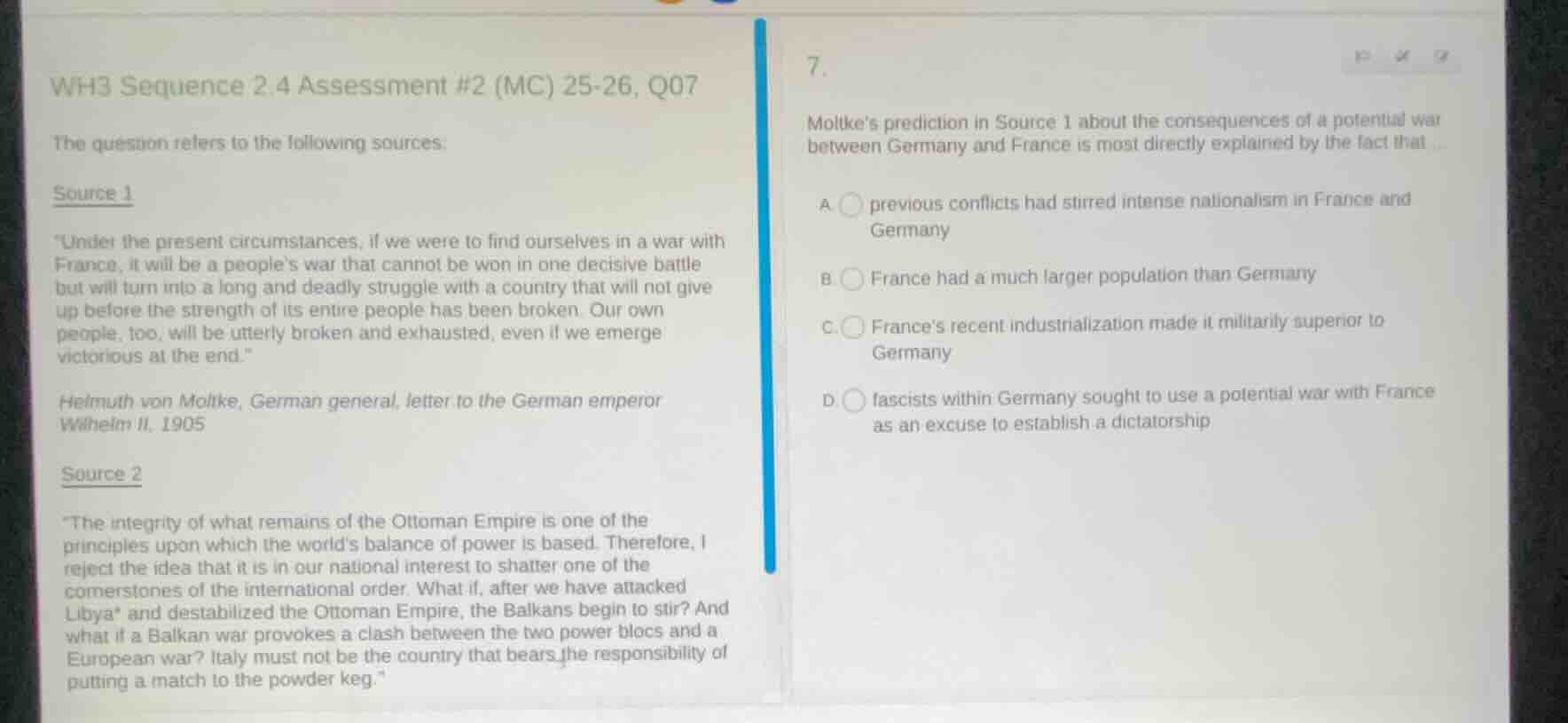
the question refers to the following sources.
source 1
\under the present circumstances, if we were to find ourselves in a war with france, it will be a peoples war that cannot be won in one decisive battle but will turn into a long and deadly struggle with a country that will not give up before the strength of its entire people has been broken. our own people, too, will be utterly broken and exhausted, even if we emerge victorious at the end.\
helmuth von moltke, german general, letter to the german emperor wilhelm ii, 1905
source 2
\the integrity of what remains of the ottoman empire is one of the principles upon which the worlds balance of power is based. therefore, i reject the idea that it is in our national interest to shatter one of the cornerstones of the international order. what if, after we have attacked libya* and destabilized the ottoman empire, the balkans begin to stir? and what if a balkan war provokes a clash between the two power blocs and a european war? italy must not be the country that bears the responsibility of putting a match to the powder keg.\
7.
moltkes prediction in source 1 about the consequences of a potential war between germany and france is most directly explained by the fact that...
a previous conflicts had stirred intense nationalism in france and germany
b france had a much larger population than germany
c frances recent industrialization made it militarily superior to germany
d fascists within germany sought to use a potential war with france as an excuse to establish a dictatorship
To solve this, we analyze each option:
- Option A: Previous conflicts (like the Franco - Prussian War) had stirred intense nationalism in both France and Germany. This would mean that a war between them would be a "people's war" as Moltke predicted, with both nations willing to fight to the limit of their people's strength.
- Option B: France did not have a much larger population than Germany in this period, so this is incorrect.
- Option C: France was not militarily superior to Germany at this time; in fact, Germany had a strong military, so this is wrong.
- Option D: Fascism was not a factor in 1905 (fascism rose later), so this is incorrect.

Snap & solve any problem in the app
Get step-by-step solutions on Sovi AI
Photo-based solutions with guided steps
Explore more problems and detailed explanations
A. previous conflicts had stirred intense nationalism in France and Germany