QUESTION IMAGE
Question
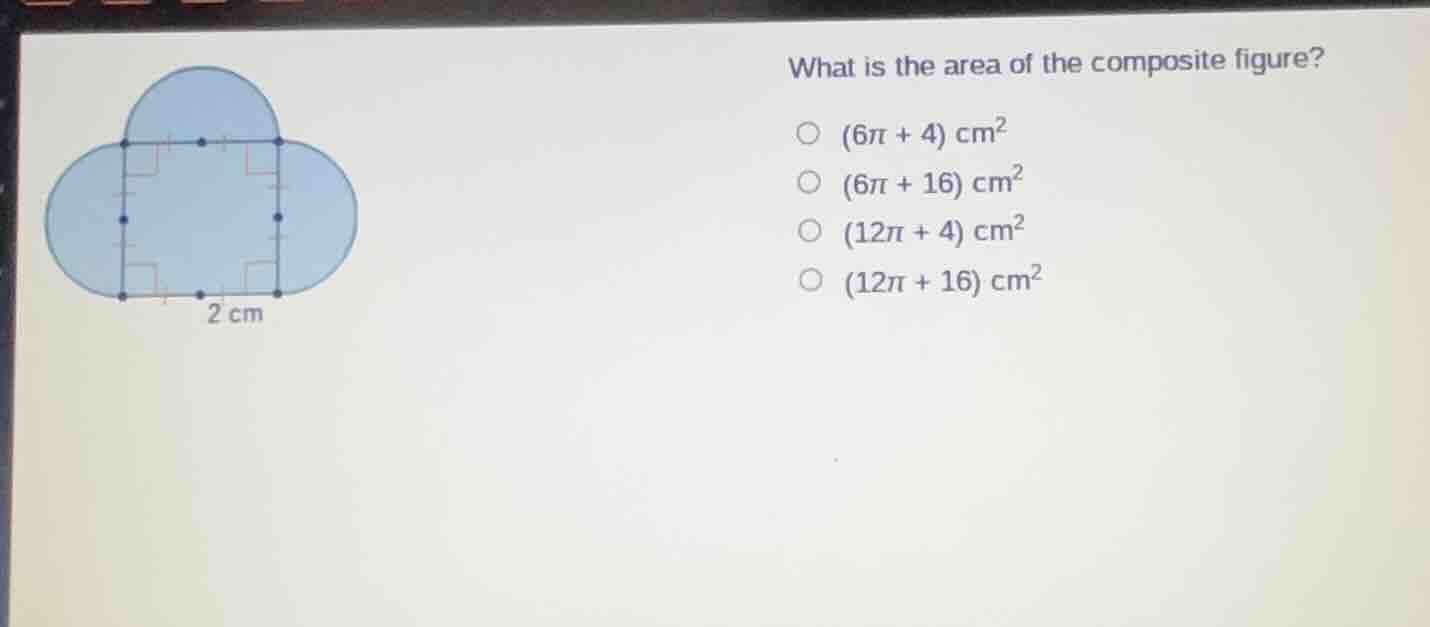
what is the area of the composite figure?
(6π + 4) cm²
(6π + 16) cm²
(12π + 4) cm²
(12π + 16) cm²
2 cm
Step1: Analyze the composite figure
The composite figure consists of a square and three semicircles (which can be combined to form 1.5 circles, or equivalently, three semicircles make 1.5 full circles, but looking at the diagram, there are three semicircles: top, left, right. Wait, actually, each side of the square has a semicircle. Wait, the square has side length? Wait, the distance between two points is 2 cm, so the side length of the square is 4 cm? Wait, no, looking at the diagram, the square has sides with segments of 2 cm? Wait, no, let's re-examine. The square: each side has a semicircle. The radius of each semicircle is 2 cm? Wait, no, the distance between the dots is 2 cm, so the side length of the square is 4 cm? Wait, no, the square has four sides, each with a semicircle. Wait, actually, the three semicircles: top, left, right. Wait, no, the figure has a square in the middle, and three semicircles: top, left, right. Wait, no, maybe the square has side length 4 cm? Wait, no, the given length is 2 cm. Wait, let's look at the options. The options have \(12\pi\) or \(6\pi\), so let's calculate the area of the circular parts and the square.
First, the square: from the diagram, the square has side length 4 cm? Wait, no, the distance between two adjacent dots on the square is 2 cm? Wait, no, the bottom side of the square has a length of 4 cm? Wait, no, the diagram shows a square with side length 4 cm? Wait, no, let's check the radius of the semicircles. The radius \(r = 2\) cm? Wait, no, the length given is 2 cm, which is the diameter? Wait, no, the distance between two points is 2 cm, so the radius \(r = 2\) cm? Wait, no, if the diameter is 4 cm, radius is 2 cm. Wait, maybe the square has side length 4 cm, and each semicircle has radius 2 cm.
Wait, the composite figure: square + three semicircles. Wait, three semicircles: top, left, right. Each semicircle has radius \(r = 2\) cm. The area of a semicircle is \(\frac{1}{2}\pi r^2\). So three semicircles: \(3 \times \frac{1}{2}\pi r^2 = \frac{3}{2}\pi r^2\). Wait, but if \(r = 2\), then \(\frac{3}{2}\pi (2)^2 = \frac{3}{2}\pi \times 4 = 6\pi\)? No, that's not right. Wait, maybe there are two full circles and one semicircle? Wait, no, let's count the number of semicircles. The top is a semicircle, left is a semicircle, right is a semicircle. Wait, no, actually, the three semicircles can be combined into 1.5 circles. Wait, no, maybe the figure has a square and three semicircles, but actually, the three semicircles make 1.5 circles, but let's check the area.
Wait, the square: side length 4 cm? Wait, no, the options have \(16\) or \(4\) for the square area. If the square has side length 4 cm, area is \(4 \times 4 = 16\) \(cm^2\). Now the circular parts: each semicircle has radius 2 cm (since the diameter is 4 cm? Wait, no, the distance between the dots is 2 cm, so the radius is 2 cm? Wait, no, the length given is 2 cm, which is the radius? No, that can't be. Wait, let's re-express.
Wait, the composite figure: the square has side length 4 cm (since from the diagram, the square has four sides, each with a semicircle, and the length between two points is 2 cm, so the side length of the square is 4 cm). The three semicircles: top, left, right. Each semicircle has radius \(r = 2\) cm. The area of one semicircle is \(\frac{1}{2}\pi r^2 = \frac{1}{2}\pi (2)^2 = 2\pi\). Three semicircles: \(3 \times 2\pi = 6\pi\)? No, that's not matching. Wait, maybe the figure has a square and two full circles and one semicircle? Wait, no, let's look at the options. The options have \(12\pi\) or \(6\p…

Snap & solve any problem in the app
Get step-by-step solutions on Sovi AI
Photo-based solutions with guided steps
Explore more problems and detailed explanations
\(\boxed{(6\pi + 16) \text{ cm}^2}\) (Option B: \((6\pi + 16) \text{ cm}^2\))