QUESTION IMAGE
Question
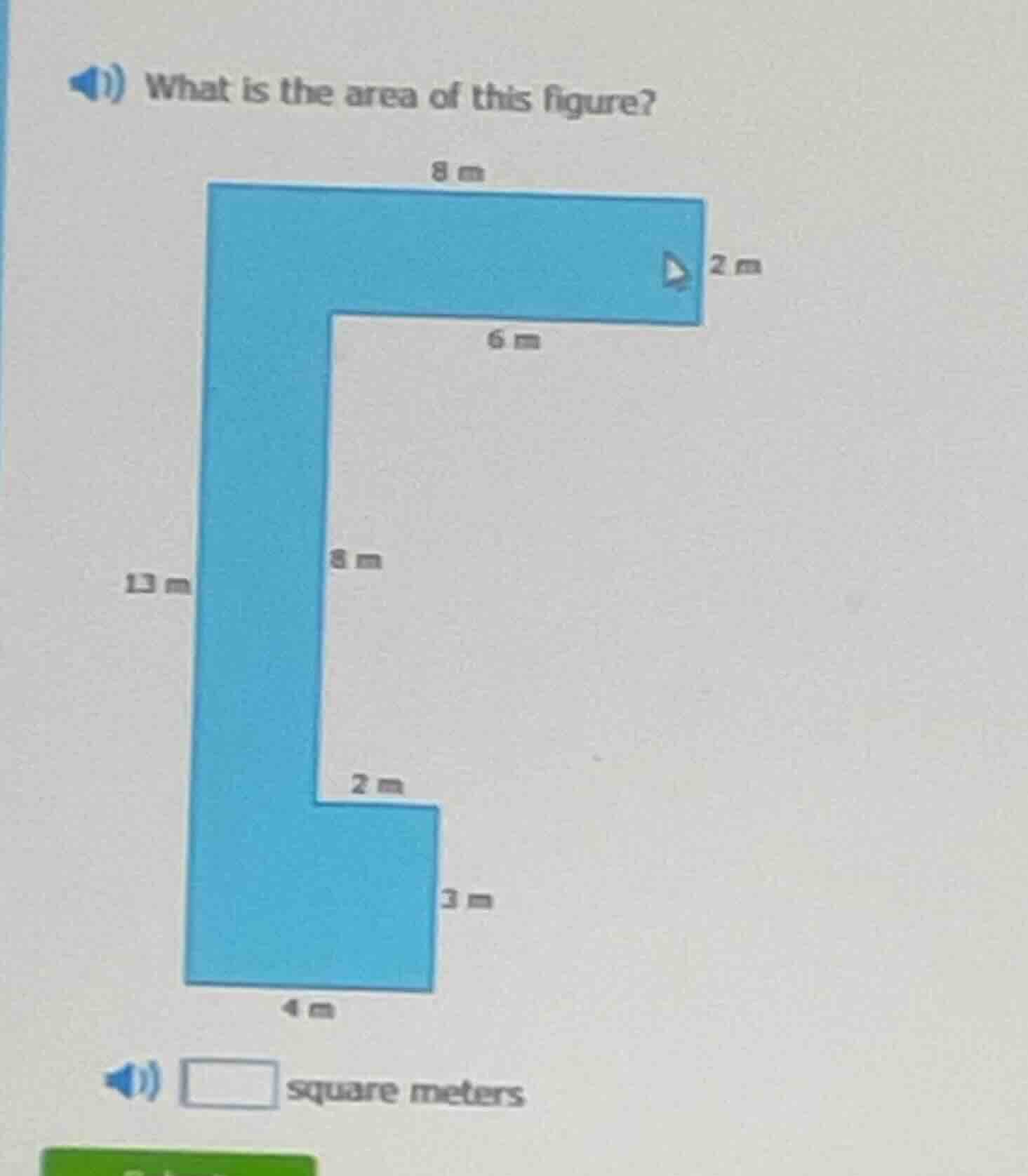
what is the area of this figure?
8 m
2 m
6 m
8 m
13 m
2 m
3 m
4 m
square meters
Step1: Divide the figure into three rectangles
We can split the blue figure into three rectangles: the top rectangle, the left - middle rectangle, and the bottom rectangle.
Step2: Calculate the area of the top rectangle
The top rectangle has a length of \(8\) m and a width of \(2\) m. The formula for the area of a rectangle is \(A = l\times w\) (where \(A\) is the area, \(l\) is the length, and \(w\) is the width). So the area of the top rectangle \(A_1=8\times2 = 16\) square meters.
Step3: Calculate the area of the left - middle rectangle
First, we need to find the dimensions of the left - middle rectangle. The height of the left - middle part: the total height is \(13\) m, the height of the top rectangle is \(2\) m, and the height of the bottom rectangle is \(3\) m. So the height of the left - middle rectangle \(h = 13-(2 + 3)=8\) m. The width of the left - middle rectangle: the total width of the bottom rectangle is \(4\) m, and the width of the indentation (the part that is not part of the left - middle rectangle in the horizontal direction) is \(2\) m? Wait, no. Wait, the width of the left - middle rectangle: the total length of the top rectangle is \(8\) m, and the length of the indentation (the horizontal part that is missing in the middle) is \(6\) m? Wait, maybe a better way: the left - middle rectangle has a width of \(4\) m (since the bottom rectangle has a width of \(4\) m and the left part is continuous) and a height of \(8\) m (as calculated above). Wait, no, let's re - examine.
Wait, the bottom rectangle: length \(4\) m, width \(3\) m, area \(A_3 = 4\times3=12\) square meters.
The left - middle rectangle: the height is \(13 - 2-3=8\) m, and the width is \(4\) m (because the bottom rectangle has a width of \(4\) m and the left part is of width \(4\) m). So the area of the left - middle rectangle \(A_2=(13 - 2 - 3)\times4=8\times4 = 32\) square meters. Wait, no, maybe I made a mistake in division.
Wait, another approach:
First rectangle (top): length \(8\) m, width \(2\) m, area \(8\times2 = 16\).
Second rectangle (left - vertical): the height is \(13\) m, and the width is \(4\) m? No, because there is an indentation. Wait, the horizontal length of the indentation is \(6\) m, and the total length of the top rectangle is \(8\) m, so the width of the left - vertical part (the part that is not part of the indentation) is \(8 - 6=2\) m? Wait, I think I messed up the division.
Let's try again. Let's divide the figure into three parts:
- Top rectangle: length \(8\) m, width \(2\) m, area \(A_1 = 8\times2=16\).
- Middle - left rectangle: the height is \(13 - 2 - 3 = 8\) m, and the width is \(4\) m (since the bottom rectangle has a width of \(4\) m and the left part is \(4\) m wide). Wait, no, the horizontal length of the indentation is \(6\) m, so the width of the middle - left rectangle (the vertical strip on the left) is \(8 - 6 = 2\) m? Wait, the total length of the top rectangle is \(8\) m, and the length of the indentation (the horizontal part that is empty in the middle) is \(6\) m, so the width of the left - vertical strip (the part that is not part of the indentation) is \(8 - 6=2\) m. Then the height of this left - vertical strip is \(13\) m? No, because the top rectangle is \(2\) m tall and the bottom rectangle is \(3\) m tall. Wait, I think my initial division was wrong.
Alternative method: Use the principle of adding and subtracting areas. The total area of a large rectangle (if there were no indentation) minus the area of the indentation.
The large rectangle would have a length of \(8\) m and…

Snap & solve any problem in the app
Get step-by-step solutions on Sovi AI
Photo-based solutions with guided steps
Explore more problems and detailed explanations
Step1: Divide the figure into three rectangles
We can split the blue figure into three rectangles: the top rectangle, the left - middle rectangle, and the bottom rectangle.
Step2: Calculate the area of the top rectangle
The top rectangle has a length of \(8\) m and a width of \(2\) m. The formula for the area of a rectangle is \(A = l\times w\) (where \(A\) is the area, \(l\) is the length, and \(w\) is the width). So the area of the top rectangle \(A_1=8\times2 = 16\) square meters.
Step3: Calculate the area of the left - middle rectangle
First, we need to find the dimensions of the left - middle rectangle. The height of the left - middle part: the total height is \(13\) m, the height of the top rectangle is \(2\) m, and the height of the bottom rectangle is \(3\) m. So the height of the left - middle rectangle \(h = 13-(2 + 3)=8\) m. The width of the left - middle rectangle: the total width of the bottom rectangle is \(4\) m, and the width of the indentation (the part that is not part of the left - middle rectangle in the horizontal direction) is \(2\) m? Wait, no. Wait, the width of the left - middle rectangle: the total length of the top rectangle is \(8\) m, and the length of the indentation (the horizontal part that is missing in the middle) is \(6\) m? Wait, maybe a better way: the left - middle rectangle has a width of \(4\) m (since the bottom rectangle has a width of \(4\) m and the left part is continuous) and a height of \(8\) m (as calculated above). Wait, no, let's re - examine.
Wait, the bottom rectangle: length \(4\) m, width \(3\) m, area \(A_3 = 4\times3=12\) square meters.
The left - middle rectangle: the height is \(13 - 2-3=8\) m, and the width is \(4\) m (because the bottom rectangle has a width of \(4\) m and the left part is of width \(4\) m). So the area of the left - middle rectangle \(A_2=(13 - 2 - 3)\times4=8\times4 = 32\) square meters. Wait, no, maybe I made a mistake in division.
Wait, another approach:
First rectangle (top): length \(8\) m, width \(2\) m, area \(8\times2 = 16\).
Second rectangle (left - vertical): the height is \(13\) m, and the width is \(4\) m? No, because there is an indentation. Wait, the horizontal length of the indentation is \(6\) m, and the total length of the top rectangle is \(8\) m, so the width of the left - vertical part (the part that is not part of the indentation) is \(8 - 6=2\) m? Wait, I think I messed up the division.
Let's try again. Let's divide the figure into three parts:
- Top rectangle: length \(8\) m, width \(2\) m, area \(A_1 = 8\times2=16\).
- Middle - left rectangle: the height is \(13 - 2 - 3 = 8\) m, and the width is \(4\) m (since the bottom rectangle has a width of \(4\) m and the left part is \(4\) m wide). Wait, no, the horizontal length of the indentation is \(6\) m, so the width of the middle - left rectangle (the vertical strip on the left) is \(8 - 6 = 2\) m? Wait, the total length of the top rectangle is \(8\) m, and the length of the indentation (the horizontal part that is empty in the middle) is \(6\) m, so the width of the left - vertical strip (the part that is not part of the indentation) is \(8 - 6=2\) m. Then the height of this left - vertical strip is \(13\) m? No, because the top rectangle is \(2\) m tall and the bottom rectangle is \(3\) m tall. Wait, I think my initial division was wrong.
Alternative method: Use the principle of adding and subtracting areas. The total area of a large rectangle (if there were no indentation) minus the area of the indentation.
The large rectangle would have a length of \(8\) m and a height of \(13\) m, area \(A_{large}=8\times13 = 104\) square meters.
The indentation: it is a rectangle with length \(6\) m and height \(8\) m (since the height of the indentation is \(13-(2 + 3)=8\) m). The area of the indentation \(A_{indent}=6\times8 = 48\) square meters. Wait, no, that can't be right.
Wait, let's look at the figure again. The figure has a top part (8m long, 2m wide), a bottom part (4m long, 3m wide), and a middle - left part.
Wait, the bottom part: length \(4\) m, width \(3\) m, area \(4\times3 = 12\).
The top part: length \(8\) m, width \(2\) m, area \(8\times2=16\).
The middle - left part: the height is \(13-(2 + 3)=8\) m, and the width is \(4 - 2=2\) m? No, the width of the middle - left part: the bottom part has a width of \(4\) m, and the top part has a width of \(8\) m. The horizontal difference between the top and bottom is \(8 - 4 = 4\) m? No, I'm getting confused.
Wait, let's use coordinates. Let's assume the bottom - left corner is at \((0,0)\).
- Bottom rectangle: from \((0,0)\) to \((4,3)\), area \(4\times3 = 12\).
- Middle - left rectangle: from \((0,3)\) to \((4,3 + 8)=(4,11)\), area \(4\times8 = 32\).
- Top rectangle: from \((4,11)\) to \((8,13)\), area \((8 - 4)\times(13 - 11)=4\times2 = 8\)? Wait, no, that's not right. Wait, the top rectangle is from \((0,11)\) to \((8,13)\), area \(8\times2 = 16\). But then the middle - left rectangle is from \((0,3)\) to \((4,11)\), area \(4\times8 = 32\), and the bottom rectangle is from \((0,0)\) to \((4,3)\), area \(12\). Then the total area is \(16+32 + 12=60\)? Wait, no, let's check the dimensions.
Wait, the height of the middle - left rectangle: from \(y = 3\) to \(y=11\), so the height is \(11 - 3 = 8\) m, width is \(4\) m, area \(4\times8 = 32\).
The top rectangle: from \(y = 11\) to \(y = 13\), height \(2\) m, length \(8\) m, area \(8\times2 = 16\).
The bottom rectangle: from \(y = 0\) to \(y = 3\), height \(3\) m, length \(4\) m, area \(4\times3 = 12\).
Now, sum them up: \(16+32 + 12=60\)? Wait, but let's check another way.
The total area can also be calculated as:
The left - most vertical strip: width \(4\) m, height \(13\) m, area \(4\times13 = 52\).
Then the top - right rectangle: length \(8 - 4=4\) m, height \(2\) m, area \(4\times2 = 8\).
Then the bottom - right rectangle: length \(4 - 2 = 2\) m? No, wait, the bottom has a width of \(4\) m, and the indentation in the bottom - right? No, the bottom rectangle is \(4\times3\), the middle - left is \(4\times8\), the top is \(8\times2\). Wait, \(4\times13=52\), \( (8 - 4)\times2=8\), and \( (4 - 2)\times3=6\)? No, this is getting too convoluted.
Wait, let's use the first method of dividing into three rectangles correctly:
- Top rectangle: length \(8\) m, width \(2\) m. Area \(A_1=8\times2 = 16\).
- Middle rectangle (the vertical part on the left, excluding the top and bottom): height \(13-(2 + 3)=8\) m, width \(4\) m. Area \(A_2=4\times8 = 32\).
- Bottom rectangle: length \(4\) m, width \(3\) m. Area \(A_3=4\times3 = 12\).
Now, sum the areas: \(A = A_1+A_2+A_3=16 + 32+12=60\) square meters.
Wait, let's verify with another approach. The area of the figure can be calculated as the area of the big rectangle (length \(8\) m, height \(13\) m) minus the area of the indentation (length \(6\) m, height \(8\) m). The area of the big rectangle is \(8\times13 = 104\) square meters. The indentation: length \(6\) m, height \(8\) m (because the height of the indentation is \(13-(2 + 3)=8\) m), area \(6\times8 = 48\) square meters. Then \(104-48 = 56\)? Wait, that's a contradiction. So my division is wrong.
Wait, let's look at the horizontal lengths. The top rectangle is \(8\) m long. The indentation (the horizontal part that is missing in the middle) has a length of \(6\) m. So the width of the left - vertical strip (the part that is not part of the indentation) is \(8 - 6 = 2\) m.
The height of the left - vertical strip: the total height is \(13\) m, the height of the top rectangle is \(2\) m, and the height of the bottom rectangle is \(3\) m. So the height of the left - vertical strip is \(13-(2 + 3)=8\) m. Area of left - vertical strip: \(2\times8 = 16\) square meters.
The top rectangle: length \(8\) m, width \(2\) m, area \(8\times2 = 16\) square meters.
The bottom rectangle: length \(4\) m, width \(3\) m, area \(4\times3 = 12\) square meters.
Wait, but then the total area would be \(16+16 + 12=44\)? No, that's not right.
Wait, I think the correct way is to divide the figure into three rectangles:
- Top rectangle: length \(8\) m, width \(2\) m. Area \(=8\times2 = 16\).
- Middle - left rectangle: length \(4\) m, height \(13 - 2 - 3=8\) m. Area \(=4\times8 = 32\).
- Bottom rectangle: length \(4\) m, width \(3\) m. Area \(=4\times3 = 12\).
Wait, but when we add them: \(16 + 32+12=60\). But let's check the horizontal alignment. The top rectangle is \(8\) m long, the middle - left is \(4\) m long, and the bottom is \(4\) m long. The extra length in the top rectangle (8 - 4 = 4 m) is a rectangle with length \(4\) m and width \(2\) m. Wait, yes! I missed that.
So actually, the figure can be divided into four rectangles? No, let's do it properly.
The figure has:
- A top rectangle: \(8\) m (length) \(\times2\) m (width): area \(16\).
- A middle - right rectangle: the part of the top rectangle that is to the right of the middle - left rectangle. The length of this rectangle is \(8 - 4=4\) m, width \(2\) m: area \(4\times2 = 8\).
- A middle - left rectangle: length \(4\) m, height \(13 - 2 - 3=8\) m: area \(4\times8 = 32\).
- A bottom rectangle: length \(4\) m, width \(3\) m: area \(12\).
Now, sum these areas: \(16+8 + 32+12=68\)? No, this is getting worse.
Wait, let's use the formula for the area of a composite figure by subtracting the area of the "missing" part from the area of a larger rectangle.
The larger rectangle that encloses the figure would have a length of \(8\) m and a height of \(13\) m, so its area is \(8\times13 = 104\) square meters.
Now, the "missing" part is a rectangle. Let's find the dimensions of the missing part. The missing part is in the middle. Its height: the total height is \(13\) m, and the height of the top and bottom rectangles (the parts that are present) is \(2 + 3=5\) m, so the height of the missing part is \(13 - 5 = 8\) m. Its length: the total length of the enclosing rectangle is \(8\) m, and the length of the part that is present (the middle - left and bottom - left) is \(4\) m, so the length of the missing part is \(8 - 4=4\)? No, wait, looking at the figure, the horizontal indentation is \(6\) m. Wait, the figure shows that in the middle, there is a horizontal segment of \(6\) m (the length of the empty part in the middle). So the length of the missing rectangle is \(6\) m, and the height is \(8\) m (as \(13-(2 + 3)=8\)). So the area of the missing rectangle is \(6\times8 = 48\) square meters.
Then the area of the figure is the area of the enclosing rectangle minus the area of the missing rectangle: \(8\times13-6\times8=104 - 48 = 56\) square meters. Wait, now I'm really confused.
Wait, let's look at the given dimensions again:
- The total height of the figure is \(13\) m.
- The top rectangle: length \(8\) m, width \(2\) m.
- The bottom rectangle: length \(4\) m, width \(3\) m.
- The middle part: between the top and bottom, the height is \(13-(2 + 3)=8\) m. The horizontal length of the middle part (the part that is not indented) is \(4\) m (since the bottom rectangle has a length of \(4\) m), and the indented part has a length of \(6\) m (as given in the figure: the horizontal segment in the middle is \(6\) m).
So the area of the figure is:
Area of top rectangle + Area of middle (non - indented) rectangle + Area of bottom rectangle.
Area of top rectangle: \(8\times2 = 16\).
Area of middle (non - indented) rectangle: \(4\times8 = 32\).
Area of bottom rectangle: \(4\times3 = 12\).
Sum: \(16+32 + 12=60\).
Wait, but why does the indented part have a length of \(6\) m? Because \(8 - 2=6\)? No, the width of the middle - left rectangle is \(4\) m, and the top rectangle is \(8\) m, so the extra length in the top rectangle is \(8 - 4 = 4\) m, which is a rectangle with length \(4\) m and width \(2\) m (area \(8\)). Then the middle - left rectangle is \(4\) m (length) \(\times8\) m (height) (area \(32\)), the bottom rectangle is \(4\) m (length) \(\times3\) m (width) (area \(12\)), and the top - right rectangle is \(4\) m (length) \(\times2\) m (width) (area \(8\)). Then total area is \(8 + 32+12 + 8=60\). Yes, that makes sense.
So:
- Top - right rectangle: \(4\) m (length) \(\times2\) m (width): area \(8\).
- Middle - left rectangle: \(4\) m (length) \(\times8\) m (height): area \(32\).