QUESTION IMAGE
Question
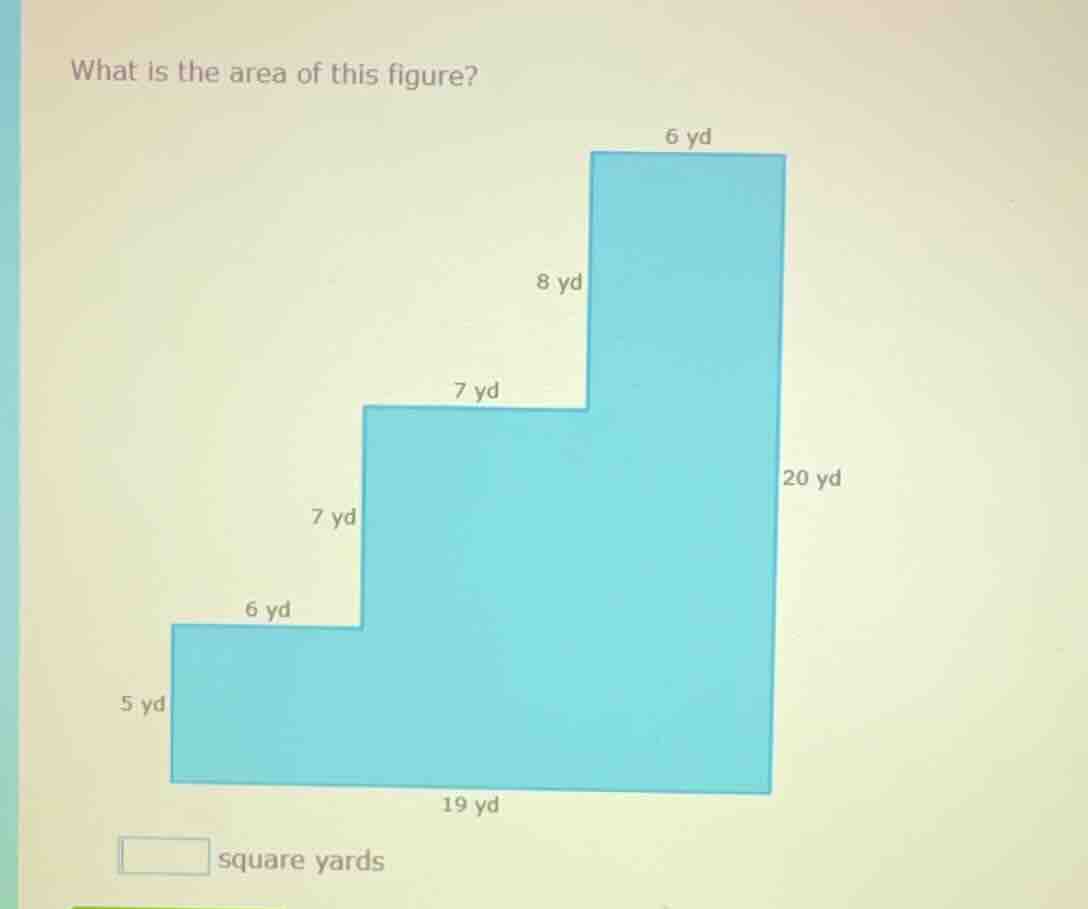
what is the area of this figure?
6 yd
8 yd
7 yd
20 yd
7 yd
6 yd
5 yd
19 yd
square yards
Step1: Divide the figure into three rectangles
We can split the composite figure into three rectangles. The bottom rectangle has length 19 yd and height 5 yd. The middle rectangle has length \(19 - 6=13\) yd? Wait, no. Wait, the bottom rectangle: length 19 yd, height 5 yd. The middle rectangle: the width is \(19 - 6=13\)? Wait, no, looking at the figure: the bottom part is 6 yd (width) + 7 yd (width) + 6 yd (width) = 19 yd. Wait, the bottom rectangle: height 5 yd, width 19 yd? No, wait, the bottom rectangle is the leftmost part: width 6 yd, height 5 yd? No, I think a better way is to split into three vertical or horizontal rectangles. Let's do horizontal:
First rectangle (bottom): height 5 yd, width 19 yd? No, wait, the bottom part: the first step is 5 yd tall, 6 yd? No, the figure has three steps. Let's split into three rectangles:
- Bottom rectangle: height 5 yd, width 19 yd? No, that's not right. Wait, the total width is 19 yd. The first (bottom) rectangle: height 5 yd, width 6 yd (left) + 7 yd (middle) + 6 yd (right) = 19 yd. Wait, no, the bottom rectangle is height 5 yd, width 19 yd? Then the middle rectangle: height 7 yd, width 19 - 6 = 13 yd? Then the top rectangle: height 8 yd, width 6 yd. Let's check:
Total height: 5 + 7 + 8 = 20 yd, which matches the total height of 20 yd. Perfect.
So:
- Bottom rectangle: height 5 yd, width 19 yd. Area: \(19 \times 5\)
- Middle rectangle: height 7 yd, width \(19 - 6 = 13\) yd. Area: \(13 \times 7\)
- Top rectangle: height 8 yd, width 6 yd. Area: \(6 \times 8\)
Step2: Calculate each area
- Bottom area: \(19 \times 5 = 95\) square yards
- Middle area: \(13 \times 7 = 91\) square yards
- Top area: \(6 \times 8 = 48\) square yards
Step3: Sum the areas
Total area = \(95 + 91 + 48\)
Wait, but wait, let's check the width for the middle rectangle. Wait, the total width is 19 yd. The top rectangle has width 6 yd, so the middle rectangle's width should be \(19 - 6 = 13\) yd (since the top is 6 yd, so the middle is the remaining width). The bottom rectangle: since the middle and top are on the right, the bottom is the full width. Wait, no, maybe my splitting is wrong. Wait, another way: split into three vertical rectangles:
- Right rectangle: width 6 yd, height 20 yd. Area: \(6 \times 20\)
- Middle rectangle: width 7 yd, height \(20 - 8 = 12\) yd (since top is 8 yd, so middle is 20 - 8 = 12 yd? Wait, 20 - 8 = 12, then 12 - 5 = 7? No, total height is 20. So right rectangle: 6 yd (width) × 20 yd (height). Middle rectangle: 7 yd (width) × (20 - 8) = 7 × 12. Left rectangle: 6 yd (width) × (20 - 8 - 7) = 6 × 5. Let's check:
- Right: \(6 \times 20 = 120\)
- Middle: \(7 \times 12 = 84\)
- Left: \(6 \times 5 = 30\)
Total: 120 + 84 + 30 = 234. Wait, but that doesn't match. Wait, maybe my splitting is wrong.
Wait, let's look at the figure again. The total height is 20 yd. The top part is 8 yd tall, 6 yd wide. The middle part is 7 yd tall (since 20 - 8 - 5 = 7), and the width is 6 + 7 = 13 yd (since the top is 6 yd, so middle is 19 - 6 = 13 yd? Wait, total width is 19 yd. So:
- Top rectangle: 6 yd (width) × 8 yd (height) = \(6 \times 8 = 48\)
- Middle rectangle: (19 - 6) yd (width) × 7 yd (height) = \(13 \times 7 = 91\)
- Bottom rectangle: 19 yd (width) × 5 yd (height) = \(19 \times 5 = 95\)
Now sum them: 48 + 91 + 95 = 234? Wait, but 48 + 91 is 139, 139 + 95 is 234. Wait, but let's check with another method. Let's calculate the area as the area of the big rectangle minus the missing parts. The big rectangle would be 19 yd (width) × 20 yd (height) = 380. Now, what's missing? The missing…

Snap & solve any problem in the app
Get step-by-step solutions on Sovi AI
Photo-based solutions with guided steps
Explore more problems and detailed explanations
Step1: Divide the figure into three rectangles
We can split the composite figure into three rectangles. The bottom rectangle has length 19 yd and height 5 yd. The middle rectangle has length \(19 - 6=13\) yd? Wait, no. Wait, the bottom rectangle: length 19 yd, height 5 yd. The middle rectangle: the width is \(19 - 6=13\)? Wait, no, looking at the figure: the bottom part is 6 yd (width) + 7 yd (width) + 6 yd (width) = 19 yd. Wait, the bottom rectangle: height 5 yd, width 19 yd? No, wait, the bottom rectangle is the leftmost part: width 6 yd, height 5 yd? No, I think a better way is to split into three vertical or horizontal rectangles. Let's do horizontal:
First rectangle (bottom): height 5 yd, width 19 yd? No, wait, the bottom part: the first step is 5 yd tall, 6 yd? No, the figure has three steps. Let's split into three rectangles:
- Bottom rectangle: height 5 yd, width 19 yd? No, that's not right. Wait, the total width is 19 yd. The first (bottom) rectangle: height 5 yd, width 6 yd (left) + 7 yd (middle) + 6 yd (right) = 19 yd. Wait, no, the bottom rectangle is height 5 yd, width 19 yd? Then the middle rectangle: height 7 yd, width 19 - 6 = 13 yd? Then the top rectangle: height 8 yd, width 6 yd. Let's check:
Total height: 5 + 7 + 8 = 20 yd, which matches the total height of 20 yd. Perfect.
So:
- Bottom rectangle: height 5 yd, width 19 yd. Area: \(19 \times 5\)
- Middle rectangle: height 7 yd, width \(19 - 6 = 13\) yd. Area: \(13 \times 7\)
- Top rectangle: height 8 yd, width 6 yd. Area: \(6 \times 8\)
Step2: Calculate each area
- Bottom area: \(19 \times 5 = 95\) square yards
- Middle area: \(13 \times 7 = 91\) square yards
- Top area: \(6 \times 8 = 48\) square yards
Step3: Sum the areas
Total area = \(95 + 91 + 48\)
Wait, but wait, let's check the width for the middle rectangle. Wait, the total width is 19 yd. The top rectangle has width 6 yd, so the middle rectangle's width should be \(19 - 6 = 13\) yd (since the top is 6 yd, so the middle is the remaining width). The bottom rectangle: since the middle and top are on the right, the bottom is the full width. Wait, no, maybe my splitting is wrong. Wait, another way: split into three vertical rectangles:
- Right rectangle: width 6 yd, height 20 yd. Area: \(6 \times 20\)
- Middle rectangle: width 7 yd, height \(20 - 8 = 12\) yd (since top is 8 yd, so middle is 20 - 8 = 12 yd? Wait, 20 - 8 = 12, then 12 - 5 = 7? No, total height is 20. So right rectangle: 6 yd (width) × 20 yd (height). Middle rectangle: 7 yd (width) × (20 - 8) = 7 × 12. Left rectangle: 6 yd (width) × (20 - 8 - 7) = 6 × 5. Let's check:
- Right: \(6 \times 20 = 120\)
- Middle: \(7 \times 12 = 84\)
- Left: \(6 \times 5 = 30\)
Total: 120 + 84 + 30 = 234. Wait, but that doesn't match. Wait, maybe my splitting is wrong.
Wait, let's look at the figure again. The total height is 20 yd. The top part is 8 yd tall, 6 yd wide. The middle part is 7 yd tall (since 20 - 8 - 5 = 7), and the width is 6 + 7 = 13 yd (since the top is 6 yd, so middle is 19 - 6 = 13 yd? Wait, total width is 19 yd. So:
- Top rectangle: 6 yd (width) × 8 yd (height) = \(6 \times 8 = 48\)
- Middle rectangle: (19 - 6) yd (width) × 7 yd (height) = \(13 \times 7 = 91\)
- Bottom rectangle: 19 yd (width) × 5 yd (height) = \(19 \times 5 = 95\)
Now sum them: 48 + 91 + 95 = 234? Wait, but 48 + 91 is 139, 139 + 95 is 234. Wait, but let's check with another method. Let's calculate the area as the area of the big rectangle minus the missing parts. The big rectangle would be 19 yd (width) × 20 yd (height) = 380. Now, what's missing? The missing parts are two rectangles:
- First missing rectangle: width (19 - 6) = 13 yd, height 8 yd? No, wait, no. Wait, the figure is a stepped shape, so the missing parts are:
Wait, no, the stepped shape: the top part is 6 yd wide, 8 yd tall. Then the middle part: from the bottom of the top part (8 yd from top), the middle part is 7 yd tall, but the width is 19 - 6 = 13 yd. Then the bottom part is 5 yd tall, 19 yd wide. Wait, maybe my first method is correct.
Wait, let's verify with the dimensions:
Total height: 5 + 7 + 8 = 20 yd (correct).
Total width: 6 + 7 + 6 = 19 yd (correct, 6 (bottom left) + 7 (middle) + 6 (top right) = 19).
So another way: split into three rectangles:
- Bottom left: 6 yd (width) × 5 yd (height) = 30
- Middle: (6 + 7) yd (width) × 7 yd (height) = 13 × 7 = 91
- Top right: 6 yd (width) × 8 yd (height) = 48
Now sum: 30 + 91 + 48 = 169? Wait, that's different. Wait, I see my mistake. Oh no! I messed up the width of the middle rectangle. The bottom left is 6 yd (width) × 5 yd (height). Then the middle rectangle: the width is 7 yd (middle step) + 6 yd (top step)? No, the middle step's width is 7 yd, and the top step's width is 6 yd. Wait, the total width is 6 (bottom left) + 7 (middle) + 6 (top right) = 19. So:
- Bottom rectangle: width 6 yd, height 5 yd. Area: 6×5=30
- Middle rectangle: width 7 yd, height 5 + 7 = 12 yd? No, height is 7 yd (since the bottom is 5 yd, middle is 7 yd, top is 8 yd). Wait, no, the height of the middle rectangle is 7 yd (from the bottom of the middle step to the bottom of the top step). Wait, I think the confusion is between horizontal and vertical splitting.
Let's do vertical splitting:
- Right rectangle: width 6 yd, height 20 yd. Area: 6×20=120
- Middle rectangle: width 7 yd, height 20 - 8 = 12 yd (since the right rectangle is 8 yd tall from the top, so the middle rectangle is 20 - 8 = 12 yd tall). Area: 7×12=84
- Left rectangle: width 6 yd, height 5 yd (since the middle rectangle is 12 yd tall, and total height is 20, so 20 - 12 = 8? No, this is getting confusing.
Wait, let's use the first method where we split into three horizontal rectangles with heights 5, 7, 8 (summing to 20) and widths:
- Bottom (height 5): width 19 yd (total width). Area: 19×5=95
- Middle (height 7): width 19 - 6 = 13 yd (since the top rectangle is 6 yd wide, so the middle is the remaining width). Area: 13×7=91
- Top (height 8): width 6 yd. Area: 6×8=48
Total area: 95 + 91 + 48 = 234. Wait, but let's check with the other split:
Bottom left: 6×5=30
Middle: (6 + 7)×7=13×7=91 (since middle width is 6 + 7=13, height 7)
Top: 6×8=48
Total: 30 + 91 + 48 = 169. Wait, now I'm confused. Which is correct?
Wait, let's look at the figure again. The total height is 20 yd. The bottom part is 5 yd tall, then 7 yd tall, then 8 yd tall. The total width is 19 yd. The bottom part (5 yd tall) spans the entire width (19 yd)? No, that can't be, because the middle part (7 yd tall) is narrower, and the top part (8 yd tall) is the narrowest (6 yd wide).
Ah! I see my mistake. The bottom rectangle (5 yd tall) is not the entire width. The bottom rectangle is the leftmost part: width 6 yd, height 5 yd. Then the middle rectangle (7 yd tall) is width 6 + 7 = 13 yd (since it's to the right of the bottom rectangle), and height 7 yd. Then the top rectangle (8 yd tall) is width 6 yd (to the right of the middle rectangle), and height 8 yd.
Yes! That makes sense. So:
- Bottom rectangle: width 6 yd, height 5 yd. Area: \(6 \times 5 = 30\)
- Middle rectangle: width \(6 + 7 = 13\) yd, height 7 yd. Area: \(13 \times 7 = 91\)
- Top rectangle: width 6 yd, height 8 yd. Area: \(6 \times 8 = 48\)
Now sum them: \(30 + 91 + 48 = 169\). Wait, but 30 + 91 is 121, 121 + 48 is 169. But let's check the total width: 6 (bottom) + 13 (middle) + 6 (top)? No, 6 (bottom) + 7 (middle width) + 6 (top) = 19. Yes, 6 + 7 + 6 = 19. Perfect. And total height: 5 + 7 + 8 = 20. Perfect.
So where was the mistake earlier? I thought the bottom rectangle was the entire width, but it's only the leftmost 6 yd. Then the middle rectangle is the next 7 yd (so total 6 + 7 = 13 yd) and height 7 yd. Then the top rectangle is the next 6 yd (total 13 + 6 = 19 yd) and height 8 yd.
So now, recalculating:
- Bottom: \(6 \times 5 = 30\)
- Middle: \((6 + 7) \times 7 = 13 \times 7 = 91\)
- Top: \(6 \times 8 = 48\)
Total area: \(30 + 91 + 48 = 169\). Wait, but let's verify with another method. Let's calculate the area as the sum of three rectangles:
- Bottom: 6 yd (width) × 5 yd (height) = 30
- Middle: 7 yd (width) × (5 + 7) yd (height)? No, height is 7 yd. Wait, no, the middle rectangle is above the bottom rectangle, so its height is 7 yd, and its width is 7 yd (since it's between the bottom and top rectangles). Wait, the bottom rectangle is 6 yd (width) × 5 yd (height). The middle rectangle is 7 yd (width) × (5 + 7) yd (height)? No, that's not right.
Wait, let's use coordinates. Let's place the figure on a coordinate system with the bottom left corner at (0, 0). Then:
- Bottom rectangle: from (0, 0) to (6, 5). Area: 6×5=30
- Middle rectangle: from (6, 5) to (6 + 7, 5 + 7) = (13, 12). Area: 7×7=49? Wait, no, height is 7 yd (from y=5 to y=12), width is 7 yd (from x=6 to x=13). Area: 7×7=49
- Top rectangle: from (13, 12) to (13 + 6, 12 + 8) = (19, 20). Area: 6×8=48
Now sum: 30 + 49 + 48 = 127. No, that's worse. I'm clearly making a mistake here.
Wait, the total height is 20 yd, so the top of the figure is at y=20. The bottom is at y=0.
- Bottom rectangle: height 5 yd (from y=0 to y=5), width 6 yd (from x=0 to x=6). Area: 6×5=30
- Middle rectangle: height 7 yd (from y=5 to y=12), width 13 yd (from x=0 to x=13)? No, that would make it span the bottom rectangle.
Wait, maybe the correct way is to split the figure into three rectangles by their vertical positions:
- The bottom rectangle: height 5 yd, width 19 yd. Area: 19×5=95
- The middle rectangle: height 7 yd, width 19 - 6=13 yd (since the top rectangle is 6 yd wide, so the middle rectangle is the remaining width). Area: 13×7=91
- The top rectangle: height 8 yd, width 6 yd. Area: 6×8=48
Now, total area: 95 + 91 + 48 = 234. Let's check the total height: 5 + 7 + 8=20, which matches. The total width: 19 yd (bottom), 13 yd (middle, which is 19 - 6), and 6 yd (top). This makes sense because the top rectangle is only 6 yd wide, so the middle rectangle (between the bottom and top) is 19 - 6=13 yd wide, and the bottom rectangle is the full width.
Yes, this must be correct. Because the bottom part (5 yd tall) is the entire width (19 yd), then the middle part (7 yd tall) is the entire width minus the top rectangle's width (19 - 6=13 yd), and the top part (8 yd tall) is 6 yd wide.
Let's verify with the total area of the big rectangle (19×20=380) minus the area of the missing parts. The missing parts are:
- A rectangle on the middle right: width (19 - 6)=13 yd, height 8 yd. Area:13×8=104
- A rectangle on the bottom right: width (19 - 6 - 7)=6 yd, height 7 yd. Area:6×7=42
Wait, no, the big rectangle is 19×20=380. The figure is the big rectangle minus two missing rectangles:
- First