QUESTION IMAGE
Question
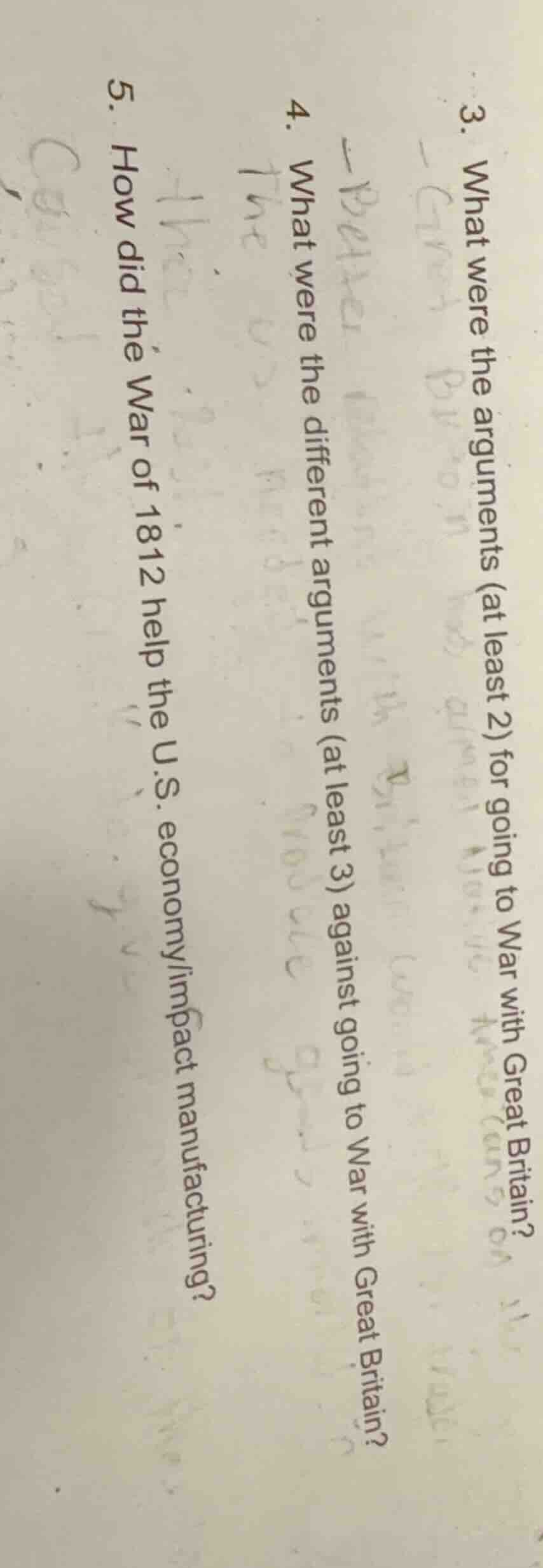
- what were the arguments (at least 2) for going to war with great britain?
- what were the different arguments (at least 3) against going to war with great britain?
- how did the war of 1812 help the u.s. economy/impact manufacturing?
Response
Question 3: What were the arguments (at least 2) for going to War with Great Britain?
Brief Explanations
- Impressment of U.S. Sailors: Great Britain was forcibly recruiting American sailors into the British Royal Navy, violating U.S. sovereignty and rights of its citizens. This was a major grievance as it undermined U.S. independence and the rights of its seamen.
- British Support for Native American Resistance: Britain was providing arms and support to Native American tribes in the western territories, who were resisting U.S. expansion. This was seen as a threat to U.S. territorial growth and security, as these tribes were attacking American settlers.
Brief Explanations
- Economic Dependence on Britain: The U.S. economy relied heavily on trade with Great Britain, especially for exporting agricultural products and importing manufactured goods. War would disrupt this trade, harming American merchants, farmers, and businesses.
- Military Weakness: The U.S. military, including the army and navy, was much smaller and less experienced than Britain’s. Many believed the U.S. could not win a war against the world’s most powerful naval and military force at the time.
- Regional Divisions: There were strong regional differences in support for war. New England, with its heavy reliance on trade, was strongly opposed, fearing economic ruin. This division raised concerns about national unity and the ability to effectively wage war.
Brief Explanations
- Boost to Domestic Manufacturing: The British naval blockade during the war cut off U.S. access to imported British manufactured goods. This forced Americans to produce more goods domestically, leading to the growth of industries like textiles, iron, and machinery. Entrepreneurs built factories to meet domestic demand, laying the foundation for future industrialization.
- Reduction of British Competition: After the war, even though trade resumed, the growth of domestic manufacturing during the war made U.S. industries more competitive. The experience of producing for the domestic market during the war helped these industries expand and compete with British imports in the post - war era.
- Expansion of Internal Markets: The war and its aftermath led to increased westward expansion and settlement. This created new internal markets for U.S. manufactured goods, as settlers needed tools, clothing, and other products. The growth of these internal markets further stimulated domestic manufacturing.

Snap & solve any problem in the app
Get step-by-step solutions on Sovi AI
Photo-based solutions with guided steps
Explore more problems and detailed explanations
- Impressment of U.S. sailors by the British Royal Navy, violating U.S. sovereignty and the rights of American seamen.
- British support for Native American tribes resisting U.S. westward expansion, threatening U.S. territorial security and growth.