QUESTION IMAGE
Question
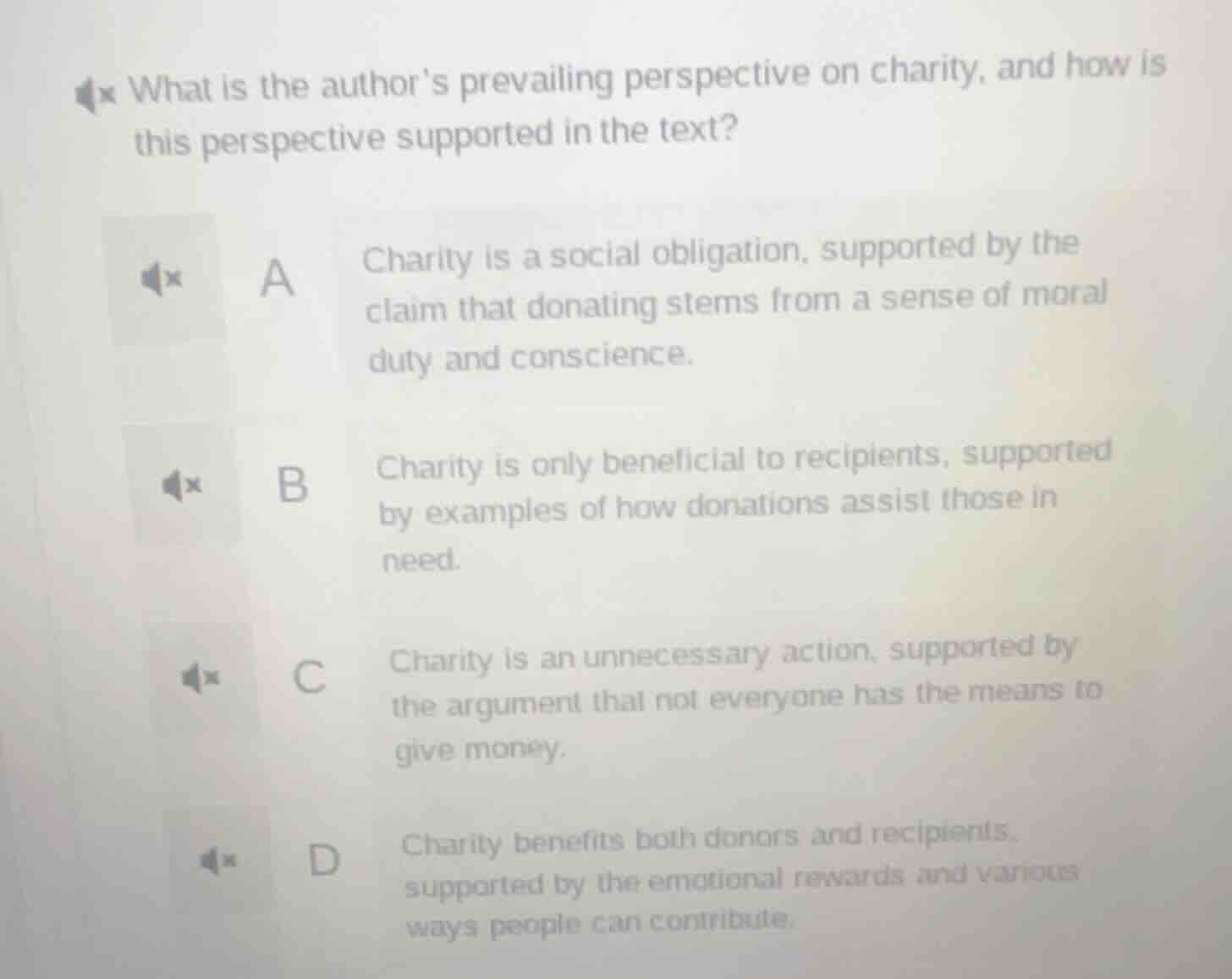
what is the author’s prevailing perspective on charity, and how is this perspective supported in the text? a charity is a social obligation, supported by the claim that donating stems from a sense of moral duty and conscience. b charity is only beneficial to recipients, supported by examples of how donations assist those in need. c charity is an unnecessary action, supported by the argument that not everyone has the means to give money. d charity benefits both donors and recipients, supported by the emotional rewards and various ways people can contribute.
To solve this, we analyze each option:
- Option A: If the text doesn't emphasize charity as a moral duty - based obligation, this is incorrect.
- Option B: "Only beneficial to recipients" is narrow; charity often has benefits for donors too (emotional, etc.), so this is wrong.
- Option C: The idea that charity is unnecessary is not a common or well - supported perspective in most texts about charity, and the reasoning about not everyone having means to give is a weak argument against charity's necessity.
- Option D: Charity can benefit donors (emotional rewards like satisfaction) and recipients (receiving help). The support about emotional rewards for donors and various contribution ways (so more people can participate, benefiting both) makes this a strong choice.

Snap & solve any problem in the app
Get step-by-step solutions on Sovi AI
Photo-based solutions with guided steps
Explore more problems and detailed explanations
D. Charity benefits both donors and recipients, supported by the emotional rewards and various ways people can contribute.