QUESTION IMAGE
Question
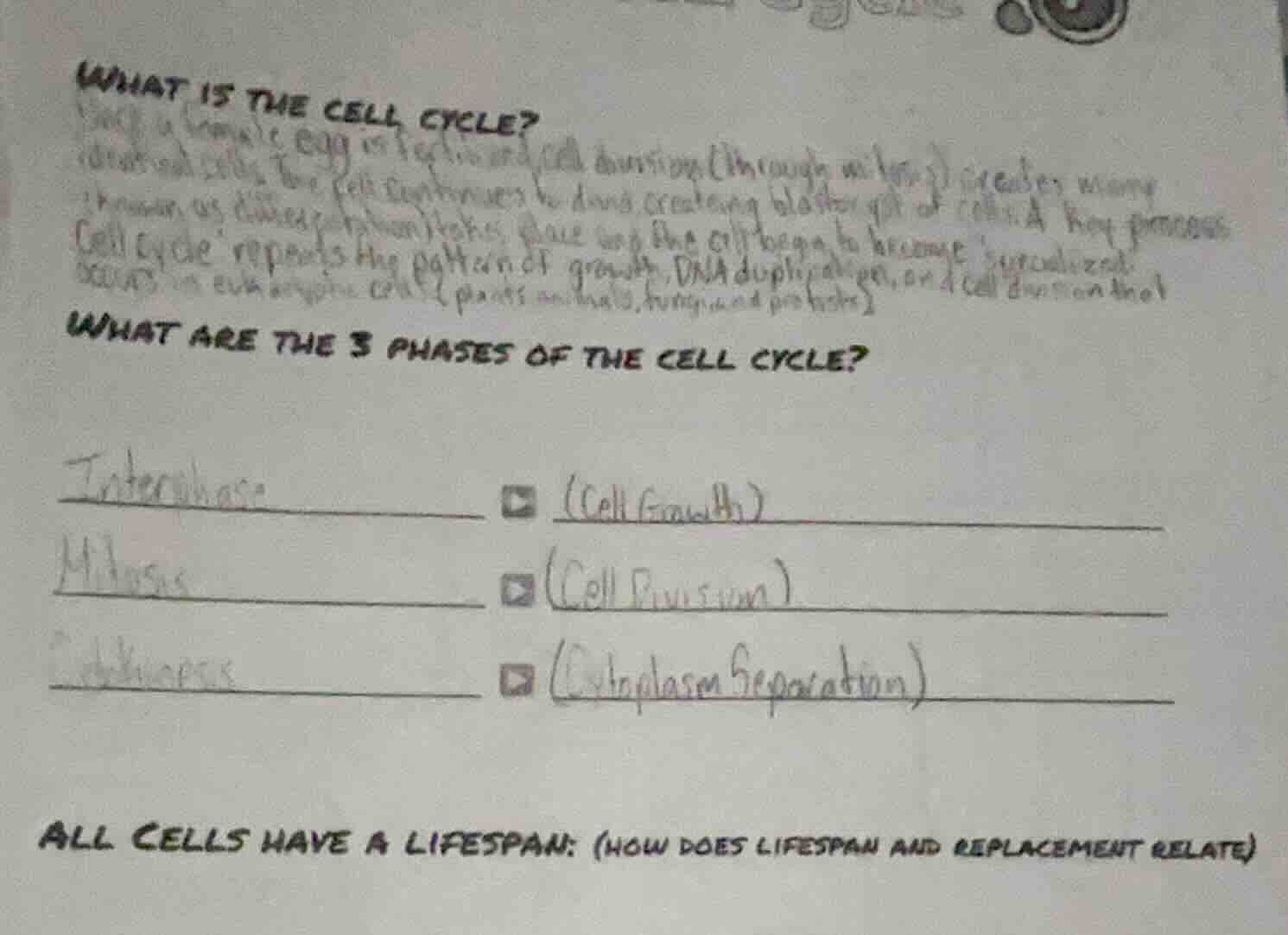
what is the cell cycle?
(after a female egg is fertilized, cell division (through mitosis) creates many identical cells, the cell continues to divide, creating a blastocyst (all of cells). a key process known as differentiation takes place when the cell began to become specialized. cell cycle repeats the pattern of growth, dna duplication, and cell division that occurs in every cell (plants, animals, fungi, and prokaryotes)
what are the 3 phases of the cell cycle?
interphase (cell growth)
mitosis (cell division)
cytokinesis (cytoplasm separation)
all cells have a lifespan: (how does lifespan and replacement relate)
For "What is the cell cycle?"
The cell cycle is the process where a cell grows, duplicates its DNA, and divides. Starting from a fertilized egg (or other cells), it divides (via mitosis) to form many cells (like a blastocyst). A key process is differentiation (cells become specialized). The cycle repeats growth, DNA duplication, and division, occurring in all cells (plants, animals, fungi, prokaryotes).
From the image, the three phases are labeled as Interphase (cell growth), Mitosis (cell division), and Cytokinesis (cytoplasm separation). Interphase involves cell growth and DNA replication, Mitosis is the nuclear division (cell division), and Cytokinesis is the division of the cytoplasm.
Cells have a limited lifespan. When a cell reaches the end of its lifespan, it is replaced by new cells produced through the cell cycle (cell division). The rate of cell replacement is related to the cell's lifespan—shorter - lived cells are replaced more frequently, and longer - lived cells are replaced less often. For example, skin cells have a short lifespan and are replaced quickly, while nerve cells have a long lifespan and are replaced slowly (or not at all in some cases).

Snap & solve any problem in the app
Get step-by-step solutions on Sovi AI
Photo-based solutions with guided steps
Explore more problems and detailed explanations
The cell cycle is the repeated pattern of cell growth, DNA duplication, and cell division (mitosis/cytokinesis), occurring in all cells (plants, animals, fungi, prokaryotes), and includes processes like cell division (from a fertilized egg to form many cells) and differentiation (cells becoming specialized).