QUESTION IMAGE
Question
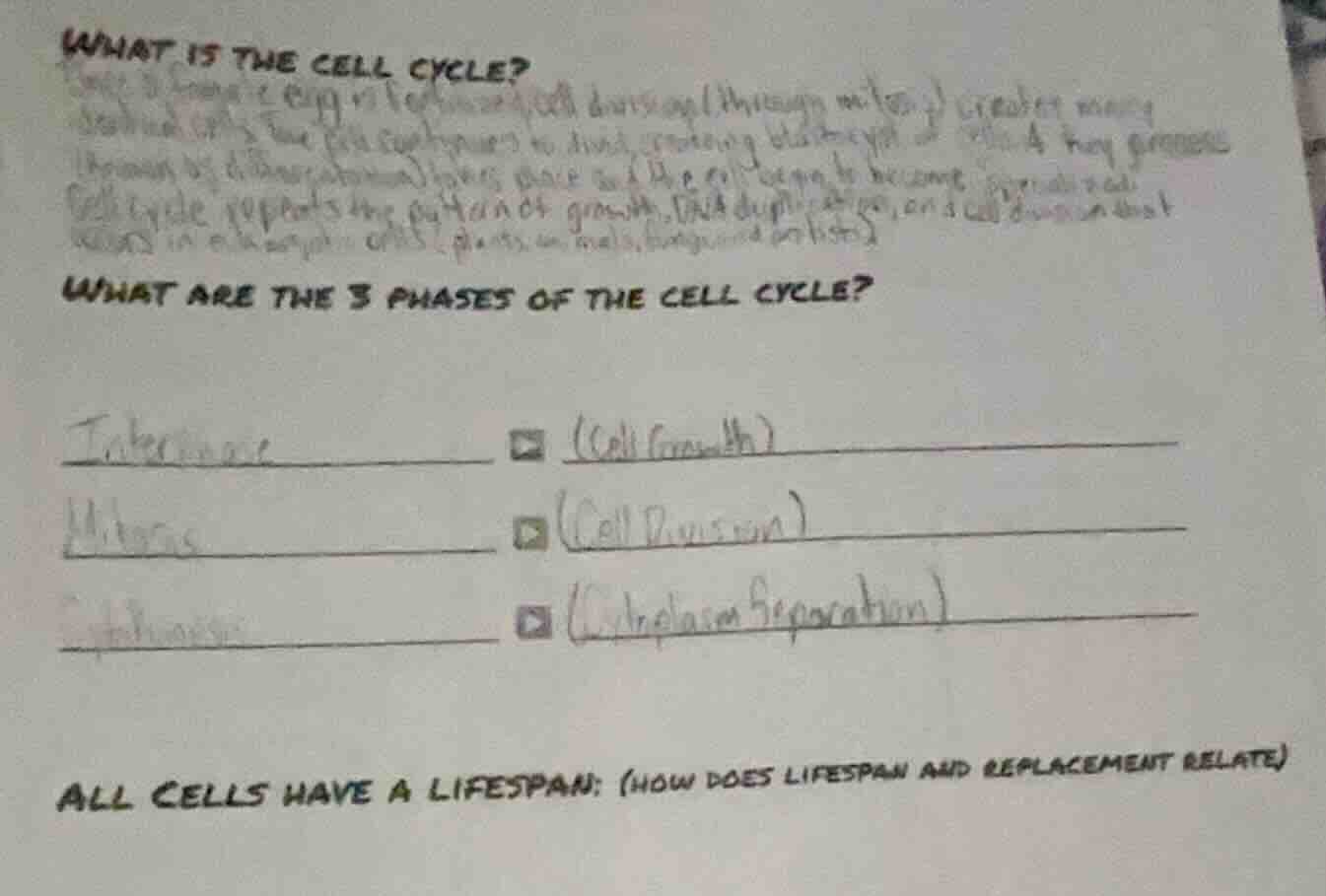
what is the cell cycle?
(some text about cell cycle description)
what are the 3 phases of the cell cycle?
interphase ▶ (cell growth)
mitosis ▶ (cell division)
cytokinesis ▶ (cytoplasm separation)
all cells have a lifespan: (how does lifespan and replacement relate)
The cell cycle is the process by which a cell grows, replicates its DNA, and divides to produce two daughter cells. The three main phases of the cell cycle are: 1. Interphase: This is the phase of cell growth, where the cell prepares for division by replicating DNA and organelles. 2. Mitosis (M - phase): This is the phase of cell division, where the nucleus divides, and the duplicated chromosomes are separated into two daughter nuclei. 3. Cytokinesis: This is the phase where the cytoplasm of the cell divides, resulting in two distinct daughter cells.
Regarding the relationship between cell lifespan and replacement, cells with shorter lifespans (e.g., skin cells, red blood cells) are replaced more frequently through the cell cycle, while cells with longer lifespans (e.g., neurons in the brain) are replaced less often or not at all in some cases. The cell cycle ensures that damaged or old cells are replaced with new, functional cells to maintain the health and function of the organism.

Snap & solve any problem in the app
Get step-by-step solutions on Sovi AI
Photo-based solutions with guided steps
Explore more problems and detailed explanations
- What is the cell cycle? The cell cycle is the series of events that a cell undergoes to grow, replicate its DNA, and divide into two daughter cells. It involves growth, DNA duplication, and cell division, and it repeats in eukaryotic cells (plants, animals, fungi, protists) to maintain cell populations and support the organism's growth, repair, and reproduction.
- What are the 3 phases of the cell cycle? The three main phases of the cell cycle are:
- Interphase: Phase of cell growth and DNA replication.
- Mitosis (M - phase): Phase of nuclear division (separation of duplicated chromosomes).
- Cytokinesis: Phase of cytoplasmic division, resulting in two daughter cells.
- All cells have a lifespan: (How does lifespan and replacement relate?) Cells with shorter lifespans (e.g., skin cells, blood cells) are replaced more frequently via the cell cycle. Cells with longer lifespans (e.g., some neurons) are replaced less often or not at all. The cell cycle ensures that cells are replaced to maintain tissue/organ function as older cells die or become damaged.