QUESTION IMAGE
Question
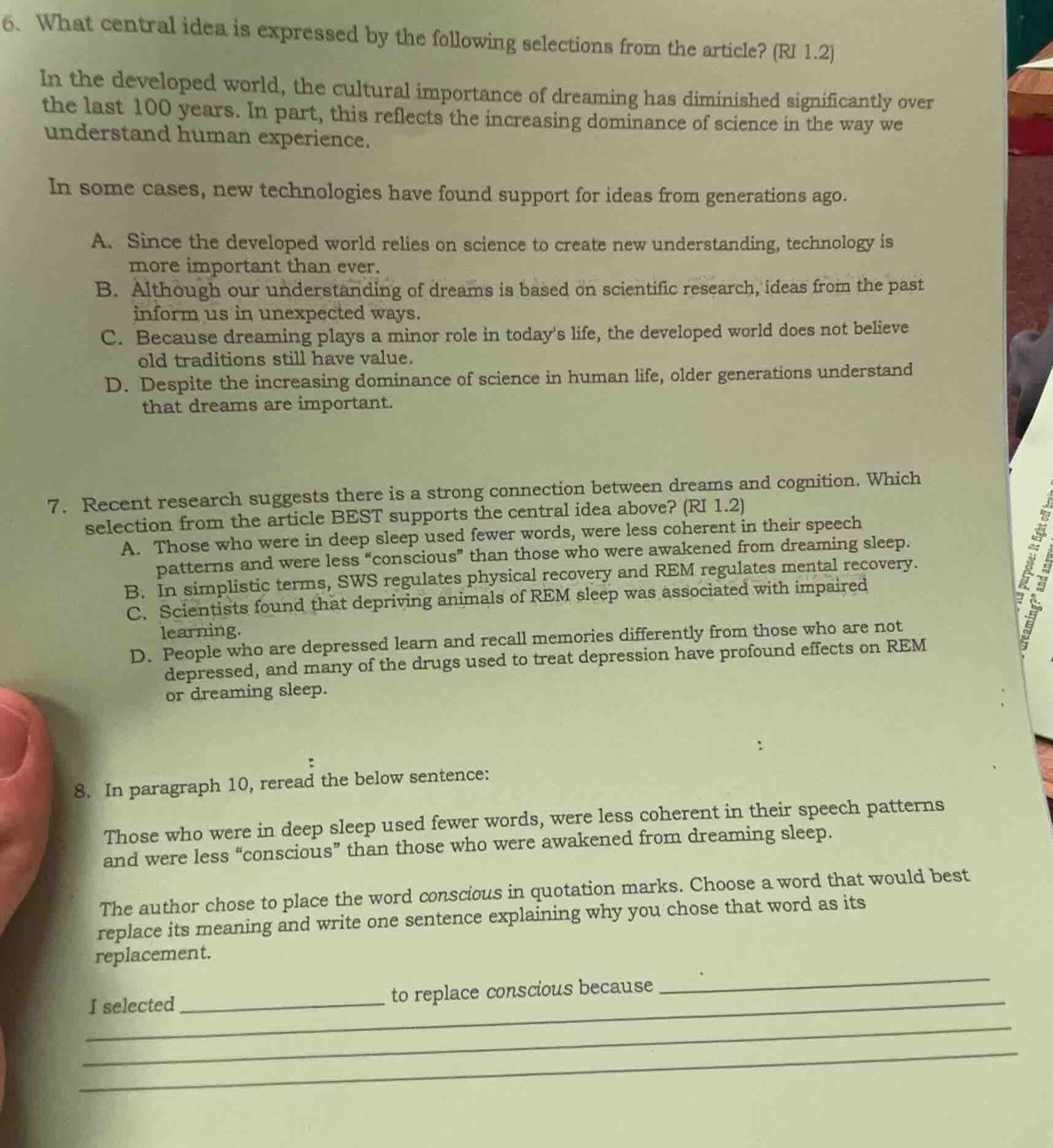
- what central idea is expressed by the following selections from the article? (ri 1.2)
in the developed world, the cultural importance of dreaming has diminished significantly over
the last 100 years. in part, this reflects the increasing dominance of science in the way we
understand human experience.
in some cases, new technologies have found support for ideas from generations ago.
a. since the developed world relies on science to create new understanding, technology is
more important than ever.
b. although our understanding of dreams is based on scientific research, ideas from the past
inform us in unexpected ways.
c. because dreaming plays a minor role in today’s life, the developed world does not believe
old traditions still have value.
d. despite the increasing dominance of science in human life, older generations understand
that dreams are important.
- recent research suggests there is a strong connection between dreams and cognition. which
selection from the article best supports the central idea above? (ri 1.2)
a. those who were in deep sleep used fewer words, were less coherent in their speech
patterns and were less “conscious” than those who were awakened from dreaming sleep.
b. in simplistic terms, sws regulates physical recovery and rem regulates mental recovery.
c. scientists found that depriving animals of rem sleep was associated with impaired
learning.
d. people who are depressed learn and recall memories differently from those who are not
depressed, and many of the drugs used to treat depression have profound effects on rem
or dreaming sleep.
- in paragraph 10, reread the below sentence:
those who were in deep sleep used fewer words, were less coherent in their speech patterns
and were less “conscious” than those who were awakened from dreaming sleep.
the author chose to place the word conscious in quotation marks. choose a word that would best
replace its meaning and write one sentence explaining why you chose that word as its
replacement.
i selected _____________ to replace conscious because ________________________________
____________________________________________________________________________________
____________________________________________________________________________________
For Question 6:
The text states two key points: 1) In the developed world, science's dominance has reduced the cultural importance of dreaming over 100 years. 2) New technologies sometimes support old ideas about dreams. Option B aligns with both: it acknowledges scientific influence on dream understanding while noting past ideas still inform us. Option A overemphasizes technology's importance, which is not the focus. Option C incorrectly claims the developed world rejects old traditions. Option D misrepresents the text, which does not state older generations view dreams as important.
For Question 7:
The central idea is a strong link between dreams and cognition (thinking, learning, memory). Option C shows that depriving animals of REM (dreaming) sleep harms their learning, directly connecting dreaming to a cognitive function. Option A compares speech coherence but does not tie to broader cognition. Option B focuses on physical/mental recovery, not cognition. Option D links depression, drugs, and REM but does not directly show a connection between dreams and core cognitive processes.
For Question 8:
The quotation marks around "conscious" indicate the word is being used to describe a specific, limited state of awareness upon waking, not full, typical consciousness. "Alert" is a suitable replacement because it refers to the state of being mentally awake and responsive, which matches the comparison between deep sleep and dreaming sleep wakefulness.

Snap & solve any problem in the app
Get step-by-step solutions on Sovi AI
Photo-based solutions with guided steps
Explore more problems and detailed explanations
- B. Although our understanding of dreams is based on scientific research, ideas from the past inform us in unexpected ways.
- C. Scientists found that depriving animals of REM sleep was associated with impaired learning.
- I selected alert to replace conscious because it accurately describes the relative state of mental wakefulness and responsiveness being compared between the two groups of sleepers.