QUESTION IMAGE
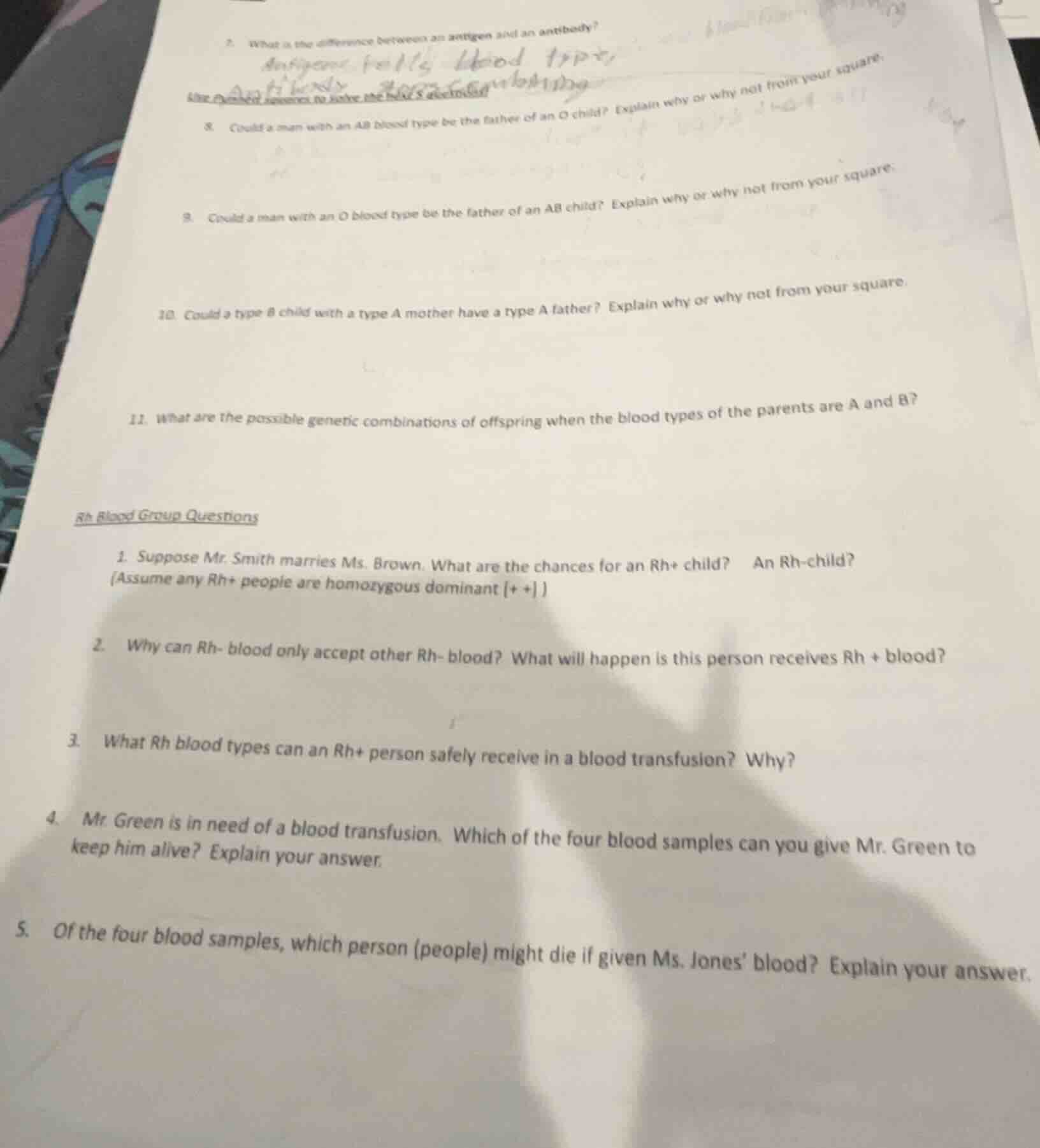
Question
- what is the difference between an antigen and an antibody?
- could a man with an ab blood type be the father of an o child? explain why or why not from your square.
- could a man with an o blood type be the father of an ab child? explain why or why not from your square.
- could a type b child with a type a mother have a type a father? explain why or why not from your square.
- what are the possible genetic combinations of offspring when the blood types of the parents are a and b?
rh blood group questions
- suppose mr. smith marries ms. brown. what are the chances for an rh+ child? an rh-child? (assume any rh+ people are homozygous dominant ++)
- why can rh- blood only accept other rh- blood? what will happen is this person receives rh + blood?
- what rh blood types can an rh+ person safely receive in a blood transfusion? why?
- mr. green is in need of a blood transfusion. which of the four blood samples can you give mr. green to keep him alive? explain your answer.
- of the four blood samples, which person (people) might die if given ms. jones’ blood? explain your answer.
Since the problem is about blood types and their genetic inheritance as well as blood transfusion compatibility, which falls under the subfield of Biology (specifically Genetics and Immunology related to blood groups) in Natural Science. Let's take question 8 as an example to solve:
Question 8: Could a man with an AB blood type be the father of an O child? Explain why or why not from your square.
Step 1: Recall Blood Type Genetics
Blood type is determined by alleles. For AB blood type, the genotype is $I^A I^B$. For O blood type, the genotype is $ii$ (homozygous recessive for the allele that doesn't produce A or B antigens).
Step 2: Analyze Possible Gametes
A man with AB blood type can only produce gametes with either $I^A$ or $I^B$ alleles (since his genotype is $I^A I^B$). A child with O blood type ($ii$) must receive one $i$ allele from each parent. But the AB father cannot pass on an $i$ allele (he only has $I^A$ and $I^B$).
Step 3: Punnett Square Verification
If we do a Punnett square with the father's alleles ($I^A$, $I^B$) and assume the mother's alleles (even if she has an $i$ allele), the possible offspring genotypes would be combinations of $I^A$ or $I^B$ with the mother's alleles. There's no way to get $ii$ (O blood type) because the father can't contribute an $i$ allele.
Step 1: Recall Blood Type Genetics
A man with O blood type has a genotype of $ii$, so he can only pass on an $i$ allele. An AB child has a genotype of $I^A I^B$, which requires one $I^A$ allele and one $I^B$ allele (one from each parent).
Step 2: Analyze Gamete Contribution
The O - blood - type father can only contribute an $i$ allele. For a child to be AB, they need $I^A$ from one parent and $I^B$ from the other. Since the father can only give $i$, he can't provide either $I^A$ or $I^B$ alleles needed for AB blood type.
Step 3: Punnett Square Verification
If we set up a Punnett square with the father's $i$ allele and the mother's alleles (even if she has $I^A$ and/or $I^B$), the possible offspring genotypes will have at least one $i$ allele (from the father), so they can be $I^A i$ (A), $I^B i$ (B), or $ii$ (O), but never $I^A I^B$ (AB).
Step 1: Recall Blood Type Genotypes
Type A mother: possible genotypes are $I^A I^A$ or $I^A i$. Type B child: possible genotypes are $I^B I^B$ or $I^B i$. Type A father: possible genotypes are $I^A I^A$ or $I^A i$.
Step 2: Analyze Allele Contribution
For a child to be type B, they need at least one $I^B$ allele. The mother (type A) can pass on $I^A$ or $i$ (if her genotype is $I^A i$). The father (type A) can pass on $I^A$ or $i$ (if his genotype is $I^A i$). Wait, no - wait, the child is type B, so they need $I^B$ from one parent. Wait, maybe the mother is $I^A i$ and the father is $I^B i$? No, the father is type A. Wait, no, let's correct. Wait, the child is type B, so the child has $I^B$ allele. The mother is type A (so she has $I^A$ or $i$). The father is type A (has $I^A$ or $i$). Wait, this seems contradictory. Wait, no - maybe the mother is $I^A i$ and the father is $I^B i$? But the father is type A. Wait, no, I made a mistake. Wait, type B child can have genotype $I^B i$. So if the mother is type A (say $I^A i$) and the father is type A (say $I^A i$), no - wait, the father is type A, so he can't have $I^B$ allele. Wait, no, the child is type B, so the child must have $I^B$ from one parent. So the mother (type A) can't give $I^B$, so the father must give $I^B$. But a type A father can't have $I^B$ allele (type A genotype is $I^A I^A$ or $I^A i$). Wait, no, this is wrong. Wait, no - the child's type B can be $I^B i$. So if the mother is $I^A i$ (type A) and the father is $I^B i$ (type B), but the question says the father is type A. Wait, I messed up. Let's start over.
Correct Step 1: Type B child genotype: $I^B I^B$ or $I^B i$. Type A mother: $I^A I^A$ or $I^A i$. Type A father: $I^A I^A$ or $I^A i$.
Step 2: For the child to be type B, they need $I^B$ allele. The mother (type A) can only give $I^A$ or $i$ (if she is $I^A i$). The father (type A) can only give $I^A$ or $i$ (if he is $I^A i$). So neither the mother nor the father can give $I^B$ allele? Wait, no, that's not right. Wait, no - the child's $I^B$ must come from one parent. So if the father is type A, he can't have $I^B$ allele. So the mother (type A) also can't have $I^B$ allele. So how can the child be type B? Wait, this is a mistake. Wait, no, the mother could be $I^A i$ and the father could be $I^B i$ (but the father is type A, so that's not possible). Wait, the question is: Could a type B child with a type A mother have a type A father? Let's do Punnett square.
Case 1: Mother is $I^A i$ (type A), Father is $I^A i$ (type A). Possible offspring genotypes: $I^A I^A$ (A), $I^A i$ (A), $I^A i$ (A), $ii$ (O). No type B.
Case 2: Mother is $I^A I^A$ (type A), Father is $I^A i$ (type A). Offspring: $I^A I^A$ (A), $I^A i$ (A), $I^A I^A$ (A), $I^A i$ (A). No type B.
Case 3: Mother is $I^A i$ (type A), Father is $I^A I^A$ (type A). Offspring: $I^A I^A$ (A), $I^A i$ (A), $I^A I^A$ (A), $I^A i$ (A). No type B.
Wait, but that's not possible. Wait, no - I think I confused the alleles. Wait, the child is type B, so the child has $I^B$ allele. So one parent must have $I^B$ allele. The mother is type A (so she has $I^A$ or $i$), so she can't have $I^B$. So the father must have $I^B$ allele, but the father is type A, which means he has $I^A$ or $i$ (no $I^B$). Therefore, a type B child with a type A mother cannot have a type A father? Wait, no, that's not right. Wait, no - the child's genotype could be $I^B i$. So if the mother is $I^A i$ (type A) and the father is $I^B i$ (type B), but the father is type A, so that's not possible. Wait, the question is "Could a type B ch…

Snap & solve any problem in the app
Get step-by-step solutions on Sovi AI
Photo-based solutions with guided steps
Explore more problems and detailed explanations
No, a man with AB blood type cannot be the father of an O child. Because a person with AB blood type (genotype $I^A I^B$) can only pass on either $I^A$ or $I^B$ alleles, while an O child (genotype $ii$) requires an $i$ allele from each parent. Since the AB father cannot provide an $i$ allele, it's impossible for him to have an O child.