QUESTION IMAGE
Question
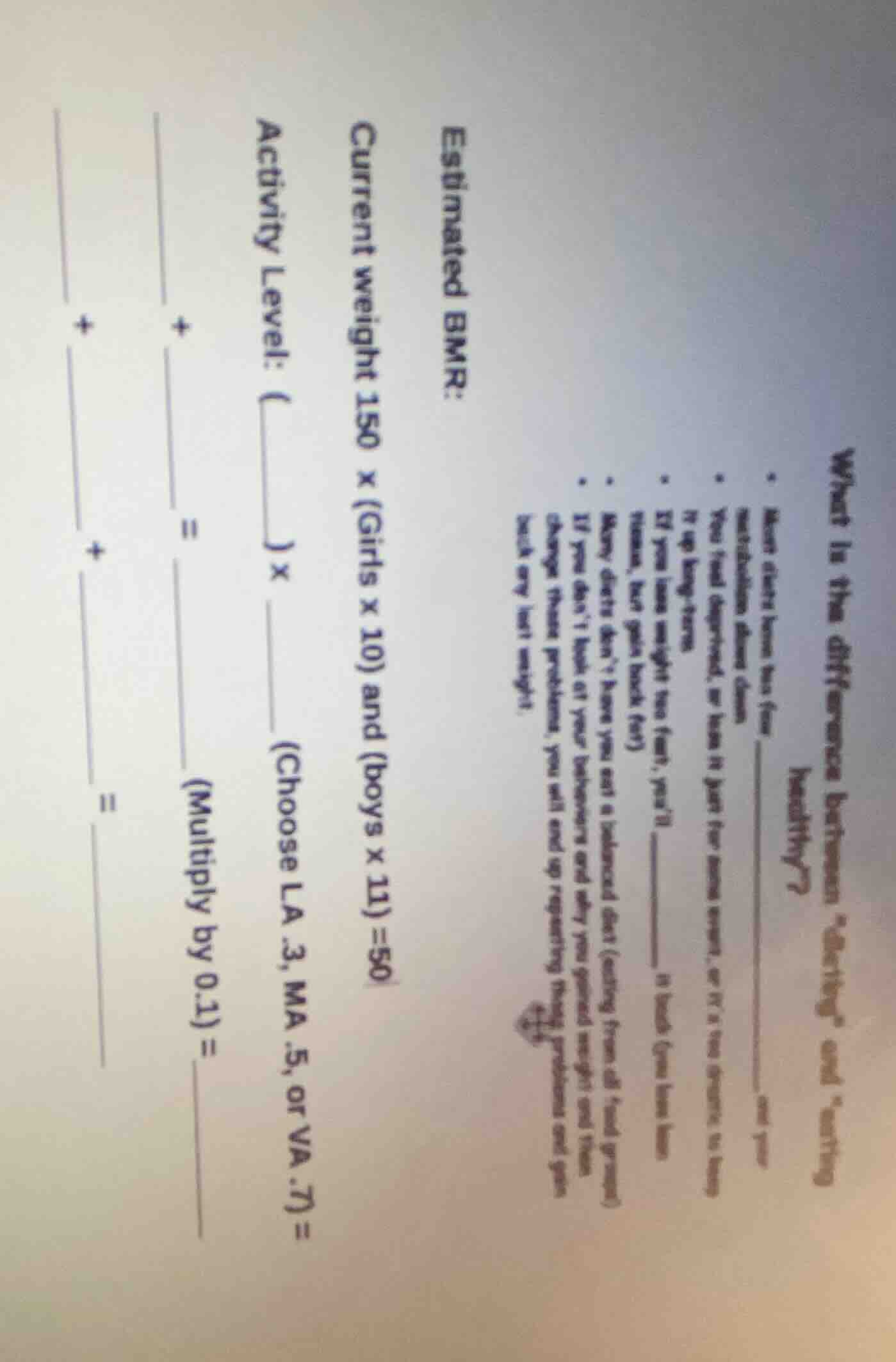
what is the difference between \dieting\ and \eating healthy\?• most diets have too few ______________________________________________ that your metabolism slows down• you feel deprived, or lose it just for some event, or its too dramatic to keep it up long-term• if you lose weight too fast, youll ________________ it back (you lose lean tissue, but gain back fat)• many diets dont have you eat a balanced diet (eating from all food groups)• if you dont look at your behaviors and why you gained weight and then change those problems, you will end up repeating those problems and gain back any lost weight.estimated bmr:current weight 150 x (girls x 10) and (boys x 11) =50activity level: (____) x ____ (choose la .3, ma .5, or va .7) =____ + ____ = ____ (multiply by 0.1) =____________ + ____ + ____ = ______
- For the diet vs healthy eating question: Dieting is often temporary, restrictive, and focused on quick weight loss, while healthy eating is a sustainable, balanced pattern that supports overall health, not just weight.
- For the low-calorie diet effect: Severely restricting calories signals the body to conserve energy, slowing metabolism.
- For rapid weight loss: Losing weight too fast typically results in losing muscle mass and water, not just fat, and the body often regains fat later.
- For unbalanced diets: Failing to eat a balanced diet means missing essential nutrients needed for proper bodily function and sustainable weight management.
- For repeating weight gain: Without addressing the behaviors that caused weight gain, the same habits will lead to regaining lost weight.
- For BMR calculation (using the given formula for girls as an example): First calculate base BMR, then adjust for activity level, then add 10% for digestion.

Snap & solve any problem in the app
Get step-by-step solutions on Sovi AI
Photo-based solutions with guided steps
Explore more problems and detailed explanations
- Difference between "dieting" and "eating healthy":
Dieting is a temporary, restrictive eating pattern focused on short-term weight loss, often involving extreme calorie cuts or food group elimination. Eating healthy is a lifelong, balanced pattern that includes all food groups in appropriate portions to support overall physical and mental health, not just weight change.
- Most diets have too few ____ that your metabolism slows down: calories
- If you feel deprived...: sustain
- If you lose weight too fast, you'll ____ it back (you lose lean tissue, but gain back fat): regain
- Many diets don't have you eat a balanced diet...: maintain healthy weight long-term
- If you don't look at your behaviors...: address the root cause
- Estimated BMR (example for female, activity level = moderately active (MA .5)):
Step1: Calculate base BMR
$150 \times 10 = 1500$
Step2: Adjust for activity level
$1500 \times 0.5 = 750$
Step3: Add digestion factor (10% of base BMR)
$1500 + 750 + (1500 \times 0.1) = 1500 + 750 + 150 = 2400$
Final estimated daily calorie needs: 2400