QUESTION IMAGE
Question
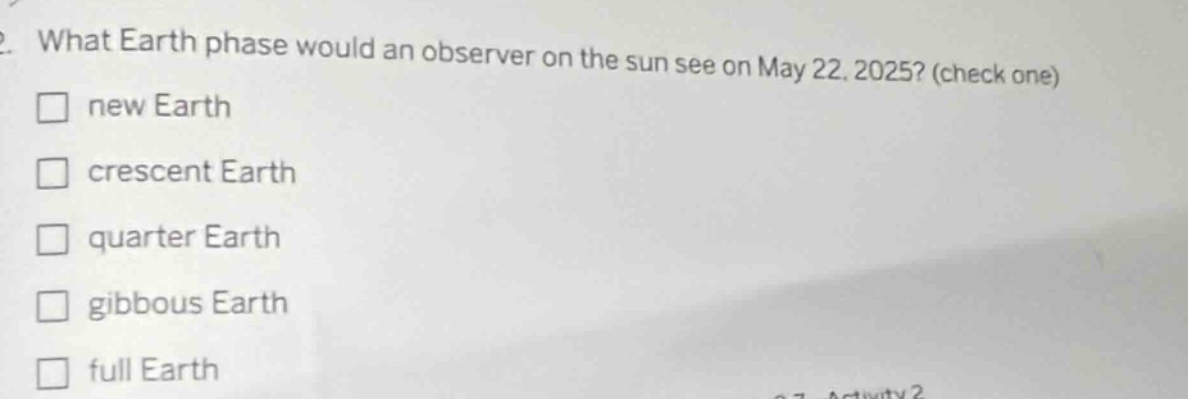
- what earth phase would an observer on the sun see on may 22, 2025? (check one)
□ new earth
□ crescent earth
□ quarter earth
□ gibbous earth
□ full earth
The Earth's phase as seen from the Sun is the opposite of the Moon's phase as seen from Earth (due to the Sun - Earth - Moon geometry). On May 22, 2025, the Moon's phase around that time: around May 22, 2025, the Moon is near the full Moon phase (full Moon in 2025 around May 25). So from the Sun, the Earth's phase would be the opposite. When the Moon is full (as seen from Earth), the Earth as seen from the Sun would be new? Wait, no. Wait, the Earth - Sun - Moon alignment: when we see a full Moon, the Earth is between the Sun and the Moon. So from the Sun, the Earth would have the side facing the Moon (which is the night side of Earth) and the side facing the Sun (day side). Wait, actually, the phase of Earth as seen from the Sun is related to the Moon's phase. The key is that the phase of Earth from the Sun is the complement of the Moon's phase from Earth. If the Moon is near full (as it is around late May), then from the Sun, the Earth would be near new? No, wait, let's think again. The Moon's phase: new Moon is when Moon is between Sun and Earth. Full Moon is when Earth is between Sun and Moon. So when Earth is between Sun and Moon (full Moon for Moon), then from the Sun, the Earth has the side facing the Moon (which is the night side of Earth) and the side facing the Sun (day side). Wait, no, the phase of Earth as seen from the Sun: the illuminated part of Earth as seen from the Sun is the day side. But the phase we are talking about here is similar to lunar phases, but for Earth. The "full Earth" from the Sun would be when the entire day - side is visible, but actually, the phase of Earth as seen from the Sun is the opposite of the Moon's phase. Let's recall: when the Moon is new (Moon between Sun and Earth), from the Sun, Earth would be full (because the side of Earth facing the Sun is fully illuminated, and the Moon is in front of Earth? No, maybe I got it reversed. Let's use the concept of opposition and conjunction. The Moon and Earth: when the Moon is in conjunction with the Sun (new Moon), the Earth as seen from the Sun would have the Moon on the same side as the Sun - facing side of Earth? No, perhaps a better way: the phase of Earth as seen from the Sun is called the "Earth phase" and it's the complement of the lunar phase. So if the Moon is in a certain phase, the Earth is in the opposite phase. For example, when the Moon is new (0% illuminated as seen from Earth), the Earth as seen from the Sun is full (100% illuminated, because the side of Earth facing the Sun is fully lit, and the Moon is between Sun and Earth, so from the Sun, Earth's day side is fully visible, with the Moon as a dark spot? No, maybe not. Wait, the question is about May 22, 2025. Let's check the lunar phase for May 22, 2025. According to lunar calendars, around May 22, 2025, the Moon is a waxing gibbous, approaching full Moon (full Moon on May 25, 2025). So the Moon is almost full. Now, the phase of Earth as seen from the Sun: when the Moon is full (Earth between Sun and Moon), from the Sun, the Earth would have the side facing the Moon (night side) and the side facing the Sun (day side). Wait, no, the phase of Earth as seen from the Sun is determined by how much of the Earth's illuminated (by Sun) side is visible from the Sun. But actually, the key point is that the phase of Earth from the Sun is the opposite of the Moon's phase from Earth. So when the Moon is gibbous (waxing, approaching full), the Earth from the Sun is crescent (waning, approaching new)? No, that doesn't seem right. Wait, maybe the correct approach is: the Earth's phase as seen f…

Snap & solve any problem in the app
Get step-by-step solutions on Sovi AI
Photo-based solutions with guided steps
Explore more problems and detailed explanations
crescent Earth