QUESTION IMAGE
Question
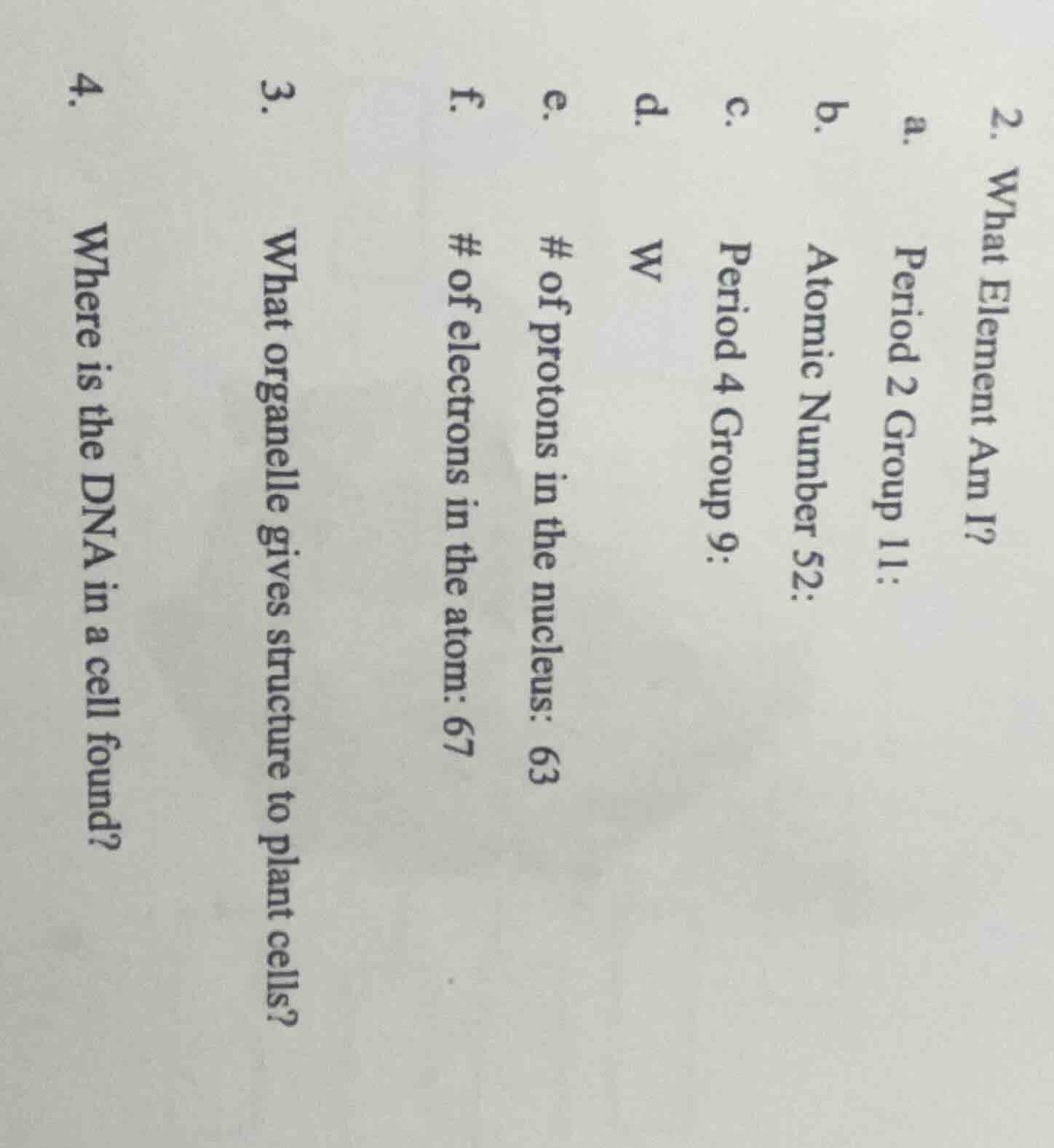
- what element am i?
a. period 2 group 11:
b. atomic number 52:
c. period 4 group 9:
d. w
e. # of protons in the nucleus: 63
f. # of electrons in the atom: 67
- what organelle gives structure to plant cells?
- where is the dna in a cell found?
Question 2a: What Element Am I? (Period 2 Group 11)
To determine the element in Period 2, Group 11, we use the periodic table. Period 2 has elements with principal quantum number \( n = 2 \). Group 11 (IB) in Period 2: The electron configuration for Group 11 elements is \( (n - 1)d^{10}ns^1 \). For Period 2 (\( n = 2 \)), the inner shell is \( n = 1 \), so \( 1s^2 2s^2 2p^6 3d^{10} 4s^1 \) is for Period 4, but wait—Period 2 has \( n = 2 \), so the maximum \( n = 2 \). Wait, Group 11 in Period 2: Wait, actually, Period 2 elements have electrons in \( n = 1 \) and \( n = 2 \). Group 11 (11th column) in Period 2: Let's check atomic numbers. Period 2: elements from Li (Z=3) to Ne (Z=10). Group 11 (IB) starts at Cu (Z=29, Period 4). Wait, maybe a typo? Wait, no—wait, Period 2, Group 11: Wait, the periodic table's Period 2 has no Group 11 element because Group 11 (IB) elements are in Periods 4, 5, 6, 7 (Cu, Ag, Au, Rg). Wait, maybe the question is miswritten? Or maybe "Period 4 Group 11"? Wait, no, the question says Period 2 Group 11. Wait, maybe a mistake. Alternatively, maybe "Group 1" (alkali metals) in Period 2 is Li, Group 2 is Be, etc. Wait, Group 11 (11th group) in Period 2: There is no element in Period 2, Group 11, because Period 2 has elements with \( n = 2 \), and Group 11 requires \( d \)-orbitals (which start at \( n = 3 \) for \( 3d \)). So perhaps a typo, but if we assume Period 4 Group 11, that's Cu, but Period 2 Group 11: no element exists. Wait, maybe the question is Period 4 Group 11? Wait, the original question: "Period 2 Group 11". Let's recheck. Period 2: \( n = 2 \), so electrons in \( 1s, 2s, 2p \). Group 11: valence electron configuration \( ns^1 \) with \( (n - 1)d^{10} \). For \( n = 2 \), \( (n - 1) = 1 \), so \( 1d^{10} \), but \( d \)-orbitals start at \( n = 3 \) (3d). So \( 1d \) is not possible. Thus, no element in Period 2, Group 11. But maybe the question meant Period 4 Group 11? Then it's Copper (Cu). Alternatively, maybe "Group 1" (1st group) in Period 2 is Li (Z=3), Group 2 is Be (Z=4), Group 13 (IIIA) is B (Z=5), Group 14 (IVA) C (Z=6), Group 15 (VA) N (Z=7), Group 16 (VIA) O (Z=8), Group 17 (VIIA) F (Z=9), Group 18 (VIIIA) Ne (Z=10). So Group 11 in Period 2: no element. Maybe a mistake.
Question 2b: Atomic Number 52
The atomic number (Z) is the number of protons. Element with Z=52 is Tellurium (Te). Tellurium is in Period 5, Group 16 (VIA), with atomic number 52.
Question 2c: Period 4 Group 9
Period 4: \( n = 4 \), Group 9 (IXB) in the periodic table. Group 9 elements have electron configuration \( (n - 1)d^7 ns^2 \) (for \( n = 4 \), \( 3d^7 4s^2 \)). The element in Period 4, Group 9 is Cobalt (Co, Z=27)? Wait, no: Period 4, Group 9: elements are Co (Z=27), Rh (Z=45, Period 5), Ir (Z=77, Period 6), Mt (Z=109, Period 7). Wait, Period 4, Group 9: Cobalt? No, wait, Group 9: the 9th column. Period 4: from K (Z=19) to Kr (Z=36). Group 9: Z=27 (Co), Z=45 (Rh, Period 5), etc. So Period 4, Group 9 is Cobalt (Co)? Wait, no: Group 9, Period 4: the element is Cobalt? Wait, no, Group 9 (IXB) in Period 4: the electron configuration is \( 1s^2 2s^2 2p^6 3s^2 3p^6 3d^7 4s^2 \), which is Cobalt (Co, Z=27).
Question 2d: W (Element Symbol)

Snap & solve any problem in the app
Get step-by-step solutions on Sovi AI
Photo-based solutions with guided steps
Explore more problems and detailed explanations
In eukaryotic cells (plant, animal, fungal), DNA is primarily found in the nucleus (as chromatin or chromosomes). Additionally, mitochondria (in all eukaryotes) and chloroplasts (in plant cells) contain their own DNA (mtDNA and cpDNA, respectively). In prokaryotic cells (bacteria, archaea), DNA is in the nucleoid region (a non-membrane-bound area) and sometimes in plasmids. For typical eukaryotic cells (like plant or animal), the main location is the nucleus, with secondary locations in mitochondria (and chloroplasts in plants).