QUESTION IMAGE
Question
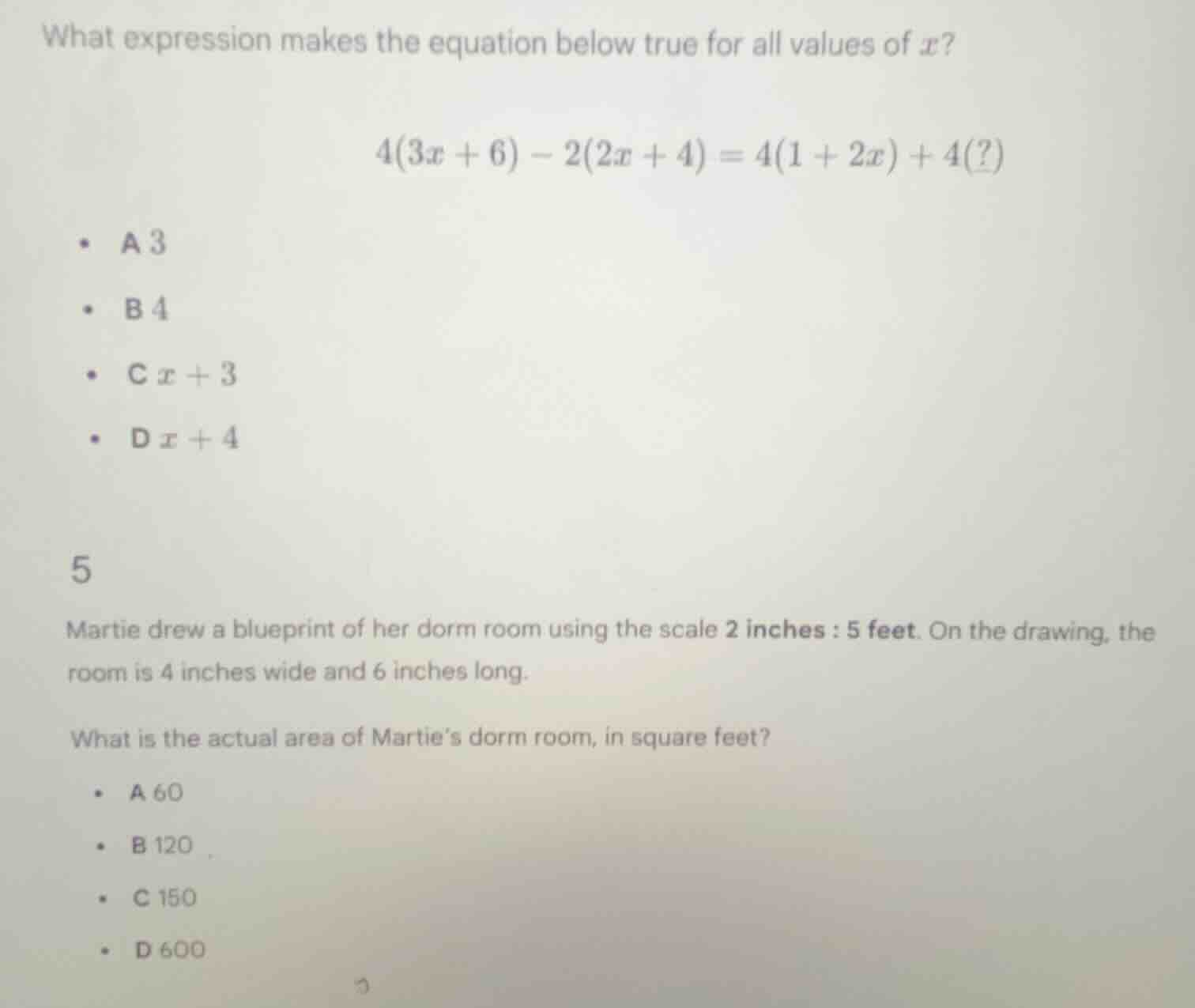
what expression makes the equation below true for all values of x?
$4(3x + 6) - 2(2x + 4) = 4(1 + 2x) + 4(?)$
- a 3
- b 4
- c $x + 3$
- d $x + 4$
5
martie drew a blueprint of her dorm room using the scale 2 inches : 5 feet. on the drawing, the room is 4 inches wide and 6 inches long.
what is the actual area of martie’s dorm room, in square feet?
- a 60
- b 120
- c 150
- d 600
Question 1:
Step1: Simplify left side
First, expand the left - hand side of the equation \(4(3x + 6)-2(2x + 4)\).
Using the distributive property \(a(b + c)=ab+ac\), we have:
\(4(3x)+4\times6-2(2x)-2\times4 = 12x + 24-4x - 8\)
Combine like terms: \((12x-4x)+(24 - 8)=8x+16\)
Step2: Simplify right side
Expand the right - hand side of the equation \(4(1 + 2x)+4(?)\).
Using the distributive property, we get \(4\times1+4\times2x + 4(?)=4 + 8x+4(?)\)
Combine like terms: \(8x+(4 + 4(?))\)
Step3: Solve for (?)
Since the left - hand side \(8x + 16\) is equal to the right - hand side \(8x+(4 + 4(?))\) for all \(x\), we can set the constant terms equal to each other:
\(16=4 + 4(?)\)
Subtract 4 from both sides: \(16-4=4(?)\)
\(12 = 4(?)\)
Divide both sides by 4: \(?=\frac{12}{4}=3\)
Step1: Find the actual width
The scale is \(2\) inches : \(5\) feet. Let the actual width be \(w\) feet.
We know that \(\frac{2}{5}=\frac{4}{w}\) (because the ratio of drawing length to actual length is constant).
Cross - multiply: \(2w=5\times4\)
\(2w = 20\)
Divide both sides by 2: \(w = 10\) feet.
Step2: Find the actual length
Let the actual length be \(l\) feet. Using the scale \(\frac{2}{5}=\frac{6}{l}\)
Cross - multiply: \(2l=5\times6\)
\(2l=30\)
Divide both sides by 2: \(l = 15\) feet.
Step3: Calculate the actual area
The area of a rectangle is \(A=l\times w\).
Substitute \(l = 15\) and \(w = 10\) into the formula: \(A=15\times10 = 150\) square feet.

Snap & solve any problem in the app
Get step-by-step solutions on Sovi AI
Photo-based solutions with guided steps
Explore more problems and detailed explanations
A. 3