QUESTION IMAGE
Question
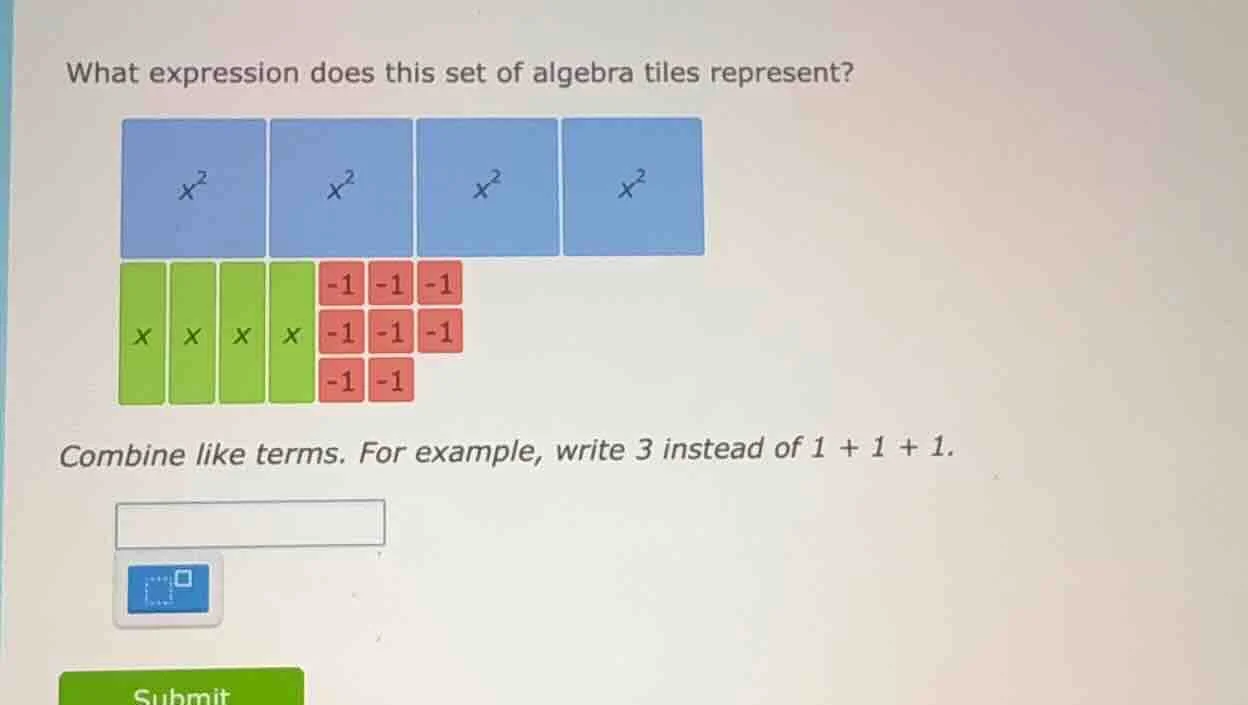
what expression does this set of algebra tiles represent?
combine like terms. for example, write 3 instead of 1 + 1 + 1.
Step1: Count \( x^2 \) tiles
There are 4 tiles with \( x^2 \), so the term is \( 4x^2 \).
Step2: Count \( x \) tiles
There are 4 tiles with \( x \), so the term is \( 4x \).
Step3: Count \(-1\) tiles
Count the red \(-1\) tiles: \( 3 + 3 + 2 = 8 \)? Wait, no, let's count again. First row of red: 3, second row: 3, third row: 2. Wait, no, looking at the image: first red row (top) 3, second red row (middle) 3, third red row (bottom) 2? Wait, no, the red tiles: let's see, the red tiles are arranged as three in first row, three in second, two in third? Wait, no, the problem's image: the red tiles are -1, -1, -1 (first row), -1, -1, -1 (second row), -1, -1 (third row)? Wait, no, maybe I miscounted. Wait, the green \( x \) tiles are 4, then red tiles: let's count the number of -1s. Let's see: first column of red: 3 (top), 3 (middle), 2 (bottom)? No, maybe the red tiles are 3 + 3 + 2 = 8? Wait, no, let's look again. The problem says "Combine like terms". Let's count each type:
- \( x^2 \) tiles: 4, so \( 4x^2 \)
- \( x \) tiles: 4, so \( 4x \)
- \(-1\) tiles: let's count the red squares. First row of red: 3, second row: 3, third row: 2? Wait, no, maybe the red tiles are 3 + 3 + 2 = 8? Wait, no, maybe the image is: the red tiles are arranged as three in the first row, three in the second, and two in the third? Wait, no, perhaps the red tiles are 3 + 3 + 2 = 8? Wait, no, let's check again. The user's image: "x x x x" (4 green), then red tiles: "-1 -1 -1" (first row), "-1 -1 -1" (second row), "-1 -1" (third row). So that's 3 + 3 + 2 = 8? Wait, 3 + 3 is 6, plus 2 is 8? So \(-8\)? Wait, no, maybe I made a mistake. Wait, let's count the number of -1 tiles:
First row of red: 3 (so 3*(-1))
Second row of red: 3 (so 3*(-1))
Third row of red: 2 (so 2*(-1))
Total -1 tiles: 3 + 3 + 2 = 8? So \(-8\)?
Wait, no, maybe the red tiles are 3 + 3 + 2 = 8? So the expression is \( 4x^2 + 4x - 8 \)? Wait, but let's check again. Wait, maybe the red tiles are 3 + 3 + 2 = 8? Let's confirm:
- \( x^2 \): 4 tiles → \( 4x^2 \)
- \( x \): 4 tiles → \( 4x \)
- \(-1\): let's count the number of red squares. Let's see the image: the red tiles are:
Row 1 (top red): 3
Row 2 (middle red): 3
Row 3 (bottom red): 2
So 3 + 3 + 2 = 8. So \(-8\).
So combining like terms: \( 4x^2 + 4x - 8 \)
Wait, but maybe I miscounted the red tiles. Let's check again. The problem's image:
The blue \( x^2 \) tiles: 4.
Green \( x \) tiles: 4.
Red \(-1\) tiles: let's count the number of red squares. Let's see, the red tiles are arranged as three in the first row, three in the second, and two in the third. So 3 + 3 + 2 = 8. So the expression is \( 4x^2 + 4x - 8 \).
Wait, but maybe the red tiles are 3 + 3 + 2 = 8? Let's confirm. So the steps:
- Count \( x^2 \) terms: 4 → \( 4x^2 \)
- Count \( x \) terms: 4 → \( 4x \)
- Count \(-1\) terms: 8 → \( -8 \)
So the expression is \( 4x^2 + 4x - 8 \).

Snap & solve any problem in the app
Get step-by-step solutions on Sovi AI
Photo-based solutions with guided steps
Explore more problems and detailed explanations
\( 4x^2 + 4x - 8 \)