QUESTION IMAGE
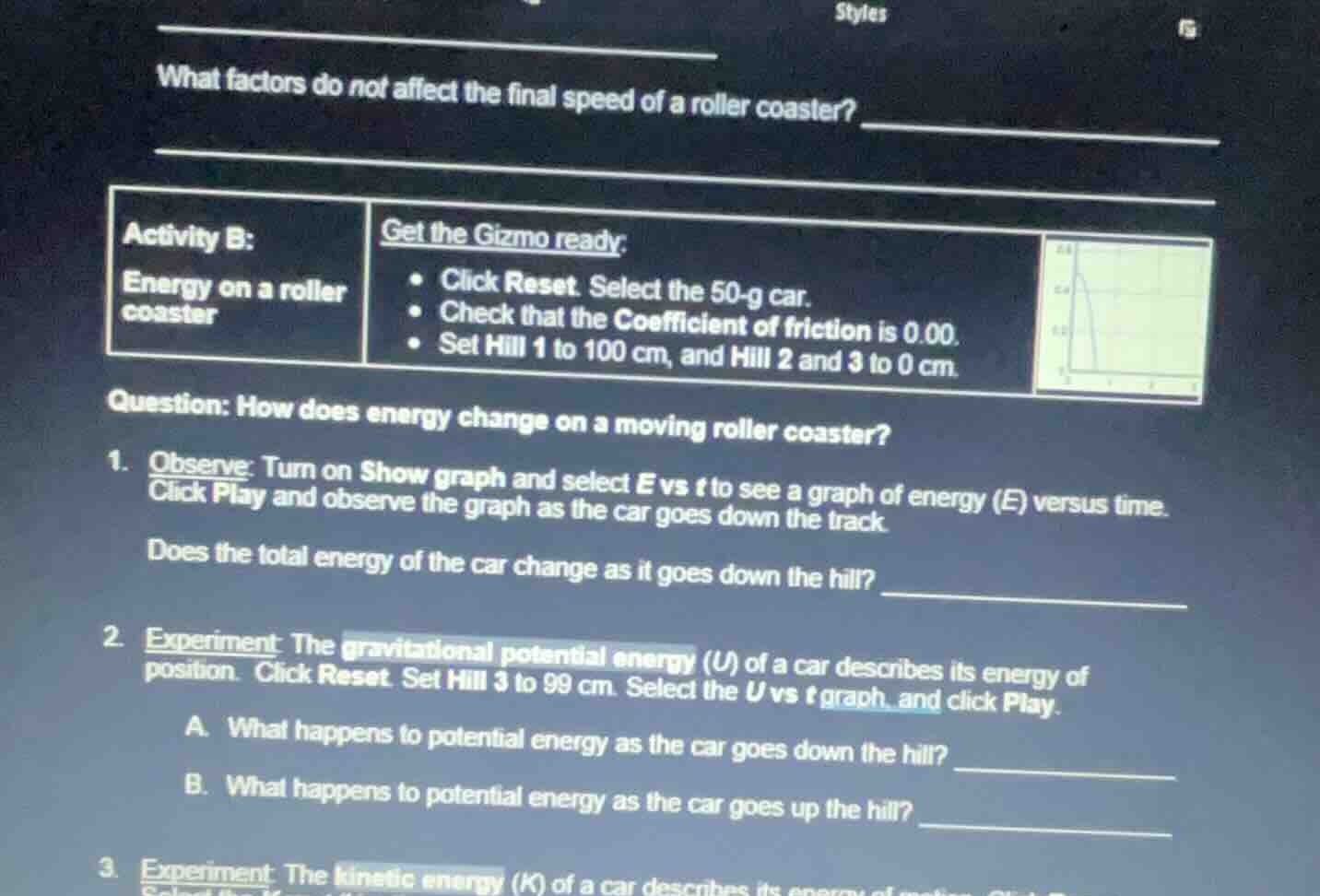
Question
what factors do not affect the final speed of a roller coaster?
activity b:
energy on a roller coaster
get the gizmo ready:
- click reset. select the 50 - g car.
- check that the coefficient of friction is 0.00.
- set hill 1 to 100 cm, and hill 2 and 3 to 0 cm.
question: how does energy change on a moving roller coaster?
- observe: turn on show graph and select e vs t to see a graph of energy (e) versus time. click play and observe the graph as the car goes down the track.
does the total energy of the car change as it goes down the hill?
- experiment: the gravitational potential energy (u) of a car describes its energy of position. click reset. set hill 3 to 99 cm. select the u vs t graph, and click play.
a. what happens to potential energy as the car goes down the hill?
b. what happens to potential energy as the car goes up the hill?
- experiment: the kinetic energy (k) of a car describes its energy of motion
For the initial question "What factors do not affect the final speed of a roller coaster?" (assuming ideal conditions with no friction as in the Gizmo setup where coefficient of friction is 0.00):
In an ideal, frictionless roller - coaster system (conservative system), the final speed at the bottom of the track depends on the initial height (due to conservation of mechanical energy, \(E = K+U=\frac{1}{2}mv^{2}+mgh\), and if energy is conserved, \(mgh_{initial}=\frac{1}{2}mv_{final}^{2}\) so \(v_{final}=\sqrt{2gh_{initial}}\) where \(g\) is acceleration due to gravity and \(h_{initial}\) is the initial height). Factors like the mass of the roller - coaster car (since it cancels out in the energy equation), the horizontal distance traveled (as only vertical height change matters for gravitational potential energy change), and in the frictionless case, friction (but here friction is set to 0) do not affect the final speed. For example, from the conservation of mechanical energy formula \(mgh=\frac{1}{2}mv^{2}\), we can see that mass \(m\) cancels, so mass does not affect the final speed. Also, the shape of the track (as long as the initial and final heights are the same) does not affect the final speed in a frictionless system.
In a system with no friction (conservative system), mechanical energy (sum of kinetic energy \(K=\frac{1}{2}mv^{2}\) and gravitational potential energy \(U = mgh\)) is conserved. As the car goes down the hill, gravitational potential energy decreases (since height \(h\) decreases) and kinetic energy increases (since speed \(v\) increases). But the sum of kinetic and potential energy (total mechanical energy) remains constant because there is no non - conservative force (like friction) doing work to dissipate energy.
Gravitational potential energy is given by the formula \(U=mgh\), where \(m\) is the mass of the car, \(g\) is the acceleration due to gravity, and \(h\) is the height of the car above a reference point. As the car goes down the hill, the height \(h\) of the car decreases. Since \(m\) and \(g\) are constant (in a given location, \(g\) is constant and the mass of the car is constant), the gravitational potential energy \(U\) will decrease.

Snap & solve any problem in the app
Get step-by-step solutions on Sovi AI
Photo-based solutions with guided steps
Explore more problems and detailed explanations
In a frictionless (ideal) roller - coaster system, factors such as the mass of the roller - coaster car, the horizontal distance traveled (as long as the vertical height change is constant), and the shape of the track (for a given initial and final height) do not affect the final speed. For example, the mass of the car (since it cancels out in the conservation of mechanical energy equation \(mgh=\frac{1}{2}mv^{2}\) leading to \(v = \sqrt{2gh}\)) does not affect the final speed.