QUESTION IMAGE
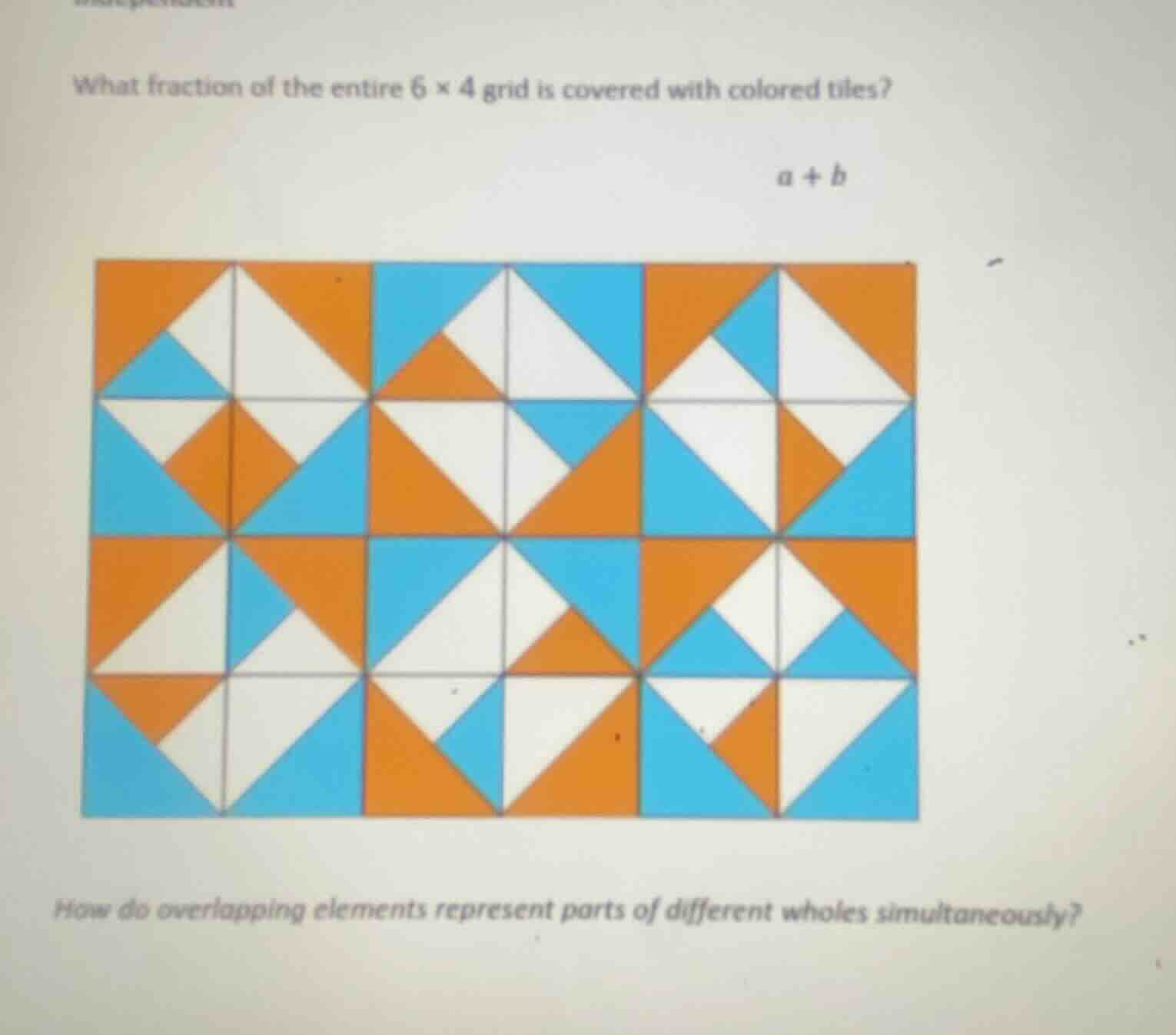
Question
what fraction of the entire 6 × 4 grid is covered with colored tiles?
how do overlapping elements represent parts of different wholes simultaneously?
Step1: Calculate total tiles in grid
The grid is \(6\times4\), so total number of unit squares (assuming each small square is a unit) is \(6\times4 = 24\) unit squares. But looking at the pattern, each unit square is divided into 4 triangles (since each square has 4 triangular parts when considering the diagonals and other divisions? Wait, actually, let's count the number of triangular tiles or the area. Wait, maybe better to count the number of colored (orange and blue) regions. Alternatively, notice that each \(2\times2\) sub - grid? Wait, no, the grid is 6 columns and 4 rows of small squares. Let's count the number of small squares: \(6\times4 = 24\) small squares. Now, each small square can be divided into 4 triangles, but maybe a better approach: count the number of colored (orange + blue) parts. Let's count the orange and blue areas.
Wait, another way: Let's count the number of small squares that are at least partially colored. Wait, no, let's look at the figure. Let's count the number of orange and blue regions. Let's count row by row.
First, let's consider that each "cell" (small square) has some colored parts. Let's count the number of colored (orange or blue) triangles or squares. Wait, maybe a simpler approach: The total number of small squares is \(6\times4=24\). Now, let's count the number of white squares. Let's find the number of white regions.
Looking at the figure, let's count the white squares (or white - colored regions). Let's see:
In each \(2\times2\) block? Wait, the grid is 6 columns (so 3 sets of 2 columns) and 4 rows (2 sets of 2 rows). Let's take a \(2\times2\) sub - grid. Wait, maybe count the number of white unit squares. Let's look at the figure:
First row (top row):
- First \(2\times2\) sub - grid (columns 1 - 2, row 1 - 2? No, row 1 is top row). Wait, maybe count the number of white triangles or squares.
Wait, perhaps a better way: Let's count the number of colored (orange + blue) squares. Let's count the number of orange and blue small squares (treating each small square as a unit, and if a square has any colored part, but no, let's see the actual coloring.
Wait, let's count the number of small squares that are colored (orange or blue). Let's go column by column and row by row:
Row 1 (top row, row 1):
- Column 1: colored (orange and blue)
- Column 2: colored (orange and blue)
- Column 3: colored (blue and orange)
- Column 4: colored (blue and orange)
- Column 5: colored (orange and blue)
- Column 6: colored (orange and blue)
Row 2:
- Column 1: colored (blue and orange)
- Column 2: colored (blue and orange)
- Column 3: colored (orange and blue)
- Column 4: colored (orange and blue)
- Column 5: colored (blue and orange)
- Column 6: colored (blue and orange)
Row 3:
- Column 1: colored (orange and blue)
- Column 2: colored (orange and blue)
- Column 3: colored (blue and orange)
- Column 4: colored (blue and orange)
- Column 5: colored (orange and blue)
- Column 6: colored (orange and blue)
Row 4 (bottom row):
- Column 1: colored (blue and orange)
- Column 2: colored (blue and orange)
- Column 3: colored (orange and blue)
- Column 4: colored (orange and blue)
- Column 5: colored (blue and orange)
- Column 6: colored (blue and orange)
Wait, maybe this is not the right way. Let's count the number of white squares. Let's find the number of white - colored unit squares.
Looking at the figure, let's count the white squares:
Let's count the number of white unit squares (each small square that is white). Let's see:
In the top row (row 1):
- The white regions: Let's count the number of white squar…

Snap & solve any problem in the app
Get step-by-step solutions on Sovi AI
Photo-based solutions with guided steps
Explore more problems and detailed explanations
\(\frac{2}{3}\)