QUESTION IMAGE
Question
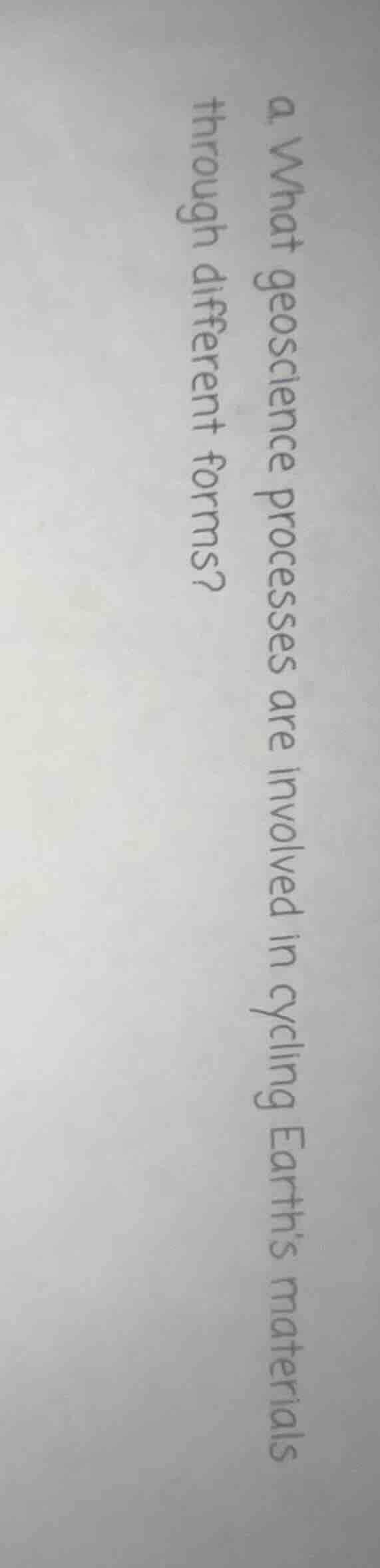
a. what geoscience processes are involved in cycling earths materials through different forms?
Brief Explanations
To determine geoscience processes for cycling Earth's materials, we analyze key processes:
- Rock Cycle: Involves igneous (magma cooling), sedimentary (weathering, erosion, deposition, lithification), and metamorphic (heat/pressure alteration) processes. Drives transformation of rock types (e.g., granite → sediment → shale → slate).
- Hydrologic Cycle: Includes evaporation (liquid → gas), condensation (gas → liquid), precipitation (liquid/solid to Earth), infiltration (water into soil), runoff (surface flow), and groundwater flow. Cycles water (and dissolved materials) through atmosphere, hydrosphere, lithosphere, and biosphere.
- Carbon Cycle: Combines geologic (fossil fuel formation, volcanic CO₂ release, limestone weathering) and biologic (photosynthesis, respiration, decomposition) processes. Cycles carbon between atmosphere, biosphere, hydrosphere, and lithosphere (e.g., CO₂ → organic matter → sedimentary rock → CO₂ via weathering/volcanism).
- Nutrient Cycles (e.g., Nitrogen, Phosphorus): Involve weathering (releasing nutrients from rocks), biological uptake (plants/animals), decomposition (returning nutrients to soil), and geologic storage (nutrients in sediments/rocks). Cycles essential elements for ecosystems.
- Tectonic Processes: Plate movement drives subduction (oceanic crust into mantle, recycling materials), mountain building (exposing rocks to weathering), and volcanic activity (releasing mantle materials to surface). Recycles lithospheric materials between crust and mantle.
- Weathering and Erosion: Physical (mechanical) weathering (e.g., freeze - thaw, abrasion) and chemical weathering (e.g., oxidation, hydrolysis) break down rocks. Erosion (wind, water, ice, gravity) transports sediments, moving materials from source to deposition (e.g., river → delta, glacier → moraine).
- Magmatic Processes: Magma generation (partial melting of mantle/crust), differentiation (magma composition change), and emplacement (intrusive/extrusive igneous rocks) create new rock materials and recycle mantle/crustal components.
These processes interact, cycling Earth's materials (rocks, water, elements, gases) across spatial and temporal scales.

Snap & solve any problem in the app
Get step-by-step solutions on Sovi AI
Photo-based solutions with guided steps
Explore more problems and detailed explanations
Geoscience processes for cycling Earth's materials include:
- Rock Cycle: Igneous (magma cooling), sedimentary (weathering, erosion, deposition, lithification), and metamorphic (heat/pressure - driven alteration) processes transform rock types.
- Hydrologic Cycle: Evaporation, condensation, precipitation, infiltration, runoff, and groundwater flow cycle water (and dissolved materials) through Earth's spheres.
- Carbon Cycle: Combines geologic (fossil fuel formation, volcanic CO₂ release, limestone weathering) and biologic (photosynthesis, respiration, decomposition) processes to cycle carbon.
- Nutrient Cycles (e.g., Nitrogen, Phosphorus): Involve weathering (nutrient release from rocks), biological uptake, decomposition, and geologic storage.
- Tectonic Processes: Plate movement (subduction, mountain building, volcanic activity) recycles lithospheric materials between crust and mantle.
- Weathering and Erosion: Physical/chemical weathering breaks down rocks; erosion (wind, water, ice, gravity) transports sediments.
- Magmatic Processes: Magma generation, differentiation, and emplacement create new rocks and recycle mantle/crustal components.