QUESTION IMAGE
Question
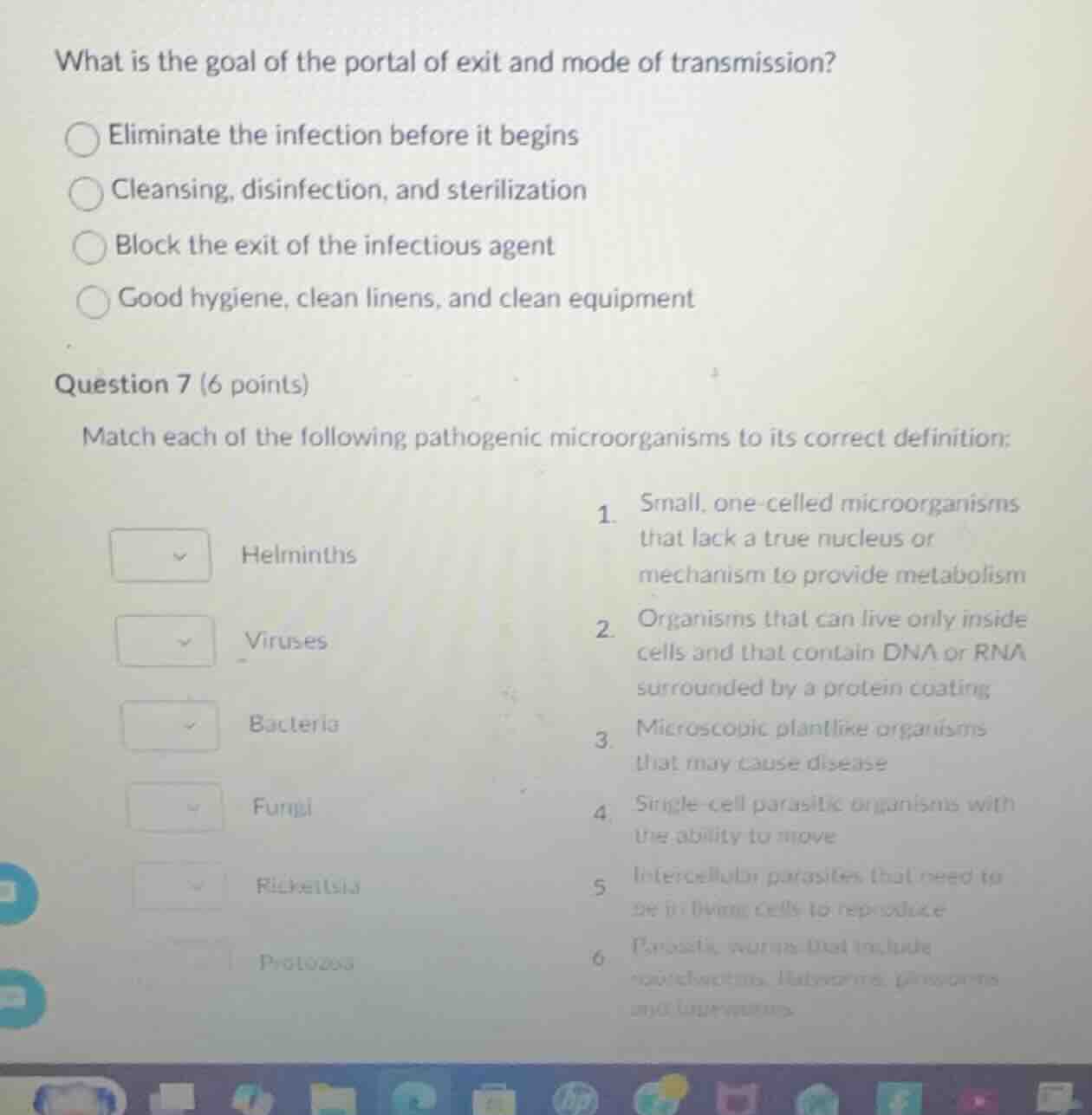
what is the goal of the portal of exit and mode of transmission?
eliminate the infection before it begins
cleansing, disinfection, and sterilization
block the exit of the infectious agent
good hygiene, clean linens, and clean equipment
question 7 (6 points)
match each of the following pathogenic microorganisms to its correct definition:
helminths
viruses
bacteria
fungi
rickettsia
protozoa
- small, one - celled microorganisms that lack a true nucleus or mechanism to provide metabolism
- organisms that can live only inside cells and that contain dna or rna surrounded by a protein coating
- microscopic plant - like organisms that may cause disease
- single - cell parasitic organisms with the ability to move
- intercellular parasites that need to be in living cells to reproduce
- parasitic worms that include roundworms, flatworms, pinworms and tapeworms
Response
First Question (Multiple Choice)
Brief Explanations
To determine the goal of the portal of exit and mode of transmission, we analyze each option:
- "Eliminate the infection before it begins" is about prevention at an earlier stage, not related to portal of exit/transmission.
- "Cleansing, disinfection, and sterilization" are general infection control methods, not specific to portal of exit/transmission.
- "Block the exit of the infectious agent" directly relates to the portal of exit (stopping the agent from leaving the reservoir) and mode of transmission (preventing spread by blocking exit).
- "Good hygiene, clean linens, and clean equipment" are general hygiene practices, not specific to portal of exit/transmission.
Brief Explanations
- Helminths: These are parasitic worms (e.g., roundworms, tapeworms), so they match definition 6 ("Parasitic worms that include roundworms, flatworms, pinworms, and tapeworms").
- Viruses: Viruses are organisms that can only live inside cells and have DNA/RNA surrounded by a protein coating, matching definition 2.
- Bacteria: Bacteria are small, one - celled microorganisms without a true nucleus (prokaryotes) and have their own metabolism mechanisms (though the option says "lack a mechanism to provide metabolism" which might be a simplification), matching definition 1.
- Fungi: Fungi are microscopic plant - like organisms (some are macroscopic, but in the context of pathogens, many are microscopic) that can cause disease, matching definition 3.
- Rickettsia: Rickettsia are intercellular parasites that need living cells to reproduce, matching definition 5.
- Protozoa: Protozoa are single - cell parasitic organisms with the ability to move, matching definition 4.

Snap & solve any problem in the app
Get step-by-step solutions on Sovi AI
Photo-based solutions with guided steps
Explore more problems and detailed explanations
C. Block the exit of the infectious agent