QUESTION IMAGE
Question
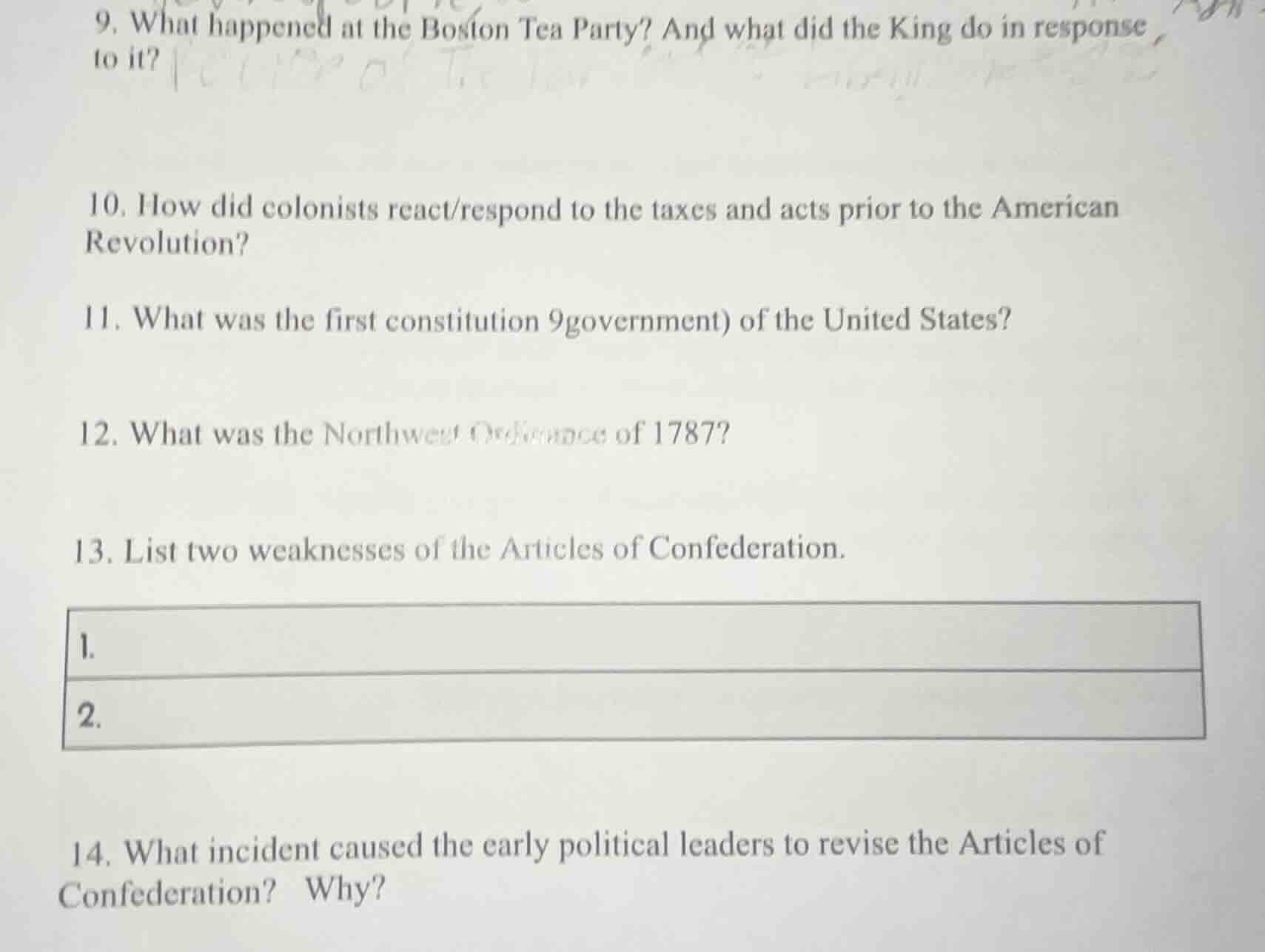
- what happened at the boston tea party? and what did the king do in response to it?10. how did colonists react/respond to the taxes and acts prior to the american revolution?11. what was the first constitution (government) of the united states?12. what was the northwest ordinance of 1787?13. list two weaknesses of the articles of confederation.1.2.14. what incident caused the early political leaders to revise the articles of confederation? why?
Brief Explanations
- The Boston Tea Party was a 1773 protest where American colonists, frustrated by British tea taxes and lack of representation, dumped 342 chests of British East India Company tea into Boston Harbor. In response, King George III and Parliament passed the Coercive Acts (called Intolerable Acts by colonists): closed Boston Harbor until the tea was paid for, revoked Massachusetts' self-government, allowed British officials accused of crimes to be tried in Britain, and quartered British troops in colonists' homes.
- Colonists responded with organized protests: they boycotted British goods, formed groups like the Sons of Liberty to lead demonstrations, argued against "taxation without representation" in writings and speeches, staged acts of civil disobedience (like the Boston Tea Party), and eventually held the First Continental Congress to coordinate unified resistance against British policies.
- The first constitution (government framework) of the United States was the Articles of Confederation, ratified in 1781.
- The Northwest Ordinance of 1787 was a federal law that established a process for admitting new states to the Union from the Northwest Territory (modern-day Ohio, Indiana, Illinois, Michigan, Wisconsin, and part of Minnesota). It also banned slavery in the territory, guaranteed basic rights to settlers, and set up a three-stage system for territorial self-government leading to statehood.
- Two key weaknesses of the Articles of Confederation:
- The federal government had no power to tax, so it could not raise funds for national needs like military defense or paying debts.
- The federal government could not regulate interstate or foreign trade, leading to economic disputes between states and difficulties in negotiating trade deals with other nations.
- Shays' Rebellion (1786-1787) caused leaders to revise the Articles. This uprising of debt-ridden Massachusetts farmers, led by Daniel Shays, protested high taxes and foreclosures. The federal government under the Articles lacked the power to raise a national army to put down the rebellion, exposing how weak and ineffective the national government was at maintaining order and addressing national crises.

Snap & solve any problem in the app
Get step-by-step solutions on Sovi AI
Photo-based solutions with guided steps
Explore more problems and detailed explanations
9.
- Boston Tea Party: In 1773, colonists dumped British tea into Boston Harbor to protest "taxation without representation" and the British East India Company's tea monopoly.
- King's response: Parliament passed the Coercive (Intolerable) Acts, closing Boston Harbor, restricting Massachusetts' self-rule, allowing British officials to be tried in Britain, and permitting troop quartering in colonists' homes.
- Colonists boycotted British goods, formed protest groups (e.g., Sons of Liberty), argued "taxation without representation," staged civil disobedience, and held the First Continental Congress to coordinate resistance.
- The Articles of Confederation
- A 1787 federal law that established rules for admitting new states from the Northwest Territory, banned slavery there, guaranteed settler rights, and created a territorial government system.
13.
- No federal power to tax
- No federal power to regulate trade
14.
- Incident: Shays' Rebellion (1786-1787), an uprising of debt-stricken Massachusetts farmers protesting high taxes and foreclosures.
- Why: The federal government under the Articles of Confederation could not raise a national army to suppress the rebellion, revealing the national government's inability to maintain order and address critical national issues.