QUESTION IMAGE
Question
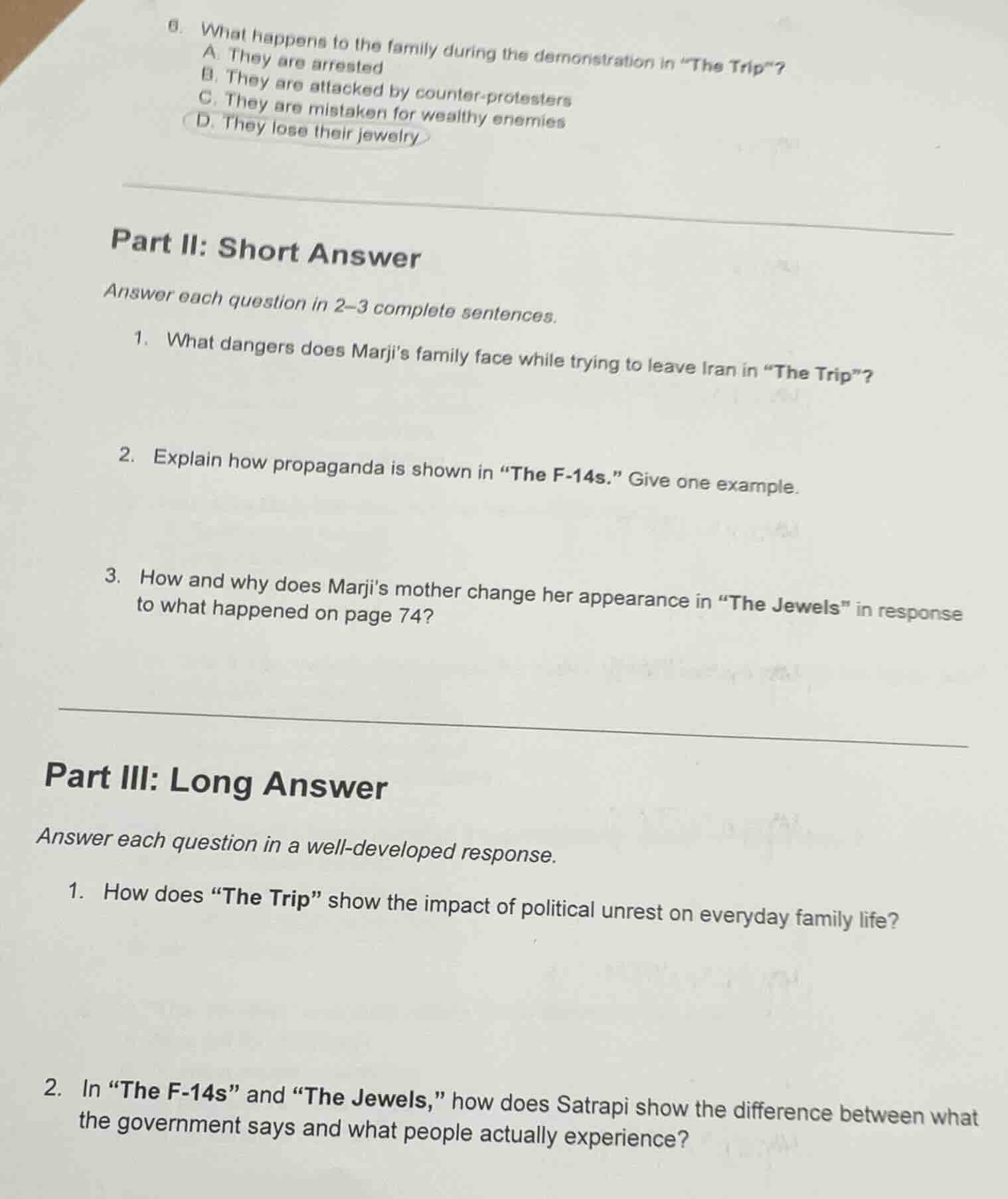
- what happens to the family during the demonstration in \the trip\?
a. they are arrested
b. they are attacked by counter - protesters
c. they are mistaken for wealthy enemies
d. they lose their jewelry
part ii: short answer
answer each question in 2 - 3 complete sentences.
- what dangers does marjis family face while trying to leave iran in \the trip\?
- explain how propaganda is shown in \the f - 14s.\ give one example.
- how and why does marjis mother change her appearance in \the jewels\ in response to what happened on page 74?
part iii: long answer
answer each question in a well - developed response.
- how does \the trip\ show the impact of political unrest on everyday family life?
- in \the f - 14s\ and \the jewels,\ how does satrapi show the difference between what the government says and what people actually experience?
Multiple Choice Question 6:
This refers to the chapter "The Trip" from Persepolis. During the demonstration, Marji's family is targeted by counter-protesters who attack them.
Short Answer 1:
When trying to leave Iran, Marji's family faces the risk of being caught by border guards and imprisoned for attempting to escape the country; they also face the threat of violence or persecution if their plan is discovered, as leaving without proper authorization was severely punished under the regime.
Short Answer 2:
In "The F-14s," propaganda is shown through state-controlled media that frames the Iranian air force's F-14s as powerful, heroic tools of national defense. For example, the government uses cartoons and official announcements to claim the jets are winning decisive victories, even though the reality of the war is far more grim and costly.
Short Answer 3:
On page 74, Marji's mother is harassed and threatened by men for not wearing a proper hijab. In "The Jewels," she changes her appearance by wearing a full chador and adopting a more modest, unassuming look to avoid further harassment and protect herself from the violent enforcement of strict dress codes by religious extremists.
Long Answer 1:
"The Trip" shows political unrest disrupts everyday family life by shattering the family's sense of safety and normalcy. Marji's parents, who once lived relatively freely, are forced to abandon their home and attempt a risky escape after facing violence at a demonstration; the fear of persecution turns a routine desire for a better life into a life-or-death gamble, and the failure of their escape traps them in a constant state of anxiety, altering their relationships and daily routines forever. The chapter also shows how political divisions tear at community bonds, as even neighbors cannot be trusted, making the family feel isolated and vulnerable in their own country.
Long Answer 2:
In "The F-14s," the government claims the Iranian military is dominant in the war, using propaganda to portray F-14 fighter jets as invincible symbols of national pride, but Marji's experience reveals the reality: her family lives in constant fear of air raids, and the war brings death, scarcity, and trauma rather than glory. In "The Jewels," the government enforces strict religious dress codes and frames them as a defense of morality, but Marji's mother experiences the violent, arbitrary enforcement of these rules when she is attacked for her clothing. Satrapi contrasts the state's polished, idealized narratives with the messy, terrifying lived experiences of ordinary people, showing that the government's rhetoric is designed to control rather than reflect the truth of life under the regime.

Snap & solve any problem in the app
Get step-by-step solutions on Sovi AI
Photo-based solutions with guided steps
Explore more problems and detailed explanations
Multiple Choice Question 6:
B. They are attacked by counter-protesters
Short Answer 1:
When trying to leave Iran, Marji's family faces the danger of being arrested and imprisoned by border authorities for attempting to escape without proper approval. They also risk violence or targeted persecution if their escape plan is uncovered, as the regime harshly punished those who tried to leave the country.
Short Answer 2:
Propaganda in "The F-14s" is shown through state media that glorifies Iran's military. For example, official broadcasts and cartoons frame the F-14 fighter jets as unbeatable heroes of the war, even as civilians like Marji live in fear of air raids and face the harsh realities of conflict.
Short Answer 3:
After being harassed and threatened by men on page 74 for not wearing a proper hijab, Marji's mother changes her appearance by wearing a full, conservative chador. She does this to avoid further violent harassment and to comply with the strict, enforced dress codes, prioritizing her safety over her personal style.
Long Answer 1:
"The Trip" illustrates how political unrest upends everyday family life by destroying the family's sense of security and normalcy. Marji's parents, who once enjoyed a relatively liberal lifestyle, are attacked at a pro-democracy demonstration, shattering their belief that they could safely participate in public life. Their desperate, failed attempt to escape Iran turns their home into a place of fear, as they must hide their plans and live with the constant threat of arrest or violence. The experience also strains their relationships: Marji's father is left traumatized by the attack, and the family is forced to abandon their hopes for a better life abroad, trapping them in a country where their basic freedoms are stripped away. The chapter shows that political unrest does not just affect large-scale politics—it invades the most intimate spaces of family life, altering daily routines, relationships, and long-term dreams.
Long Answer 2:
Satrapi contrasts government rhetoric and lived experience in "The F-14s" and "The Jewels" by pairing official propaganda with the raw, unfiltered realities of Marji and her family. In "The F-14s," the government uses state media to portray the Iranian military's F-14 jets as invincible symbols of national strength, claiming they are winning the war and protecting civilians. However, Marji's daily life tells a different story: she and her family hide in bomb shelters during air raids, face food and fuel shortages, and grieve the deaths of friends and family members, exposing the government's lies about the war's progress. In "The Jewels," the government frames strict religious dress codes as a way to uphold morality and protect women, but Marji's mother experiences the violent side of these rules when she is attacked by men for her clothing. Later, when the family is targeted at a demonstration, it becomes clear that the government's focus on "morality" is a tool to control and suppress dissent, not to keep people safe. By juxtaposing these two narratives, Satrapi shows that the government's words are designed to maintain power, while ordinary people are left to endure the consequences of its oppressive policies.