QUESTION IMAGE
Question
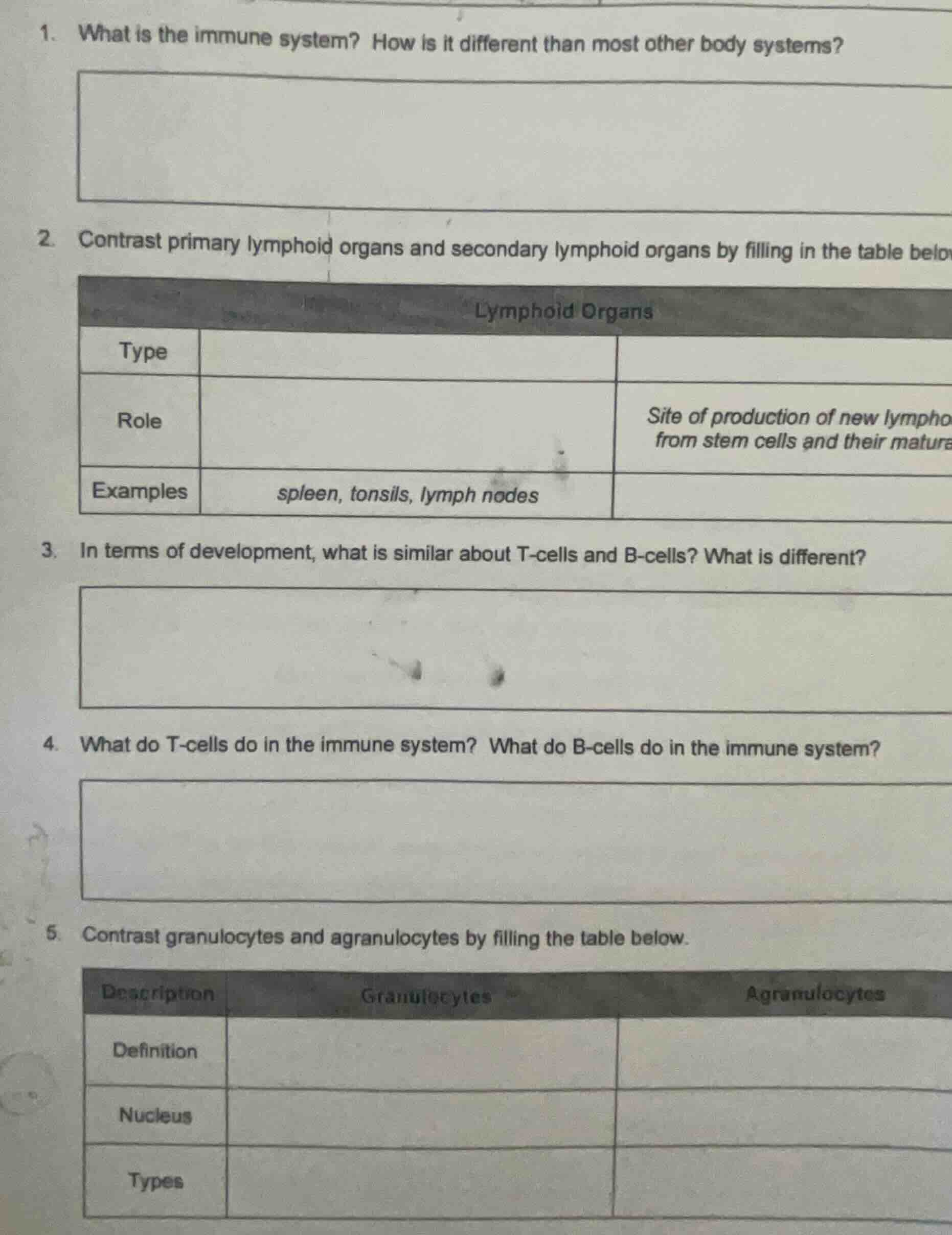
- what is the immune system? how is it different than most other body systems?
- contrast primary lymphoid organs and secondary lymphoid organs by filling in the table belo
lymphoid organs
type
role
site of production of new lympho
from stem cells and their matura
examples
spleen, tonsils, lymph nodes
- in terms of development, what is similar about t - cells and b - cells? what is different?
- what do t - cells do in the immune system? what do b - cells do in the immune system?
- contrast granulocytes and agranulocytes by filling the table below.
description
granulocytes
agranulocytes
definition
nucleus
types
- The immune system is a network of cells, tissues, and organs that defends the body against pathogens and abnormal cells. Unlike most body systems with fixed, structured organs, it is dispersed throughout the body, made of mobile cells and scattered tissues rather than a single cohesive organ structure.
- For the lymphoid organs table:
- The first column is Secondary Lymphoid Organs, whose role is to act as sites for lymphocyte activation and immune response initiation.
- The second column is Primary Lymphoid Organs, with examples being bone marrow and thymus.
- T-cells and B-cells both originate from hematopoietic stem cells in the bone marrow. The key difference is that T-cells mature in the thymus, while B-cells mature in the bone marrow.
- T-cells coordinate adaptive immune responses, kill infected/abnormal cells (cytotoxic T-cells), and help activate other immune cells (helper T-cells). B-cells produce antibodies to target and neutralize pathogens, and can differentiate into memory B-cells for long-term immunity.
- For the granulocytes/agranulocytes table:
- Definition: Granulocytes are white blood cells with visible cytoplasmic granules; Agranulocytes are white blood cells without visible cytoplasmic granules.
- Nucleus: Granulocytes have lobed, irregular nuclei; Agranulocytes have round or kidney-bean shaped, unlobed nuclei.
- Types: Granulocytes include neutrophils, eosinophils, basophils; Agranulocytes include lymphocytes and monocytes.

Snap & solve any problem in the app
Get step-by-step solutions on Sovi AI
Photo-based solutions with guided steps
Explore more problems and detailed explanations
- The immune system is a widespread network of cells, tissues, and organs that protects the body from harmful pathogens, foreign substances, and abnormal cells. It differs from most other body systems because it is not composed of a single, connected set of organs; instead, it is made up of scattered cells and tissues that operate across the entire body rather than a localized, structured organ system.
2.
| Type | Secondary Lymphoid Organs | Primary Lymphoid Organs |
|---|---|---|
| Examples | spleen, tonsils, lymph nodes | bone marrow, thymus |
- Similarity: Both T-cells and B-cells develop from hematopoietic stem cells in the bone marrow.
Difference: T-cells migrate to and mature in the thymus, while B-cells mature in the bone marrow.
- T-cells: Cytotoxic T-cells directly kill infected or cancerous body cells; helper T-cells secrete signals to activate B-cells, macrophages, and other immune cells to mount a coordinated immune response; regulatory T-cells suppress overactive immune responses to prevent autoimmunity.
B-cells: Differentiate into plasma cells that produce and secrete antibodies, which bind to specific pathogens to neutralize them, mark them for destruction by other immune cells, or clump them together for easier removal; also develop into memory B-cells that provide long-term immunity by recognizing the same pathogen quickly upon re-exposure.
5.
| Description | Granulocytes | Agranulocytes |
|---|---|---|
| Nucleus | Have irregular, lobed nuclei (shape varies by type) | Have round, oval, or kidney-bean shaped, unlobed nuclei |
| Types | Neutrophils, eosinophils, basophils | Lymphocytes (T-cells, B-cells), monocytes |