QUESTION IMAGE
Question
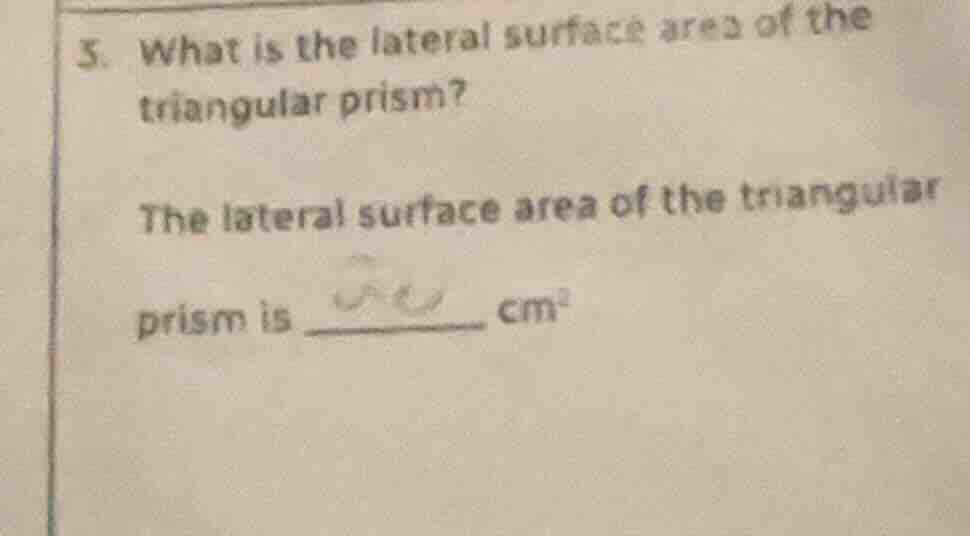
- what is the lateral surface area of the triangular prism? the lateral surface area of the triangular prism is ______ cm²
To find the lateral surface area of a triangular prism, we need the lengths of the sides of the triangular base and the length of the prism (the distance between the two triangular bases). However, since the problem statement in the image does not provide the necessary dimensions (like the side lengths of the triangle and the length of the prism), we can't calculate the lateral surface area directly.
The formula for the lateral surface area (LSA) of a triangular prism is:
$$\text{LSA} = \text{Perimeter of the triangular base} \times \text{Length of the prism}$$
If we assume the triangular base has sides \( a \), \( b \), \( c \) and the length of the prism is \( l \), then:
$$\text{LSA} = (a + b + c) \times l$$
For example, if the triangular base is an equilateral triangle with side \( 5 \, \text{cm} \) and the length of the prism is \( 10 \, \text{cm} \):
Step1: Calculate the perimeter of the triangular base
Perimeter \( = 5 + 5 + 5 = 15 \, \text{cm} \)
Step2: Multiply by the length of the prism
\(\text{LSA} = 15 \times 10 = 150 \, \text{cm}^2\)
But since the original problem lacks specific dimensions, please provide the side lengths of the triangular base and the length of the prism to get the exact lateral surface area.

Snap & solve any problem in the app
Get step-by-step solutions on Sovi AI
Photo-based solutions with guided steps
Explore more problems and detailed explanations
To find the lateral surface area of a triangular prism, we need the lengths of the sides of the triangular base and the length of the prism (the distance between the two triangular bases). However, since the problem statement in the image does not provide the necessary dimensions (like the side lengths of the triangle and the length of the prism), we can't calculate the lateral surface area directly.
The formula for the lateral surface area (LSA) of a triangular prism is:
$$\text{LSA} = \text{Perimeter of the triangular base} \times \text{Length of the prism}$$
If we assume the triangular base has sides \( a \), \( b \), \( c \) and the length of the prism is \( l \), then:
$$\text{LSA} = (a + b + c) \times l$$
For example, if the triangular base is an equilateral triangle with side \( 5 \, \text{cm} \) and the length of the prism is \( 10 \, \text{cm} \):
Step1: Calculate the perimeter of the triangular base
Perimeter \( = 5 + 5 + 5 = 15 \, \text{cm} \)
Step2: Multiply by the length of the prism
\(\text{LSA} = 15 \times 10 = 150 \, \text{cm}^2\)
But since the original problem lacks specific dimensions, please provide the side lengths of the triangular base and the length of the prism to get the exact lateral surface area.