QUESTION IMAGE
Question
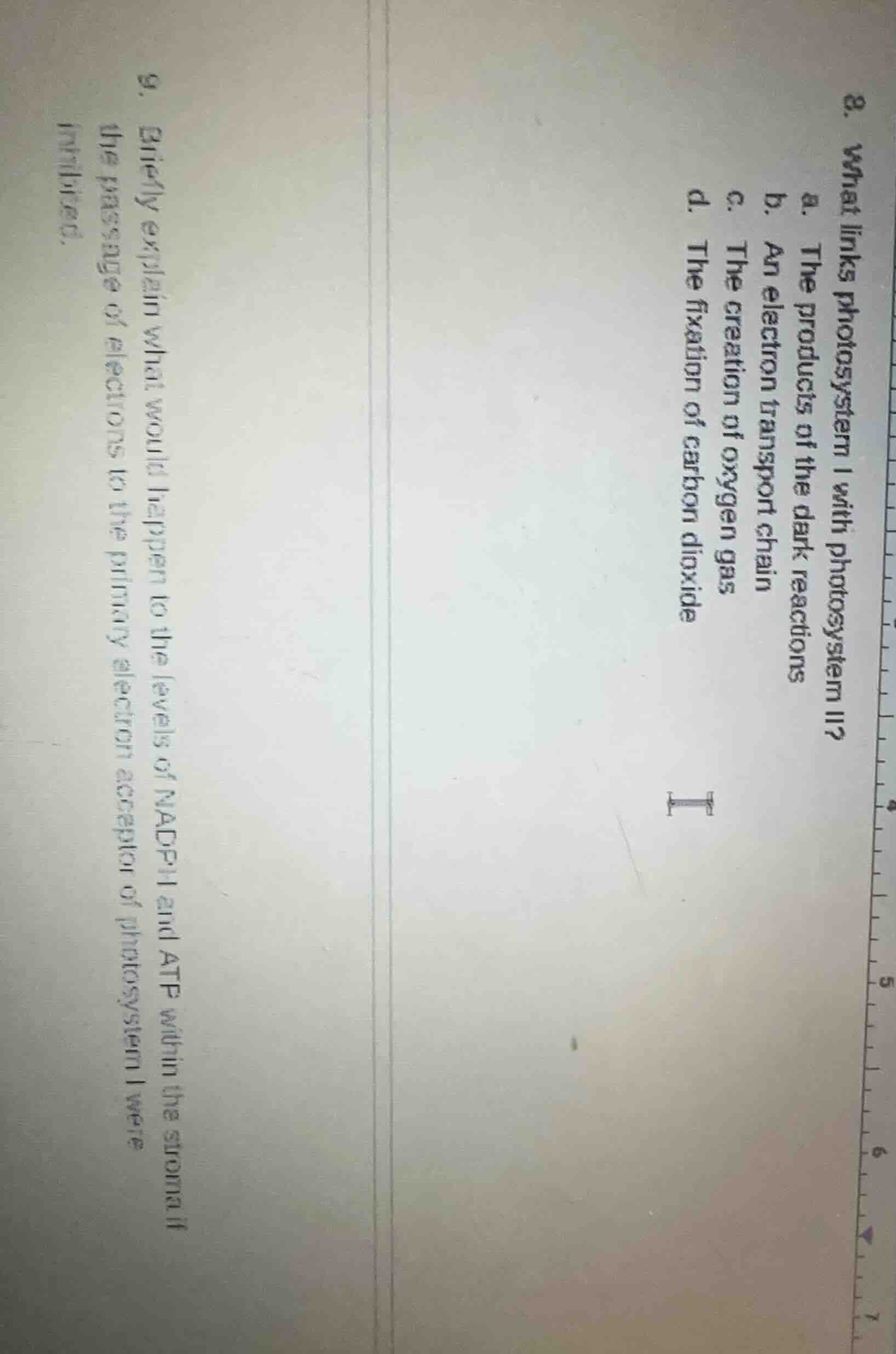
- what links photosystem i with photosystem ii?
a. the products of the dark reactions
b. an electron transport chain
c. the creation of oxygen gas
d. the fixation of carbon dioxide
- briefly explain what would happen to the levels of nadph and atp within the stroma if the passage of electrons to the primary electron acceptor of photosystem i were inhibited.
Brief Explanations
For Question 8:
Photosystem II and Photosystem I are connected by an electron transport chain. Electrons excited in Photosystem II move through this chain, creating a proton gradient for ATP synthesis before reaching Photosystem I. The other options describe unrelated processes: dark reaction products are used in carbon fixation, oxygen creation comes from water splitting in PSII, and carbon fixation is a dark reaction step.
For Question 9:
- ATP levels: The electron transport chain between PSII and PSI generates the proton gradient used to make ATP. If electrons can't leave PSI's primary acceptor, the chain before PSI will back up, halting new proton gradient formation and ATP production, so ATP levels will drop.
- NADPH levels: NADPH is made when electrons from PSI's acceptor are passed to NADP$^+$. If this passage is inhibited, NADP$^+$ can't be reduced, so NADPH production stops, and existing NADPH will be used up in dark reactions, causing its levels to drop.

Snap & solve any problem in the app
Get step-by-step solutions on Sovi AI
Photo-based solutions with guided steps
Explore more problems and detailed explanations
- b. An electron transport chain
- - ATP levels in the stroma would decrease: The electron flow that drives ATP production via the proton gradient would be disrupted, halting new ATP synthesis, and existing ATP would be consumed in the Calvin cycle.
- NADPH levels in the stroma would decrease: The final electron transfer to NADP$^+$ (to make NADPH) would be blocked, and existing NADPH would be used up in the Calvin cycle with no new production to replace it.