QUESTION IMAGE
Question
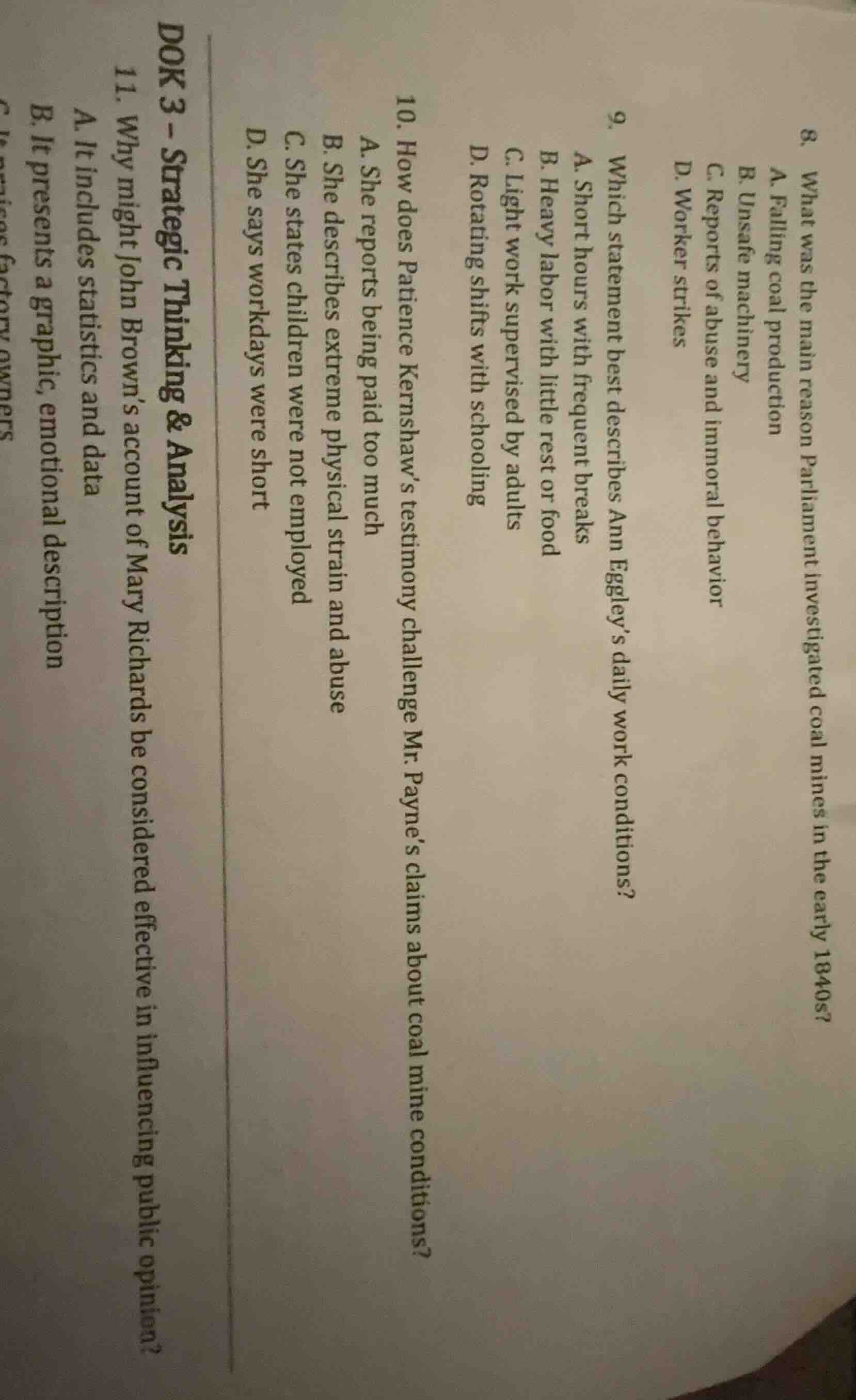
- what was the main reason parliament investigated coal mines in the early 1840s?
a. falling coal production
b. unsafe machinery
c. reports of abuse and immoral behavior
d. worker strikes
- which statement best describes ann eggley’s daily work conditions?
a. short hours with frequent breaks
b. heavy labor with little rest or food
c. light work supervised by adults
d. rotating shifts with schooling
- how does patience kernshaw’s testimony challenge mr. payne’s claims about coal mine conditions?
a. she reports being paid too much
b. she describes extreme physical strain and abuse
c. she states children were not employed
d. she says workdays were short
dok 3 – strategic thinking & analysis
- why might john brown’s account of mary richards be considered effective in influencing public opinion?
a. it includes statistics and data
b. it presents a graphic, emotional description
c. it criticizes factory owners
To answer these questions, we need context about the testimonies or reports related to coal mine conditions (likely from historical documents about the Industrial Revolution, child labor, or mine inspections). Since the text of the testimonies (like Ann Eggley, Patience Kernshaw, Mary Richards, John Brown’s account) isn’t provided, we can’t give specific answers. However, here’s how to approach each:
Question 8 (Main reason for Parliament investigating coal mines):
During the early 1840s, public concern over unsafe working conditions (including dangerous machinery, poor ventilation, and child labor) in coal mines led to investigations. Worker strikes (D) were less common as a trigger for Parliamentary inquiries, and “falling coal production” (A) or “reports of abuse” (C) were not the primary drivers. So the most likely answer is B. Unsafe machinery (or broader unsafe conditions, but from the options, B fits).
Question 9 (Ann Eggley’s work conditions):
Typical 19th - century coal mine labor for women/children involved long hours, heavy labor, little rest/food. “Short hours with frequent breaks” (A) is incorrect. “Light work supervised by adults” (C) is wrong (work was grueling). “Rotating shifts with schooling” (D) is incorrect (child laborers had no schooling). So B. Heavy labor with little rest or food is correct.
Question 10 (Patience Kernshaw challenging Mr. Payne’s claims):
If Mr. Payne claimed good conditions (e.g., no child labor, easy work), Patience would challenge by describing extreme physical strain and abuse (B) to contradict. “Reports being paid too much” (A) is irrelevant. “States children not employed” (C) would agree with a false claim. “Says workdays were short” (D) also agrees with a false claim. So B is correct.
Question 11 (John Brown’s account of Mary Richards influencing public opinion):
Emotional, graphic descriptions (B) of harsh conditions (e.g., child labor, physical suffering) are more persuasive than “statistics and data” (A, which were less common in public appeals then). So B. It presents a graphic, emotional description is correct.
Since the original text of the testimonies is missing, these are educated guesses based on historical context. For precise answers, the full testimonies (or source material) would be needed.
If we assume standard historical context:
- Answer: B. Unsafe machinery
- Answer: B. Heavy labor with little rest or food
- Answer: B. She describes extreme physical strain and abuse
- Answer: B. It presents a graphic, emotional description

Snap & solve any problem in the app
Get step-by-step solutions on Sovi AI
Photo-based solutions with guided steps
Explore more problems and detailed explanations
To answer these questions, we need context about the testimonies or reports related to coal mine conditions (likely from historical documents about the Industrial Revolution, child labor, or mine inspections). Since the text of the testimonies (like Ann Eggley, Patience Kernshaw, Mary Richards, John Brown’s account) isn’t provided, we can’t give specific answers. However, here’s how to approach each:
Question 8 (Main reason for Parliament investigating coal mines):
During the early 1840s, public concern over unsafe working conditions (including dangerous machinery, poor ventilation, and child labor) in coal mines led to investigations. Worker strikes (D) were less common as a trigger for Parliamentary inquiries, and “falling coal production” (A) or “reports of abuse” (C) were not the primary drivers. So the most likely answer is B. Unsafe machinery (or broader unsafe conditions, but from the options, B fits).
Question 9 (Ann Eggley’s work conditions):
Typical 19th - century coal mine labor for women/children involved long hours, heavy labor, little rest/food. “Short hours with frequent breaks” (A) is incorrect. “Light work supervised by adults” (C) is wrong (work was grueling). “Rotating shifts with schooling” (D) is incorrect (child laborers had no schooling). So B. Heavy labor with little rest or food is correct.
Question 10 (Patience Kernshaw challenging Mr. Payne’s claims):
If Mr. Payne claimed good conditions (e.g., no child labor, easy work), Patience would challenge by describing extreme physical strain and abuse (B) to contradict. “Reports being paid too much” (A) is irrelevant. “States children not employed” (C) would agree with a false claim. “Says workdays were short” (D) also agrees with a false claim. So B is correct.
Question 11 (John Brown’s account of Mary Richards influencing public opinion):
Emotional, graphic descriptions (B) of harsh conditions (e.g., child labor, physical suffering) are more persuasive than “statistics and data” (A, which were less common in public appeals then). So B. It presents a graphic, emotional description is correct.
Since the original text of the testimonies is missing, these are educated guesses based on historical context. For precise answers, the full testimonies (or source material) would be needed.
If we assume standard historical context:
- Answer: B. Unsafe machinery
- Answer: B. Heavy labor with little rest or food
- Answer: B. She describes extreme physical strain and abuse
- Answer: B. It presents a graphic, emotional description